Act I: Playing for change on New York City street corners and subway platforms, without a regular home, for 20 years.
Act II: Performing at nightclubs, concert halls, and festivals around the world.
That’s a life story no one would believe. But it’s the one this guy has lived.
Charles Gayle Trio, live, Russia (St. Petersburg)
**********
lagniappe
The challenge of free jazz is to create coherent, compelling music without such obvious devices as melody, recurring chord sequences or a steady beat. It’s a challenge that has defeated many a virtuoso since the free-jazz heyday of the 1960’s. But Charles Gayle, a tenor saxophonist, is carving out a free jazz that is muscular, impassioned, clearly structured and wonderfully volatile. . . . Mr. Gayle’s trio made music to move mountains by.—Jon Pareles, New York Times
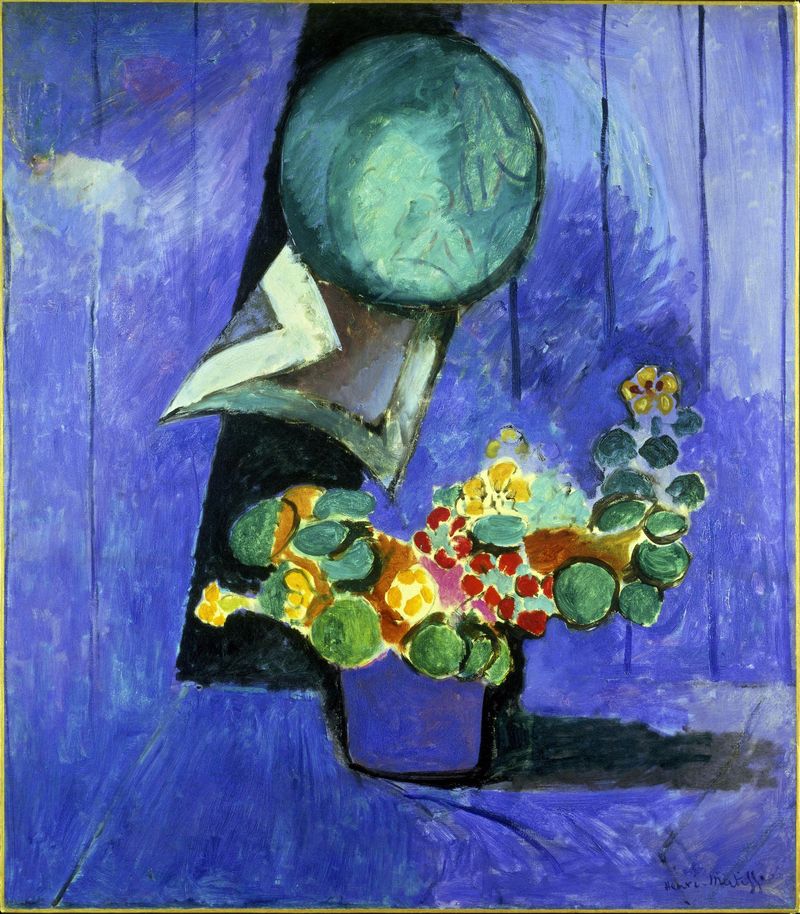
This is just one of dozens of reasons to see “Matisse: Radical Invention, 1913-1917,” which will be at the Art Institute through June 20th, then at the Museum of Modern Art beginning July 18th. At the risk of sounding like a PR flack, this exhibit (which I saw opening weekend and will return to soon) has critics scrambling for superlatives: “revelatory” (Artforum), “thrilling” (San Francisco Chronicle), “breathtaking” (Los Angeles Times)—well, you get the idea.
Here’s another musician who, like Dinu Lipatti (Tuesday’s post), died way too young: the great Chicago blues artist Magic Sam (AKA Samuel Maghett). He suffered a fatal heart attack just months after this performance. He was 32.
[T]he greatest rock is birthed from equal parts intelligence and stupidity.—Chris Bohn (The Wire, 2/10)
Jandek
“Real Wild,” live, Glasgow, 2004
*****
Live, Houston, 2009
**********
lagniappe
Much speculation has been made over the true identity of the mysterious singer/songwriter Jandek, and his equally obscure record label, Corwood Industries. For over 25 years, the artist released album after album of twisted, ghostly, and utterly unique songs that crooned a tale of despair.
***
Jandek played his first ever concert on October 17th, 2004 in Glasgow, Scotland as part of the Instal Festival, accompanied by Richard Youngs on bass, and Alexander Neilson on drums. The name Jandek did not appear on any of the promotional material for the festival. Some members of the audience, in disbelief, recognized the man from his album covers and could not mistake the sound for any other. Word quickly spread that Jandek had indeed performed . . . —Raphi Gottesman
Tom Waits, “Make It Rain,” live (TV broadcast), 2004
**********
lagniappe
More on William Eggleston and Alex Chilton
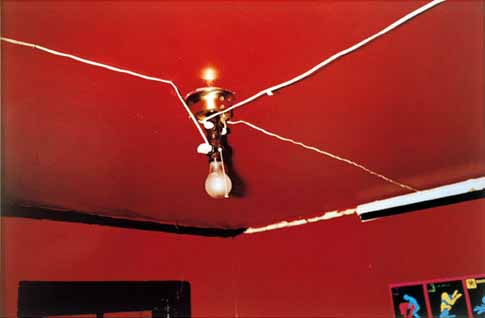
Yesterday, while at the Art Institute, I stopped again at the William Eggleston exhibit (previously mentioned here and here), which runs through May 23rd. It includes not only the album cover I posted earlier (Big Star’s Radio City), but also this one. Eggleston, an accomplished piano player, once accompanied Chilton on a track—the Nat King Cole classic “Nature Boy,” which appears on Big Star’s Third/Sister Lovers (expanded reissue), produced by Jim Dickinson, as well as Keep an Eye on the Sky (2009 boxed set).
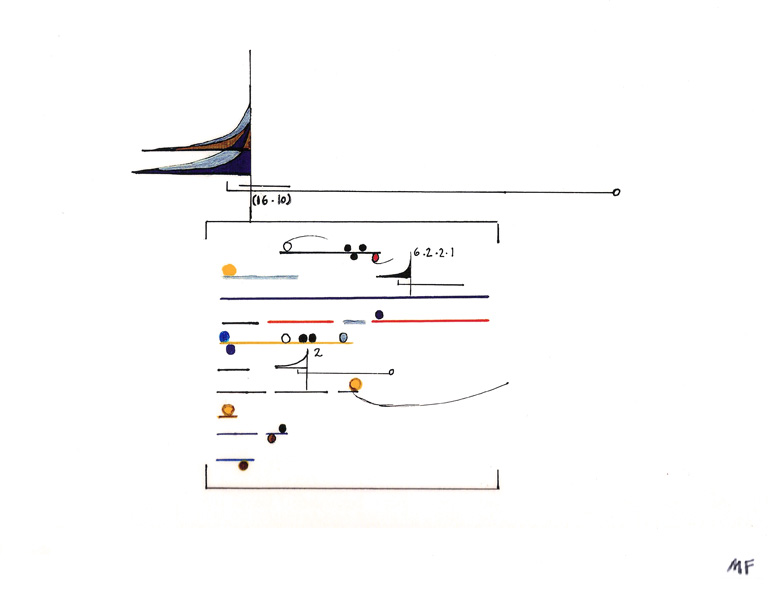
Trying to capture jazz in standard notation can be like trying to translate poetry into another language—what you wind up with is everything but the poetry. So composer/trumpeter Wadada Leo Smith (who, like many of his peers, eschews “jazz” as a label for his music) invented his own system of graphic notation.
***************
Wadada Leo Smith (trumpet) with his Golden Quartet (Vijay Iyer [piano], John Lindberg [bass], Ronald Shannon Jackson [drums]); Eclipse, 2005
Part 1
*****
Part 2
*****
Part 3
*****
Part 4
*****
Part 5
*****
Part 6
*****
Part 7
*****
Part 8
**********
lagniappe
art beat
Earlier this month, when I mentioned the exhibit of William Eggleston’s photographs that’s currently at the Art Institute—posting an album cover that you’ll find in a display case there—I didn’t expect that Big Star would appear here again before the month’s end. But then I didn’t expect that Alex Chilton would pass away, either.Alex had more than simply an artistic interest in Eggleston and his work. He’d known the photographer, who was a good friend of his parents, since he was a little boy. Here, again, is the image Alex chose for that album cover, followed by a couple more from this exhibit.
What a nasty one-two punch for Memphis: first Jim Dickinson, then—seven months later—Alex Chilton.
Alex Chilton, December 28, 1950-March 17, 2010
Big Star, “Thirteen” (1972)
*****
Big Star, “September Gurls” (1974)
*****
Alex Chilton, “Bangkok” (1978)
*****
The Replacements, “Alex Chilton” (1987)
*****
Alex Chilton, “There Will Never Be Another You” (1985?)
**********
lagniappe
Alex Chilton, the pop hitmaker, cult icon and Memphis rock iconoclast best known as a member of 1960s pop-soul act the Box Tops and the 1970s power-pop act Big Star, died Wednesday at a hospital in New Orleans.
The singer, songwriter and guitarist was 59.
“I’m crushed. We’re all just crushed,” said John Fry, owner of Memphis’ Ardent Studios and a longtime friend of Chilton’s. “This sudden death experience is never something that you’re prepared for. And yet it occurs.”
***
The Memphis-born Chilton rose to prominence at age 16 when his gruff vocals powered the massive Box Tops hit “The Letter,” as well as “Cry Like a Baby” and “Neon Rainbow.”
After the Box Tops broke up in 1970, Chilton had a brief solo run in New York before returning to Memphis. He soon joined forces with a group of Anglo-pop-obsessed musicians — fellow songwriter/guitarist Chris Bell, bassist Andy Hummel and drummer Jody Stephens — to form Big Star.
The group became the flagship act for Ardent’s Stax-distributed label. Big Star’s 1972 debut album, #1 Record, met with critical acclaim but poor sales.
The group briefly disbanded, but reunited without Bell to record the album Radio City. Released in 1974, the second album suffered a similar fate, plagued by Stax’s distribution woes.
The group made one more album, Third/Sister Lovers, with just Chilton and Stephens — and it, too, was a minor masterpiece. Darker and more complex than the band’s previous pop-oriented material, it remained unreleased for several years.
In 2003, Rolling Stone magazine named all three Big Star albums to its list of the 500 Greatest Albums of All Time.
“It’s a fork in the road that a lot of different bands stemmed from,” said Jeff Powell, a respected local producer who worked on some of Chilton’s records. “If you’re drawing a family tree of American music, they’re definitely a branch.”
***
“When some people pass, you say it was the end of an era. In this case, it’s really true,” said Van Duren, a fellow Memphis musician who knew Chilton for decades. “It puts an end to the Big Star thing, and that’s a very sad thing.”—Jody Callahan, Bob Mehr, Memphis Commericial Appeal (3/17/10)
*****
A day after the death of Memphis music legend Alex Chilton, shock and sadness slowly gave way to fond remembrance by friends, fans and fellow musicians.
Over the course of a remarkably varied 40-plus-year career with the Box Tops, Big Star and as a solo artist, Chilton was a creative chameleon. A teen pop hitmaker, a reluctant cult hero, a champion of Southern roots music, a visionary producer, a punk-rock provocateur and a much underrated guitarist, Chilton had carved his place as one of the most singular figures — both as an artist and as a personality — that Memphis music has ever produced.
***
The news of Chilton’s death sent shockwaves through the annual South by Southwest music conference in Austin, Texas. The massive industry gathering kicked off Wednesday night just as word of his passing began to spread.
Chilton had been scheduled to perform with Big Star on Saturday night, part of a headlining set at Antone’s nightclub, and the group was also set to be the subject of a historical panel earlier in the day.
After consulting with Chilton’s wife and festival organizers, surviving Big Star members Jody Stephens, Jon Auer and Ken Stringfellow confirmed that the panel and performance would go on as scheduled, effectively serving as memorials for Chilton.
“It felt like we had to pay tribute in some form,” said Auer. “In a strange way, it’s amazing that it happened around something like South by Southwest. So many people there are hyper-aware of Chilton and understand what he means musically, so it seems like the perfect place to do something like this.”
The Saturday night Big Star set is shaping up to be an all-star tribute. Though the lineup is still coming together, a variety of artists including X’s John Doe, R.E.M.’s Mike Mills, indie-folk singer M. Ward, the dB’s Chris Stamey, Green on Red veteran Chuck Prophet and Chilton’s longtime New Orleans collaborators Doug Garrison and René Coman are among those expected to appear.
For Coman, the sheer breadth of Chilton’s artistry and the scope of his career remain the true measure of the man. “Alex had such a long career, and all kinds of different stages to it.” said Coman. “The people that stay in it for a really long time and still enjoy it, it seems like they wind up finding different things to keep them interested as the years go by.
With John Coltrane (saxophone), Wynton Kelly (piano), Paul Chambers (bass), Jimmy Cobb (drums), Gil Evans Orchestra; live (TV Broadcast), 1959
*****
Take 2
With Wayne Shorter (saxophone), Herbie Hancock (piano), Ron Carter (bass), Tony Williams (drums); live (TV broadcast), 1964
**********
lagniappe
[Many admirers of Kind of Blue] are forced to reach back before the modern era to find its measure. Drummer Elvin Jones hears the same timeless sublimity and depth of feeling ‘in some of the movements of Beethoven’s Ninth Symphony, or when I hear Pablo Casals play unaccompanied cello.’ ‘It’s like listening to Tosca, says pianist/singer Shirley Horn. ‘ You know, you always cry, or at least I do.’
***
Quincy Jones: ‘That will always be my music, man. I play Kind of Blue every day—it’s my orange juice. It still sounds like it was made yesterday.’
***
Chick Corea: ‘It’s one thing to just play a tune, or play a program of music, but it’s another thing to practically create a new language of music, which is what Kind of Blue did.’
—Ashley Kahn, Kind of Blue: The Making of the Miles Davis Masterpiece (2000)
Both Chicago blues artists. Both guitar players. Both influenced by other kinds of music.
Musical personalities? They could hardly be more different.
Buddy Guy, “Let Me Love You Baby,” live
*****
Fenton Robinson, “Somebody Loan Me A Dime,” live, 1977
***
Back in the 1970s, when I was at Alligator Records, I had the pleasure of working with Fenton, co-producing his album I Hear Some Blues Downstairs (a Grammy nominee). He didn’t fit the stereotype of a bluesman. Gentle, soft-spoken, serious, introspective: he was all these things. He died in 1997.