Thursday, 4/15/10
What a joy it is (and how rare) to hear someone who makes every note count.
Abdullah Ibrahim Trio, live, Germany (Leverkusen), 2007
Part 1
*****
Part 2
What a joy it is (and how rare) to hear someone who makes every note count.
Abdullah Ibrahim Trio, live, Germany (Leverkusen), 2007
Part 1
*****
Part 2
listening to history
The sound quality may be pretty raggedy, but that hardly matters—this is history.
Albert Ayler, tenor saxophone (“Love Cry,” “Truth Is Marching In,” “Our Prayer”), live, John Coltrane’s funeral, St. Peter’s Lutheran Church, New York, July 21, 1967
**********
lagniappe
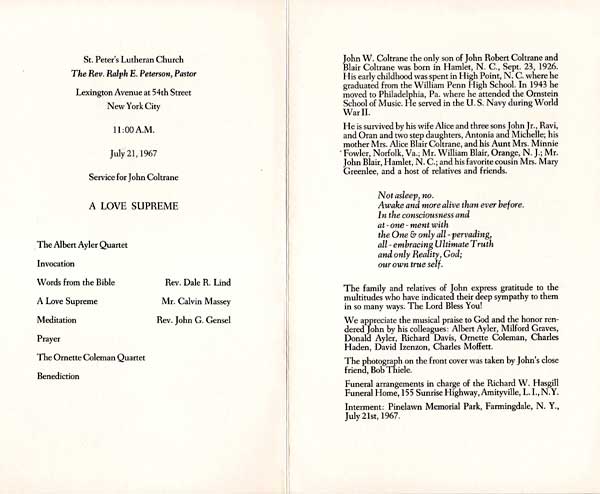
Click for a clearer image.
*****

Pinelawn Memorial Park, Farmingdale, New York
*****
Trane was the father. Pharoah was the son. I was the holy ghost.—Albert Ayler
no wonder they’re called “hooks”
The moment it ends—a great pop song, that is—you want to hear it again.
Prefab Sprout
“Doo Wop In Harlem,” live (TV broadcast), c. 1990
*****
“Sweet Gospel Music”
This guy’s one of the most lyrical players and composers around.
(He also happens to have paranoid schizophrenia.)
Tom Harrell, flugelhorn/Tom Harrell Quintet
“Rhythm-A-Ning,” live, France (Paris), 2008
*****
“In the Infinite” (by TH), live, Italy (Sorrento), 2008
*****
“Dancin’ Around” (by TH), live, Brazil (Sao Paulo), 2003
**********
lagniappe
I’m posting this next piece with mixed feelings. Talking about Harrell’s psychiatric condition can distract from what’s most important—his music. On the other hand, what he’s been able to accomplish says a lot not only about him but also about the power of music.
Happy Birthday, Billie!
If I could listen to only one singer for the rest of my life, she’d be the one.
No one gives you more of life.
Inessentials? No one offers fewer.
Moment by moment, no one is more enthralling.
***
Billie Holiday
“The Blues Are Brewin’,” with Louis Armstrong (New Orleans, 1947)
*****
“Fine and Mellow,” with Ben Webster (ts), Lester Young (ts), Vic Dickenson (trbn), Gerry Mulligan (bs), Coleman Hawkins (ts), Roy Eldridge (trmpt), live (TV broadcast), 1957
*****
“What A Little Moonlight Can Do,” with Mal Waldron (p), live (TV broadcast), 1958
Want more? Here.
**********
lagniappe
Radio Billie: all Billie, all the time
In celebration of Billie Holiday’s birthday, WKCR-FM (broadcasting from Columbia University) is playing her music all day.
BILLIE HOLIDAY BIRTHDAY BROADCAST : APRIL 7th, 2010
Ninety-five years after her birth, on April 7th, 2010, WKCR will dedicate all programming to Billie Holiday. Born Elinore Fagan in Baltimore, Holiday learned songs by Louis Armstrong and Bessie Smith despite the instability and tragedy of her childhood. In 1929, she teamed up with tenor sax player Kenneth Hollan, slowly building her reputation as a vocalist. She replaced Monette Moore at a club called “Covan’s” on West 132 Street in 1932. When producer John Hammond came to see Moore, he was instead captivated by Holiday. He secured a record deal for her, and she recorded two tracks with Benny Goodman. She soon began to record under her own name, collaborating with the greatest artists of the swing era. With pianist Teddy Wilson, she manipulated the melody of dull pop songs for jukeboxes, transforming them into jazz standards, and she courageously recorded “Strange Fruit” with Commodore records when Columbia rejected the sensitive subject matter. Though her career was strained by substance abuse and heartbreak, her voice did not deteriorate. As she inscribed the catastrophes of her life on the texture of her voice, it became only more powerful, more haunting. On April 7th, we will examine the life of this great, mysterious artist, but most importantly, we will listen to her voice.—WKCR-FM
Act I: Playing for change on New York City street corners and subway platforms, without a regular home, for 20 years.
Act II: Performing at nightclubs, concert halls, and festivals around the world.
That’s a life story no one would believe. But it’s the one this guy has lived.
Charles Gayle Trio, live, Russia (St. Petersburg)
**********
lagniappe
The challenge of free jazz is to create coherent, compelling music without such obvious devices as melody, recurring chord sequences or a steady beat. It’s a challenge that has defeated many a virtuoso since the free-jazz heyday of the 1960’s. But Charles Gayle, a tenor saxophonist, is carving out a free jazz that is muscular, impassioned, clearly structured and wonderfully volatile. . . . Mr. Gayle’s trio made music to move mountains by.—Jon Pareles, New York Times
When it comes to working an audience, no one outshines gospel singers.
Paul Porter, “Two Wings,” live, Cleveland, 2009
**********
lagniappe
Want more gospel?
*****
art beat
Henri Matisse, Flowers and Ceramic Plate (1913)
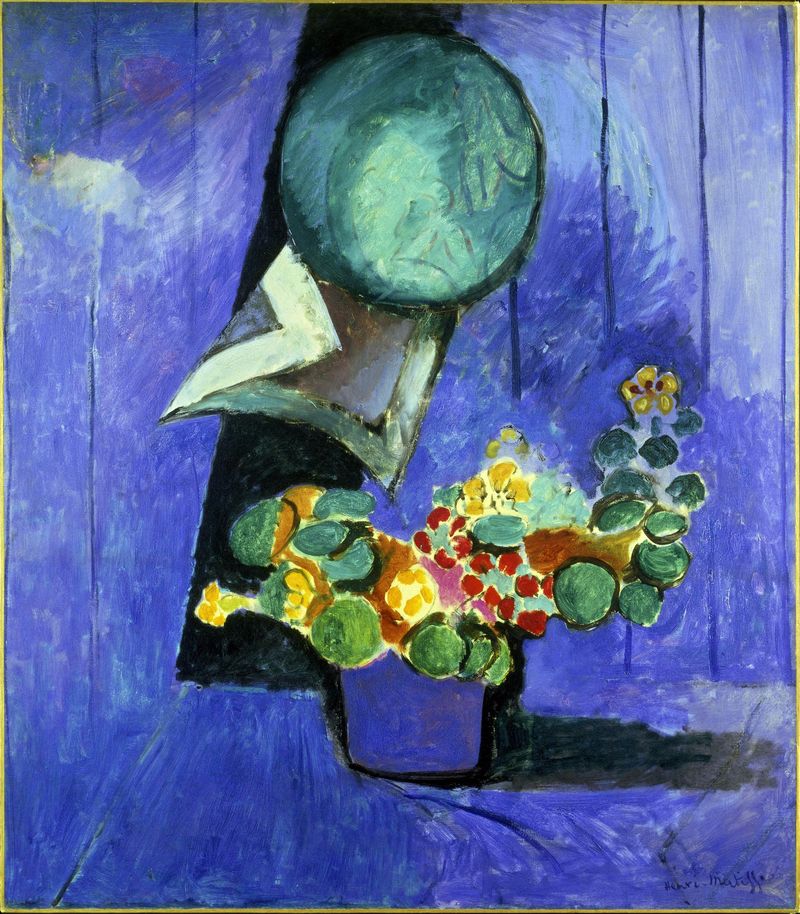
This is just one of dozens of reasons to see “Matisse: Radical Invention, 1913-1917,” which will be at the Art Institute through June 20th, then at the Museum of Modern Art beginning July 18th. At the risk of sounding like a PR flack, this exhibit (which I saw opening weekend and will return to soon) has critics scrambling for superlatives: “revelatory” (Artforum), “thrilling” (San Francisco Chronicle), “breathtaking” (Los Angeles Times)—well, you get the idea.
replay: a clip too good for just one day
Here’s another musician who, like Dinu Lipatti (Tuesday’s post), died way too young: the great Chicago blues artist Magic Sam (AKA Samuel Maghett). He suffered a fatal heart attack just months after this performance. He was 32.
Magic Sam, live (TV broadcast), Germany, 1969
**********
lagniappe
Facebook seems to have expanded into new markets. “Sign up,” they say, “to connect with [t]he late, great Magic Sam.”
(Originally posted 11/21/09.)
**********
Want more Chicago blues?
[T]he greatest rock is birthed from equal parts intelligence and stupidity.—Chris Bohn (The Wire, 2/10)
Jandek
“Real Wild,” live, Glasgow, 2004
*****
Live, Houston, 2009
**********
lagniappe
Much speculation has been made over the true identity of the mysterious singer/songwriter Jandek, and his equally obscure record label, Corwood Industries. For over 25 years, the artist released album after album of twisted, ghostly, and utterly unique songs that crooned a tale of despair.
***
Jandek played his first ever concert on October 17th, 2004 in Glasgow, Scotland as part of the Instal Festival, accompanied by Richard Youngs on bass, and Alexander Neilson on drums. The name Jandek did not appear on any of the promotional material for the festival. Some members of the audience, in disbelief, recognized the man from his album covers and could not mistake the sound for any other. Word quickly spread that Jandek had indeed performed . . . —Raphi Gottesman
*****
art beat
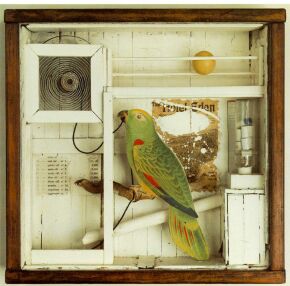
Joseph Cornell, Hotel Eden (c. 1945)
This guy, like Captain Beefheart, studied at the Howlin’ Wolf School of Vocal Alchemy.
Tom Waits, “Make It Rain,” live (TV broadcast), 2004
**********
lagniappe
More on William Eggleston and Alex Chilton
Yesterday, while at the Art Institute, I stopped again at the William Eggleston exhibit (previously mentioned here and here), which runs through May 23rd. It includes not only the album cover I posted earlier (Big Star’s Radio City), but also this one. Eggleston, an accomplished piano player, once accompanied Chilton on a track—the Nat King Cole classic “Nature Boy,” which appears on Big Star’s Third/Sister Lovers (expanded reissue), produced by Jim Dickinson, as well as Keep an Eye on the Sky (2009 boxed set).


