music clip of the day

jazz/blues/rock/classical/gospel/more

Sunday, 4/4/10

When it comes to working an audience, no one outshines gospel singers.

Paul Porter, “Two Wings,” live, Cleveland, 2009

**********

lagniappe

Want more gospel?

Stevie Wonder

Al Green

Aretha Franklin

Otis Clay

*****

art beat

Henri Matisse, Flowers and Ceramic Plate (1913)
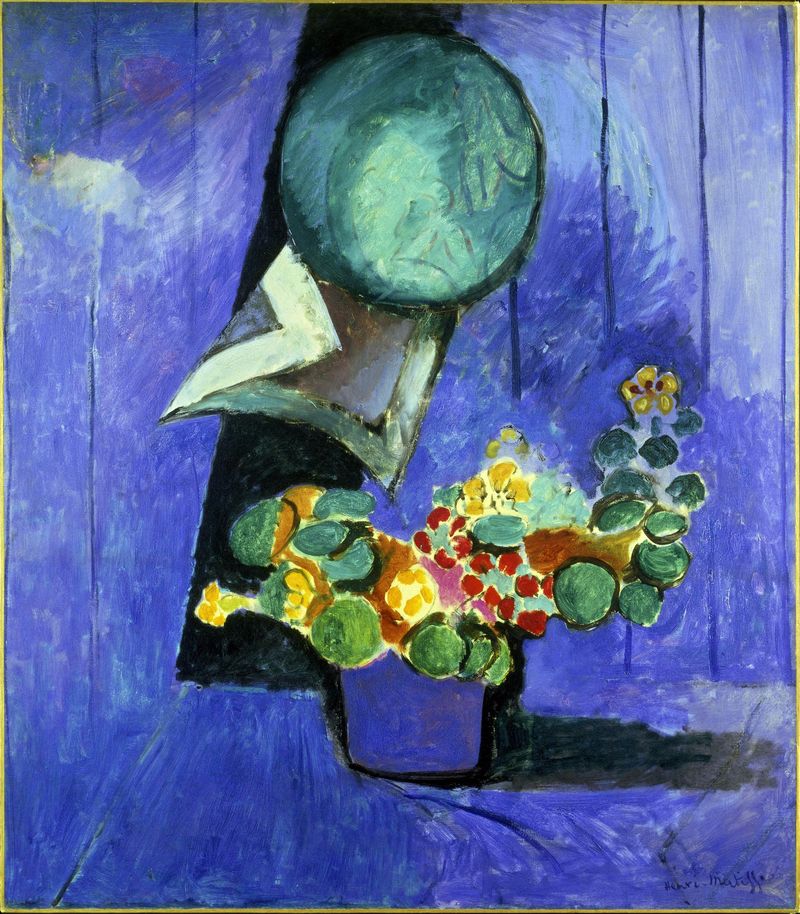
This is just one of dozens of reasons to see “Matisse: Radical Invention, 1913-1917,” which will be at the Art Institute through June 20th, then at the Museum of Modern Art beginning July 18th. At the risk of sounding like a PR flack, this exhibit (which I saw opening weekend and will return to soon) has critics scrambling for superlatives: “revelatory” (Artforum), “thrilling” (San Francisco Chronicle), “breathtaking” (Los Angeles Times)—well, you get the idea.
Saturday, 4/3/10

replay: a clip too good for just one day

Here’s another musician who, like Dinu Lipatti (Tuesday’s post), died way too young: the great Chicago blues artist Magic Sam (AKA Samuel Maghett). He suffered a fatal heart attack just months after this performance. He was 32.

Magic Sam, live (TV broadcast), Germany, 1969

**********

lagniappe

Facebook seems to have expanded into new markets. “Sign up,” they say, “to connect with [t]he late, great Magic Sam.”

(Originally posted 11/21/09.)

**********

Want more Chicago blues?

Muddy Waters

Howlin’ Wolf

Robert Nighthawk

Earl Hooker

Junior Wells

Otis Rush

Hound Dog Taylor

Buddy Guy

Fenton Robinson

Jimmy Johnson

Friday, 4/2/10

[T]he greatest rock is birthed from equal parts intelligence and stupidity.—Chris Bohn (The Wire, 2/10)

Jandek

“Real Wild,” live, Glasgow, 2004

*****

Live, Houston, 2009

**********

lagniappe

Much speculation has been made over the true identity of the mysterious singer/songwriter Jandek, and his equally obscure record label, Corwood Industries. For over 25 years, the artist released album after album of twisted, ghostly, and utterly unique songs that crooned a tale of despair.

***

Jandek played his first ever concert on October 17th, 2004 in Glasgow, Scotland as part of the Instal Festival, accompanied by Richard Youngs on bass, and Alexander Neilson on drums. The name Jandek did not appear on any of the promotional material for the festival. Some members of the audience, in disbelief, recognized the man from his album covers and could not mistake the sound for any other. Word quickly spread that Jandek had indeed performed . . . —Raphi Gottesman

*****

art beat

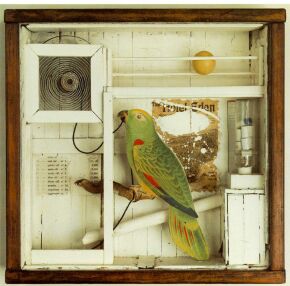
Joseph Cornell, Hotel Eden (c. 1945)


Thursday, 4/1/10

Indian Music Festival, part 3

Light, clear, open: I could listen to this all day.

Shivkumar Sharma, santoor, with Zakir Hussain, tabla

Raga Kausi Kanada, live

*****

Raga Kirwani, live

**********

lagniappe

Shivkumar Sharma is responsible for validating the santoor as a classical instrument . . . . and it is especially exciting to hear him with an accomplished tabla master, particularly his long-time collaborator Zakir Hussain.

—Peter Lavezzoli, The Dawn of Indian Music in the West (2006)

*****

More Indian music?

Every Sunday one of my favorite radio stations, WKCR-FM (broadcasting from Columbia University), offers four hours of Indian music (6-8 a.m., 7-9 p.m. [EST])—records, interviews, studio performances, etc.

Wednesday, 3/31/10

Indian Music Festival, part 2

Nikhil Banerjee, sitar

With Zakir Hussain (tabla), live

*****

Raga Bhimpalasi (Alap [opening section])

*****

Raga Bhairavi

*****

Raga Manj Khammaj, with Ali Akbar Khan (sarod)

Part 1

***

Part 2

**********

lagniappe

In my own listening, I have sometimes felt that a raga symbolizes the states of a person’s life in reverse order. The open-ended introduction, or the alap, with its meditative quality, seems to reflect the wisdom of the elder sage, or sannyasin. As the raga progresses, and the rhythmic pulse and melodic development begins, one meets the adult in full control of his or her faculties in the prime of life. There is a healthy balance between bursts of improvisation and the observance of structure. Toward the end, as the raga accelerates and approaches a climax, one enters the childlike realm, where the desire to display virtuosity is strongest, and the performers throw caution to the wind and go for broke. But for many musicians and connoisseurs, this is where the raga has lost its purity, with the delicate opening alap seen as the “true essence” of raga.—Peter Lavezzoli, The Dawn of Indian Music in the West (2006)

*****

A musician must lift up the souls of the listeners, and take them towards Space.—Nikhil Banerjee

Tuesday, 3/30/10

Indian Music Festival, part 1

Ali Akbar Khan, sarod

Raga Brindabani Sarang

*****

Raga Marwa

Part 1

***

Part 2

*****

Raga Shree

Part 1

***

Part 2

**********

lagniappe

Zakir Hussain on Ali Akbar Khan (following his death last year)

*****

Yehudi Menuhin on Ali Akbar Khan

An absolute genius . . . the greatest musician in the world.

*****

Philip Glass on Indian Music

The thing I learned from Ravi [Shankar] is that the rhythmic structure could become an overall musical structure. In our Western tradition that’s simply not the case. . . . There [India], rhythm is used in the way that timbre and pitch and other aspects are used. In the West we have an alliance between harmony and melody. That’s the basic alliance: rhythm comes along to liven things up. . . . There [India], the tension is between the melody and the rhythm, not between the melody and the harmony. . . . The moment that the tala, or the rhythmic structure, comes up and meets against the melodic structure at the sum—when the beats come together—that’s the resolution in Indian music. The complications that the cyclic rhythmic structure can create, and the effects to the melodic development, open up a whole different way of thinking about music. And that’s basically what I heard. I knew nothing like that in my own personal experience, or in any Western music that I knew.—Philip Glass (in William Duckworth, Talking Music [1995])

*****

Ali Akbar Khan on Music

For us, as a family, music is like food. When you need it you don’t have to explain why, because it is basic to life.

Monday, 3/29/10

This guy, like Captain Beefheart, studied at the Howlin’ Wolf School of Vocal Alchemy.

Tom Waits, “Make It Rain,” live (TV broadcast), 2004

**********

lagniappe

More on William Eggleston and Alex Chilton

Yesterday, while at the Art Institute, I stopped again at the William Eggleston exhibit (previously mentioned here and here), which runs through May 23rd. It includes not only the album cover I posted earlier (Big Star’s Radio City), but also this one. Eggleston, an accomplished piano player, once accompanied Chilton on a track—the Nat King Cole classic  “Nature Boy,” which appears on Big Star’s Third/Sister Lovers (expanded reissue), produced by Jim Dickinson, as well as Keep an Eye on the Sky (2009 boxed set).

Sunday, 3/28/10

Rough.

Grainy.

Insistent.

Long after a song has ended, you still hear that voice.

Dorothy Love Coates & the Gospel Harmonettes

“They Won’t Believe,” live (TV broadcast)

*****

“That’s Alright With Me”

*****

“I’m Just Holding On,” live (TV broadcast)

**********

lagniappe

Were gospel to be more publicly acclaimed, she [Dorothy Love Coates] might have the stature of a Billie Holiday or a Judy Garland. Instead, for thousands of black people, she is the message carrier.—Anthony Heilbut, The Gospel Sound: Good News and Bad Times (6th ed. 2002)

*****

[I]t was obvious that Keith [Richards] and Gram [Parsons] enjoyed spending time together. . . . [W]e just all cared deeply about the same things. We just loved, for instance, to sit and listen to Dorothy Love Coates, the gospel singer.—Stanley Booth

*****

Want more gospel?

A couple weeks ago I mentioned Bob Marovich’s radio show on WLUW-FM (Saturday, 10-11 a.m. [CST]). Another wonderful gospel radio show is Kevin Nutt’s “Sinner’s Crossroads” on WFMU-FM (Thursday, 7-8 p.m. [EST]). Kevin describes the show this way: “Scratchy vanity 45s, pilfered field recordings, muddy off-the-radio sounds, homemade congregational tapes and vintage commercial gospel throw-downs; a little preachin’, a little salvation, a little audio tomfoolery.” If you can’t catch it live, don’t worry—you can listen anytime.

Saturday, 3/27/10

Here’s more from my favorite 101-year-old composer.

Elliott Carter, Two Diversions for Piano (2) (1999)/Pierre-Laurent Aimard, piano

Want more Elliott Carter? Here. Here.

More Pierre-Laurent Aimard? Here.

**********

lagniappe

I used to write these gigantic pieces that were very complex and took a long time to compose, if not to play. I am now much more impatient and couldn’t stand working for so long on the same thing. But also those pieces were me working out certain ideas about music. Those ideas are now part of my life, so I don’t have to think about them in quite the same way. But some things never change, in that you are still glad to finish a piece and still wonder whether it is as good as you hoped it might be when you started out.

***

The Two Diversions were an idea of Ursula Oppens. Oppens decided that Carnegie Hall should commission composers to write what they considered easy pieces, and to make an album for piano students, and so I wrote two pieces for this album. I don’t think they’re as easy as they’d hoped, but there are some people with even harder ones.

—Elliott Carter (first quote’s from here, second here)

Friday, 3/26/10

Last night, drifting off to sleep, I heard (or dreamed) a commercial for a new  cable TV channel:

The Jackie Wilson Channel

All Jackie, All the Time

Jackie Wilson, “Baby, Work Out” (AKA “Baby Workout”), live (TV broadcast), 1963

Want more? Here. Here.

**********

lagniappe

reading table

I threw a party, wore a very sharp suit. My wife had out all sorts of hors d’oeuvres, some ordered from long off—little briny peppery seafoods you wouldn’t have thought of as something to eat. We waited for the guests. Some of the food went bad. Hardly anybody came. It was the night of the lunar eclipse, I think. Underwood, the pianist, showed up and maybe twelve other people. Three I never invited were there. We’d planned on sixty-five.

I guess this was the signal we weren’t liked anymore in town.

—Barry Hannah (April 23, 1942-March 1, 2010), “Our Secret Home,” in Airships (1978)

*****

mail

Thanks for linking—very much appreciated!

—Tim

(Tim Lawrence, author of Hold On To Your Dreams: Arthur Russell and the Downtown Music Scene, 1973-92 [2009], in response to Tuesday’s post )