Originally, Morton Feldman was commissioned to compose the score for the film [Something Wild], but when the director heard the music, he promptly withdrew his commission, opting to enlist Aaron Copland instead. The reaction of the baffled director [Jack Garfein] was said to be, ‘My wife is being raped and you write celesta music?’
Hearing John Berryman read his poetry changed my life, as I saida while back. I was in college at the time. A year later, he was dead—a suicide (jumping off a bridge in Minneapolis, where he lived and taught). Here, in Dublin in 1967, he reads one of his Pulitzer-Prize-winning Dream Songs (29). Drunk, mannered, idiosyncratic: yes, yes, yes. Obscure at times to the point of opacity: yes. But also (to these ears) exquisitely controlled, deeply moving, utterly unforgettable.
The sound quality may be pretty raggedy, but that hardly matters—this is history.
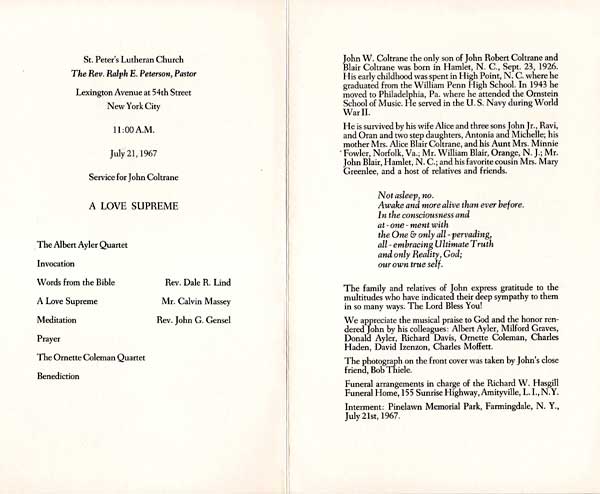
Albert Ayler, tenor saxophone (“Love Cry,” “Truth Is Marching In,” “Our Prayer”), live, John Coltrane’s funeral, St. Peter’s Lutheran Church, New York, July 21, 1967
**********
lagniappe
Click for a clearer image.
*****
Pinelawn Memorial Park, Farmingdale, New York
*****
Trane was the father. Pharoah was the son. I was the holy ghost.—Albert Ayler
Earlier this week the last surviving member of the Chicago-based Gay Sisters passed away. She was a piano wizard—sometimes referred to as the “Erroll Garner of gospel piano.” A musical tribute is scheduled for Friday evening, April 16th, at the Prayer Center Church of God in Christ, which is located at 526 E. 67th St. in Chicago.
Geraldine Gay, 1931-April 6, 2010
Gay Sisters, Savoy Records, 1951
“I’m A Soldier In The Army Of The Lord”
That’s Geraldine on the right.
*****
“I’m Goin’ To Walk Out In His Name”
*****
“God Will Take Care Of You”
**********
lagniappe
‘God Will Take Care Of You’ . . . sold an easy 100,000 units (an astounding amount of records for any genre to sell at the time), which in today’s sales would be equal to the popularity of a platinum album.—Bill Carpenter, Uncloudy Days: The Gospel Music Encyclopedia (2005)
*****
Chicago is known the world over as the birthplace of gospel music. So it comes as no surprise that city officials can barely contain their excitement over the possibility of a gospel museum opening on the city’s south side. How excited are they? Well, an official with the Chicago Board of Tourism recently made this commitment: the gospel museum “is exactly the kind of thing,” she said, that they “would put up” on their Web site. Yes, you heard that right: a city official announced, publicly, that they would include it on their Web site. Take that, Nashville!
This guy’s one of the most lyrical players and composers around.
(He also happens to have paranoid schizophrenia.)
Tom Harrell, flugelhorn/Tom Harrell Quintet
“Rhythm-A-Ning,” live, France (Paris), 2008
*****
“In the Infinite” (by TH), live, Italy (Sorrento), 2008
*****
“Dancin’ Around” (by TH), live, Brazil (Sao Paulo), 2003
**********
lagniappe
I’m posting this next piece with mixed feelings. Talking about Harrell’s psychiatric condition can distract from what’s most important—his music. On the other hand, what he’s been able to accomplish says a lot not only about him but also about the power of music.
If I could listen to only one singer for the rest of my life, she’d be the one.
No one gives you more of life.
Inessentials? No one offers fewer.
Moment by moment, no one is more enthralling.
***
Billie Holiday
“The Blues Are Brewin’,” with Louis Armstrong (New Orleans, 1947)
*****
“Fine and Mellow,” with Ben Webster (ts), Lester Young (ts), Vic Dickenson (trbn), Gerry Mulligan (bs), Coleman Hawkins (ts), Roy Eldridge (trmpt), live (TV broadcast), 1957
*****
“What A Little Moonlight Can Do,” with Mal Waldron (p), live (TV broadcast), 1958
BILLIE HOLIDAY BIRTHDAY BROADCAST : APRIL 7th, 2010
Ninety-five years after her birth, on April 7th, 2010, WKCR will dedicate all programming to Billie Holiday. Born Elinore Fagan in Baltimore, Holiday learned songs by Louis Armstrong and Bessie Smith despite the instability and tragedy of her childhood. In 1929, she teamed up with tenor sax player Kenneth Hollan, slowly building her reputation as a vocalist. She replaced Monette Moore at a club called “Covan’s” on West 132 Street in 1932. When producer John Hammond came to see Moore, he was instead captivated by Holiday. He secured a record deal for her, and she recorded two tracks with Benny Goodman. She soon began to record under her own name, collaborating with the greatest artists of the swing era. With pianist Teddy Wilson, she manipulated the melody of dull pop songs for jukeboxes, transforming them into jazz standards, and she courageously recorded “Strange Fruit” with Commodore records when Columbia rejected the sensitive subject matter. Though her career was strained by substance abuse and heartbreak, her voice did not deteriorate. As she inscribed the catastrophes of her life on the texture of her voice, it became only more powerful, more haunting. On April 7th, we will examine the life of this great, mysterious artist, but most importantly, we will listen to her voice.—WKCR-FM
Act I: Playing for change on New York City street corners and subway platforms, without a regular home, for 20 years.
Act II: Performing at nightclubs, concert halls, and festivals around the world.
That’s a life story no one would believe. But it’s the one this guy has lived.
Charles Gayle Trio, live, Russia (St. Petersburg)
**********
lagniappe
The challenge of free jazz is to create coherent, compelling music without such obvious devices as melody, recurring chord sequences or a steady beat. It’s a challenge that has defeated many a virtuoso since the free-jazz heyday of the 1960’s. But Charles Gayle, a tenor saxophonist, is carving out a free jazz that is muscular, impassioned, clearly structured and wonderfully volatile. . . . Mr. Gayle’s trio made music to move mountains by.—Jon Pareles, New York Times
That’s not something you think about with a musician.
But this guy, who’s celebrating his 85th birthday with a sold-out Carnegie Hall concert, is so deaf that as a child he was mistaken for retarded.
James Moody, saxophone & flute
**********
lagniappe
How were you able to become a musician?
Well, I hear what I hear. I can hear low pitches but I can’t hear high pitches. That’s why I don’t play high on the flute and I don’t play piccolo. I can’t hear them. I have to really listen for the high notes. And that’s why I sound like I have a lisp. But I don’t have a lisp, I mean a speech impediment. It’s ’cause I don’t hear S’s. I can’t hear them.—James Moody