music clip of the day

jazz/blues/rock/classical/gospel/more

Category: trumpet

Saturday, 5/8/10

New Orleans Jazz & Heritage Festival, 2010/part 2

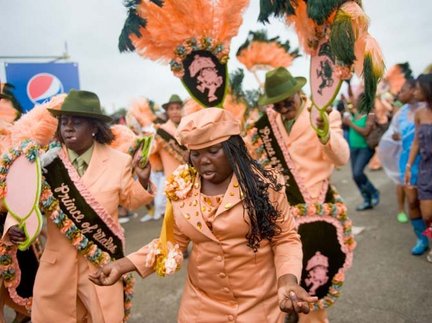
Scene 1: Parade of the New Orleans Social Aid and Pleasure Club

*****

Scene 2: Chouval Bwa

*****

Scene 3: Trombone Shorty and Orleans Avenue, “Backatown” (record-store performance)

*****

Scene 4: Pinettes Brass Band (outside another record store)

**********

lagniappe


Friday, May 7, 2010

New Orleans Jazz & Heritage Festival, 2010/part 1

Scene 1: Sousaphone Parade

*****

Scene 2: Brian Blade & The Fellowship

Want more Brian Blade? Here.

*****

Scene 3: Mardi Gras Indians (Members of the Golden Star Hunters, Carrolton Hunters, et al.), Backstage

Want more Mardi Gras Indians? Here.

**********

lagniappe


Friday, April 30, 2010

Me and a million other dudes said ‘later’ to picking cotton.—Wilson Pickett (in Gerri Hershey, Nowhere to Run: The Story of Soul Music [1994])

Wilson Pickett, live, Germany, 1968

“Stagger Lee”

*****

“Funky Broadway”

Want more? Here.

**********

lagniappe

listening room

The UPS guy left a tiny box yesterday—the new albums by Roky Erickson and Gil Scott-Heron. Who’s next? Sly Stone?

*****

mail

The Bobby Dylan clip was very nice and linked to Manfred Mann—sweet. Thanks.

***

Thanks, Richard! Emails like yours are the main reason I have some energy every week to sit down and grind through another show. Many thanks.

—Kevin [Nutt, host of Sinner’s Crossroads on WFMU-FM, responding to an email notifying him of this mention]

Thursday, April 29, 2010

Happy (111th) Birthday, Duke!

At least one day out of the year all musicans should just put their instruments down, and give thanks to Duke Ellington.

—Miles Davis

Duke Ellington and His Orchestra

“C Jam Blues,” 1942

*****

“Mood Indigo,” “Sophisticated Lady,” “It Don’t Mean a Thing (If It Ain’t Got That Swing),” “Don’t Get Around Much Anymore,” 1943

lagniappe

It is becoming increasingly difficult to decide where jazz starts or where it stops, where Tin Pan Alley begins and jazz ends, or even where the borderline lies between between classical music and jazz. I feel there is no boundary line.

—Duke Ellington

*****

Radio Ellington: All Duke, All Day

WKCR-FM (broadcasting from Columbia University)

Friday, 4/23/10

Imagine that you were talking with someone who’d been blind all his life.

How would you describe this guy’s act?

Wayne Cochran & the C.C. Riders, live (TV broadcast [The Jackie Gleason Show]), 1968

Friday, 4/16/10

The Rock n’ Roll Guide To Getting Girls (excerpt)

“Treat Her Right”

Roy Head, live (TV broadcast), 1965

*****

Bob Dylan, live (TV studio, rehearsal [David Letterman Show]), 1984

Monday, 4/12/10

listening to history

The sound quality may be pretty raggedy, but that hardly matters—this is history.

Albert Ayler, tenor saxophone (“Love Cry,” “Truth Is Marching In,” “Our Prayer”), live, John Coltrane’s funeral, St. Peter’s Lutheran Church, New York, July 21, 1967

**********

lagniappe

Click for a clearer image.

*****

Pinelawn Memorial Park, Farmingdale, New York

*****

Trane was the father. Pharoah was the son. I was the holy ghost.—Albert Ayler

Wednesday, 4/7/10

Happy Birthday, Billie!

If I could listen to only one singer for the rest of my life, she’d be the one.

No one gives you more of life.

Inessentials? No one offers fewer.

Moment by moment, no one is more enthralling.

***

Billie Holiday

“The Blues Are Brewin’,” with Louis Armstrong (New Orleans, 1947)

*****

“Fine and Mellow,” with Ben Webster (ts), Lester Young (ts), Vic Dickenson (trbn), Gerry Mulligan (bs), Coleman Hawkins (ts), Roy Eldridge (trmpt), live (TV broadcast), 1957

*****

“What A Little Moonlight Can Do,” with Mal Waldron (p), live (TV broadcast), 1958

Want more? Here.

**********

lagniappe

Radio Billie: all Billie, all the time

In celebration of Billie Holiday’s birthday, WKCR-FM (broadcasting from Columbia University) is playing her music all day.

BILLIE HOLIDAY BIRTHDAY BROADCAST : APRIL 7th, 2010

Ninety-five years after her birth, on April 7th, 2010, WKCR will dedicate all programming to Billie Holiday. Born Elinore Fagan in Baltimore, Holiday learned songs by Louis Armstrong and Bessie Smith despite the instability and tragedy of her childhood. In 1929, she teamed up with tenor sax player Kenneth Hollan, slowly building her reputation as a vocalist. She replaced Monette Moore at a club called “Covan’s” on West 132 Street in 1932. When producer John Hammond came to see Moore, he was instead captivated by Holiday. He secured a record deal for her, and she recorded two tracks with Benny Goodman. She soon began to record under her own name, collaborating with the greatest artists of the swing era. With pianist Teddy Wilson, she manipulated the melody of dull pop songs for jukeboxes, transforming them into jazz standards, and she courageously recorded “Strange Fruit” with Commodore records when Columbia rejected the sensitive subject matter. Though her career was strained by substance abuse and heartbreak, her voice did not deteriorate. As she inscribed the catastrophes of her life on the texture of her voice, it became only more powerful, more haunting. On April 7th, we will examine the life of this great, mysterious artist, but most importantly, we will listen to her voice.—WKCR-FM

Monday, 3/22/10

Trying to capture jazz in standard notation can be like trying to translate poetry into another language—what you wind up with is everything but the poetry. So composer/trumpeter Wadada Leo Smith (who, like many of his peers, eschews “jazz” as a label for his music) invented his own system of graphic notation.

***************

Wadada Leo Smith (trumpet) with his Golden Quartet (Vijay Iyer [piano], John Lindberg [bass], Ronald Shannon Jackson [drums]); Eclipse, 2005

Part 1

*****

Part 2

*****

Part 3

*****

Part 4

*****

Part 5

*****

Part 6

*****

Part 7

*****

Part 8

**********

lagniappe

art beat

Earlier this month, when I mentioned the exhibit of William Eggleston’s photographs that’s currently at the Art Institute—posting an album cover that you’ll find in a display case there—I didn’t expect that Big Star would appear here again before the month’s end. But then I didn’t expect that Alex Chilton would pass away, either. Alex had more than simply an artistic interest in Eggleston and his work. He’d known the photographer, who was a good friend of his parents, since he was a little boy. Here, again, is the image Alex chose for that album cover, followed by a couple more from this exhibit.

***

***

Tuesday, 3/16/10

street music

New Orleans

Loose Marbles, in the French Quarter

Part 1

*****

Part 2

**********

lagniappe

The Loose Marbles is a sort of Amalgamated Jazz Corporation that creates subsidiaries around the city, to maximize tips and minimize boredom. The fifteen musicians play clarinet, trumpet, banjo, washboard, accordion, trombone, guitars, sousaphone, standup bass, and guitars, but you’re likely to see only seven or eight performers at any given gig. And since you rarely see the same configuration of instruments twice in a row, you rarely hear the same kind of jazz. If Patrick McPeck is there with the accordion, you’ll hear the Marbles’ repertoire of spooky, minor-keyed, Gypsy-influenced songs. If Alynda Segarra is there, with her banjo or washboard, and Jason Jurzek is on string bass instead of tuba, they’ll be playing songs that sound as if they were first performed in a hobo jungle during the Hoover Administration. In Washington Square, in New York, they split into two groups, one anchored by the tuba and the other anchored by the bass, and they play on opposite sides of the park. Halfway through the day, they’ll mix up the configurations to give both the musicians and the crowd a change of pace. At the end of the day, they pool all the tips and divide them equally. I’ve seen days here in New Orleans where they have a stack of bills that’s so thick it can’t be held in one hand, and that contains a lot of portraits of Hamilton and Jackson.

***

The Loose Marbles look like street urchins, and at least a few of them are. The goat-bearded guitar and tuba player, Barnabus Jones; Ruth’s boy, Kiowa Wells; and the banjo and washboard player Alynda all come from a subculture of rail-riding, outdoor-living hobos that was beautifully documented a couple of years ago by the photographer James Heil in Time. . . . But the trumpeter Ben Polcer is a University of Michigan music-school graduate, and the clarinetist Mike Magro, from suburban Philadelphia, is a virtuoso who can hold forth at length about the rare and antiquated Albert fingering of his clarinet.

In addition to their song selection and their remarkably tight and vibrant musicianship, two things particularly excite me about the Loose Marbles. One is how carefully thought out their act is; their inter-war, Mitteleuropean flavor is somehow more than accidental and less than shtick. The other is how much, and how obviously, they all love each other.

***

I asked Ben why he and his friends aren’t playing rock and roll like proper twenty-somethings. What is the attraction, I wanted to know, of music his grandparents listened to?

“I’ve played in a lot of rock bands,” he said. “I like rock and roll. We all like rock and roll. But jazz is special. To play it well, you really have to listen to each other.”—Dan Baum