Hearing John Berryman read his poetry changed my life, as I saida while back. I was in college at the time. A year later, he was dead—a suicide (jumping off a bridge in Minneapolis, where he lived and taught). Here, in Dublin in 1967, he reads one of his Pulitzer-Prize-winning Dream Songs (29). Drunk, mannered, idiosyncratic: yes, yes, yes. Obscure at times to the point of opacity: yes. But also (to these ears) exquisitely controlled, deeply moving, utterly unforgettable.
The sound quality may be pretty raggedy, but that hardly matters—this is history.
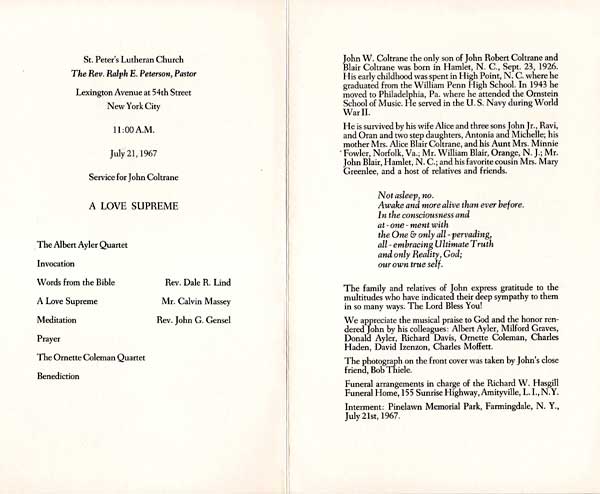
Albert Ayler, tenor saxophone (“Love Cry,” “Truth Is Marching In,” “Our Prayer”), live, John Coltrane’s funeral, St. Peter’s Lutheran Church, New York, July 21, 1967
**********
lagniappe
Click for a clearer image.
*****
Pinelawn Memorial Park, Farmingdale, New York
*****
Trane was the father. Pharoah was the son. I was the holy ghost.—Albert Ayler
This guy’s one of the most lyrical players and composers around.
(He also happens to have paranoid schizophrenia.)
Tom Harrell, flugelhorn/Tom Harrell Quintet
“Rhythm-A-Ning,” live, France (Paris), 2008
*****
“In the Infinite” (by TH), live, Italy (Sorrento), 2008
*****
“Dancin’ Around” (by TH), live, Brazil (Sao Paulo), 2003
**********
lagniappe
I’m posting this next piece with mixed feelings. Talking about Harrell’s psychiatric condition can distract from what’s most important—his music. On the other hand, what he’s been able to accomplish says a lot not only about him but also about the power of music.
If I could listen to only one singer for the rest of my life, she’d be the one.
No one gives you more of life.
Inessentials? No one offers fewer.
Moment by moment, no one is more enthralling.
***
Billie Holiday
“The Blues Are Brewin’,” with Louis Armstrong (New Orleans, 1947)
*****
“Fine and Mellow,” with Ben Webster (ts), Lester Young (ts), Vic Dickenson (trbn), Gerry Mulligan (bs), Coleman Hawkins (ts), Roy Eldridge (trmpt), live (TV broadcast), 1957
*****
“What A Little Moonlight Can Do,” with Mal Waldron (p), live (TV broadcast), 1958
BILLIE HOLIDAY BIRTHDAY BROADCAST : APRIL 7th, 2010
Ninety-five years after her birth, on April 7th, 2010, WKCR will dedicate all programming to Billie Holiday. Born Elinore Fagan in Baltimore, Holiday learned songs by Louis Armstrong and Bessie Smith despite the instability and tragedy of her childhood. In 1929, she teamed up with tenor sax player Kenneth Hollan, slowly building her reputation as a vocalist. She replaced Monette Moore at a club called “Covan’s” on West 132 Street in 1932. When producer John Hammond came to see Moore, he was instead captivated by Holiday. He secured a record deal for her, and she recorded two tracks with Benny Goodman. She soon began to record under her own name, collaborating with the greatest artists of the swing era. With pianist Teddy Wilson, she manipulated the melody of dull pop songs for jukeboxes, transforming them into jazz standards, and she courageously recorded “Strange Fruit” with Commodore records when Columbia rejected the sensitive subject matter. Though her career was strained by substance abuse and heartbreak, her voice did not deteriorate. As she inscribed the catastrophes of her life on the texture of her voice, it became only more powerful, more haunting. On April 7th, we will examine the life of this great, mysterious artist, but most importantly, we will listen to her voice.—WKCR-FM
Act I: Playing for change on New York City street corners and subway platforms, without a regular home, for 20 years.
Act II: Performing at nightclubs, concert halls, and festivals around the world.
That’s a life story no one would believe. But it’s the one this guy has lived.
Charles Gayle Trio, live, Russia (St. Petersburg)
**********
lagniappe
The challenge of free jazz is to create coherent, compelling music without such obvious devices as melody, recurring chord sequences or a steady beat. It’s a challenge that has defeated many a virtuoso since the free-jazz heyday of the 1960’s. But Charles Gayle, a tenor saxophonist, is carving out a free jazz that is muscular, impassioned, clearly structured and wonderfully volatile. . . . Mr. Gayle’s trio made music to move mountains by.—Jon Pareles, New York Times
That’s not something you think about with a musician.
But this guy, who’s celebrating his 85th birthday with a sold-out Carnegie Hall concert, is so deaf that as a child he was mistaken for retarded.
James Moody, saxophone & flute
**********
lagniappe
How were you able to become a musician?
Well, I hear what I hear. I can hear low pitches but I can’t hear high pitches. That’s why I don’t play high on the flute and I don’t play piccolo. I can’t hear them. I have to really listen for the high notes. And that’s why I sound like I have a lisp. But I don’t have a lisp, I mean a speech impediment. It’s ’cause I don’t hear S’s. I can’t hear them.—James Moody
With John Coltrane (saxophone), Wynton Kelly (piano), Paul Chambers (bass), Jimmy Cobb (drums), Gil Evans Orchestra; live (TV Broadcast), 1959
*****
Take 2
With Wayne Shorter (saxophone), Herbie Hancock (piano), Ron Carter (bass), Tony Williams (drums); live (TV broadcast), 1964
**********
lagniappe
[Many admirers of Kind of Blue] are forced to reach back before the modern era to find its measure. Drummer Elvin Jones hears the same timeless sublimity and depth of feeling ‘in some of the movements of Beethoven’s Ninth Symphony, or when I hear Pablo Casals play unaccompanied cello.’ ‘It’s like listening to Tosca, says pianist/singer Shirley Horn. ‘ You know, you always cry, or at least I do.’
***
Quincy Jones: ‘That will always be my music, man. I play Kind of Blue every day—it’s my orange juice. It still sounds like it was made yesterday.’
***
Chick Corea: ‘It’s one thing to just play a tune, or play a program of music, but it’s another thing to practically create a new language of music, which is what Kind of Blue did.’
—Ashley Kahn, Kind of Blue: The Making of the Miles Davis Masterpiece (2000)
Both Chicago blues artists. Both guitar players. Both influenced by other kinds of music.
Musical personalities? They could hardly be more different.
Buddy Guy, “Let Me Love You Baby,” live
*****
Fenton Robinson, “Somebody Loan Me A Dime,” live, 1977
***
Back in the 1970s, when I was at Alligator Records, I had the pleasure of working with Fenton, co-producing his album I Hear Some Blues Downstairs (a Grammy nominee). He didn’t fit the stereotype of a bluesman. Gentle, soft-spoken, serious, introspective: he was all these things. He died in 1997.
Ornette Coleman Quartet (with Don Cherry, trumpet; Charlie Haden, bass; Billy Higgins, drums), live, Spain (Barcelona), 1987
Part 1
*****
Part 2
*****
Part 3
*****
Part 4
*****
The sounds you don’t hear can mean as much as the ones you do. Here, for instance, it’s hard to overstate the importance of what isn’t onstage—a harmony instrument (piano, guitar). Without it, the drums move forward in the mix. The bass has more space to fill. The sound of each instrument becomes clearer, more distinct. The group sound becomes lighter, more open.
lagniappe
When we were on relief during the Depression, they’d give us dried-up old cheese and dried milk and we’d get ourselves all filled up and we’d kept this thing going, singing and dancing. I remember that when I play. You have to stick to your roots. Sometimes I play happy. Sometimes I play sad. But the condition of being alive is what I play all the time.
***
You know what I realize? That all sound has a need. Otherwise it wouldn’t have a use. Sound has a use. . . . You use it to establish something—an invisible presence or some belief. . . . But isn’t it amazing that sound causes the idea to sound the way it is, more than the idea?
***
Music has no face. Whatever gives oxygen its power, music is cut from the same cloth.
—Ornette Coleman
(The first and last quotes are from Ornette’s website. The second is from Ben Ratliff, The Jazz Ear: Conversations over Music [2008].)
*****
It is not enough to say that Ornette Coleman’s music will affect jazz profoundly, for it already has so affected it, and not only the jazz of younger men but that of some of his elders as well. His music represents the first fundamental reevaluation of basic materials and basic procedures for jazz since the innovations of Charlie Parker. ‘Let’s play the music and not the background,’ Coleman has said. And when someone does something with the passion and deep conviction of an Ornette Coleman, I doubt if there could be any turning back; it seems mandatory somehow for others somehow to respond to his work.—Martin Williams, The Jazz Tradition (2d rev. ed. 1993)
*****
Radio Ornette: all Ornette, all the time
Want more? In celebration of Ornette’s birthday, one of my favorite radio stations, WKCR-FM(at Columbia University), is playing his music all day.


 music clip of the day