music clip of the day

jazz/blues/rock/classical/gospel/more

Category: saxophone

Thursday, 7/28/11

 favorites
(an occasional series)

A charter member of the just-announced (to excitement so deafening it’s inaudible) MCOTD Hall of Fame, he’s being celebrated tonight at a concert, in Chicago’s Millenium Park, featuring musicians who came up under him, including saxophonists Steve Coleman and Eric Alexander.

*****

No tenor player moves me more.

Von Freeman

“I Can’t Get Started” (excerpt), live, Belgium, 1992

*****

“Blues for Sunnyland,” live, Germany (Berlin), 2002

*****

Live, Chicago, 2009

**********

lagniappe

Being a local legend can be a mixed bag. Consider Von Freeman, the 72-year-old tenor saxophonist who reigns as Chicago’s preeminent local jazz legend. In the 40s, he performed with bop genius Charlie Parker. In the 60s, Miles Davis tried to hire him as a replacement for John Coltrane. In the 80s, he and his son Chico, a formidable saxophonist himself, shared an album with the first family of jazz: trumpeter Wynton Marsalis, his saxophonist brother Branford, and his pianist father Ellis (Fathers and Sons, Columbia). And in the 90s, he’s performed at New York’s most prestigious concert halls–Lincoln Center and Carnegie Hall.

But legendary status can have drawbacks. It’s opened a lot of doors for Freeman, making him a familiar figure at a variety of local clubs (including the Bop Shop, the Green Mill, Pops for Champagne, and Andy’s). But appearing so often at so many places can make a performer seem as unremarkable as a crooked alderman. And the tag “legendary,” which smacks of the sort of hushed reverence usually reserved for the dead, can make a performer seem less a vital artist–one who continues to take chances–than a bloodless icon.

But Freeman is neither unremarkable nor bloodless. Hearing him live is like taking a tour of a fun house: you never know what you’ll find behind the next door.

Upon entering, the first thing you notice is that the floor seems tilted–the result of Freeman’s distinctively oblique intonation. His sour off-center tone–which occasionally prompts charges that he plays out of tune–invests the best of his performances with a hard-edged emotional intensity. When he played Charlie Parker’s “Confirmation” on a recent weekend at the Jazz Showcase, where he led a fine quintet (Brad Goode on trumpet; Joan Hickey on piano; Mendai on bass; Robert Shy on drums one night and Michael Raynor on drums the other), he bristled with energy but also sounded wounded. And when he played the ballad “Lover Man,” he conjured up a world that was unremittingly bleak.

Freeman’s improvisations take you quickly from one room to the next. Some of them, like the meowing slurs during an unaccompanied solo on the ballad “Body and Soul,” are breathtakingly strange. Others, like the wild chorus at the top of his range on Duke Ellington’s “Caravan,” offer hair-raising adventure.

Not all of his ideas are equally striking. But jazz improvisation on the order of Freeman’s is necessarily a hit-or-miss affair. As Somerset Maugham put it, only the mediocre are always at their best.

Throughout the recent performance Freeman played the role of genial host. One moment he was encouraging the bassist: “Hit it, Mendai!” The next he was indulging in Von-speak, adding the ending “-ski” to proper nouns, turning himself into “Vonski” and the Duke Ellington piece into “Caravanski.” And in another he was explaining, in a tone half mocking and half serious, the unpredictable nature of jazz: “Sometimes this horn plays and sometimes it doesn’t. I have no control over it.”

At their best, Freeman’s performances dazzle in ways all too rarely encountered in jazz these days. While the well-mannered music of many of today’s most acclaimed performers (Wynton Marsalis, Marcus Roberts) may have its appeal, it generally lacks those undomesticated virtues that Freeman’s music celebrates: daring, originality, and unpredictability. Like the man himself, Freeman’s musical values are a product of this city. He began developing them while attending DuSable High School, where–like many other Chicago-bred jazz giants, including fellow tenor saxophonists Gene Ammons, Johnny Griffin, and John Gilmore–he studied under the fabled music teacher Captain Walter Dyett. As Freeman once explained in a New York Times interview, Dyett stressed originality, preaching a message both simple and elusive: “Try and find yourself.” Even when performing classic material (Ellington, Parker, Monk), Freeman’s music sounds brand-new. The difference between him and many younger musicians who have achieved greater renown is like that between a fun house and a museum.

Jazz Tilt-A-Whirl,(review of Von Freeman, Jazz Showcase, 1/13-14/1995), Chicago Reader, 1/26/1995 (yeah, I’m cannibalizing myself here)

*****

. . . one of the most original and creative tenormen of the 1950s and, in light of other work I’ve heard by him, a great tenor player by any standards.

***

An exceptional artist, he belongs in jazz’s pantheon.

Harvey Pekar, JazzTimes, 1-2/2001

(Originally posted 9/21/10.)

*****

My favorite tenor player?

A while back, I said that if I had to name my favorite alto player, there would be days where I’d say Art Pepper.

Tenor players?

Some days this’d be the guy.

Like Pepper, he has a sound that’s immediately identifiable. It’s a sound that, like Pepper’s, holds both joy and heartbreak. And like Pepper, he’s hard—no, impossible—to pigeonhole. Swing, bebop, free: the label that’s capacious enough to contain him hasn’t been invented.

Von Freeman, “Lester Leaps In,” live, Chicago (New Apartment Lounge), 2010

Vodpod videos no longer available.

(Originally posted 2/12/11.)

*****

Our music is a Secret Order.

—Louis Armstrong, 1954 (John F. Zwed, Space Is The Place: The Lives And Times Of Sun Ra [1997], epigraph)

Von Freeman (tenor saxophone, with Ed Petersen, tenor saxophone; Willie Pickens, piano; Brian Sandstrom, bass; Robert Shy, drums), live, Chicago (Green Mill Lounge), 12/31/10

Vodpod videos no longer available.

(Originally posted 2/25/11.)

*****

More Von

The other night, during a performance and interview at the University of Chicago, he seemed, at times, a bit frail. He’s nearing 90 and was recently in the hospital. But what I said a while back still holds true: no tenor player moves me more.

Von Freeman (tenor saxophone, with Mike Allemena, guitar; Matt Ferguson, bass; Michael Raynor, drums), “Bewitched, Bothered and Bewildered,” live, Chicago (Mandel Hall, University of Chicago), 2/24/11

Vodpod videos no longer available.

**********

lagniappe

better late, etc.

The University of Chicago recently awarded Von the Rosenberger Medal, which was established in 1917 . . . [and recognizes] achievement through research, in authorship, in invention, for discovery, for unusual public service, or for anything deemed of great benefit to humanity.” Past recipients include Toni Morrison, Pierre Boulez, and Frederick Wiseman.

*****

musical thoughts

It takes years to explain those vibrational things in verbal language. And it still might not work. One time I asked Von Freeman about his voice-leading in harmony, he’s the master of that shit. I asked him, “How did you learn that shit? You’re so fluent at it.” And he said, “Well, you know, I sat down one day and I said, let me look at this thing.” He said, “I began with one tone. I studied one tone. And I studied all that I could study about one tone.” When these old guys talk, you don’t ask too many questions. You pretty much just listen to what they say. And so, I didn’t know what he meant, but I just listened. And he said, “I worked on that for a long time, you know, for months. Just seeing what could be done with one tone. When I felt pretty good about that, I moved on to two tones. That was a bit harder. I worked a lot longer, but I worked and saw all that I could do with two tones. Then I moved to three tones, and so on. After I went on for a while I realized that you can pretty much do everything that you need to do with two tones.” That’s what he told me. I spent years thinking about this shit. Years. I’m still thinking about it, you know. I feel like I have a better handle on knowing what he meant now than then, although it is not a simple thing to explain. And when I tell the story to somebody playing in my group or something, and they ask me, “What did he mean?” it takes me literally years to explain what I think he means. And I’m sure I only have part of what he means. What it means to me. Some things, you have to explain them with a million examples over a period of time. The meaning dawns on a person and when they have to explain it it’s funny. We live in this McDonald’s type society where everybody thinks everything is just quick. It’s not like that. You have to actually build the understanding, slowly over time. So this thing that Von Freeman explained to me, it sounds like a very simple thing, but it really doesn’t make any sense at all without the experience. It’s maybe fifteen years ago that he told me, and I found it to be absolutely true. I could never explain it in one day, or in a lecture over an hour.

Steve Coleman (whose latest album was named one of the year’s ten best in the 2010 Village Voice Jazz Critics’ Poll)

*****

my back pages

No other musician, in any genre, has meant so much to me in so many ways for so many years. I first heard Von in the mid-70s, when I was in my twenties (and working for Alligator Records) and he was in his fifties. The setting, coincidentally, was the University of Chicago; he opened for Cecil Taylor. I got to know him and booked a few shows for him. In 1977, when I got married, he and pianist John Young played at our wedding ceremony. Later, when I was reviewing live jazz, I wrote a piece about him for the Chicago Reader. Over the last three decades, I’ve listened, avidly, to his growing catalog of albums and seen him live more times than I could count. He is now an old man. And I am getting there.

(Originally posted 3/1/11.)

*****

rewarding the deserving

So often, it seems, when arts awards are announced, my initial reaction is: “Huh?” Not this time. The National Endowment of the Arts just announced their 2012 Jazz Masters Awards, which recognize, with Lifetime Honors, “living musicians for career-long achievement.” And the winners are Jack DeJohnette, Jimmy Owens, Charlie Haden, Sheila Jordan, and Von Freeman.

(Originally posted 6/25/11.)

Monday, 7/25/11

What better way to start the workweek?

 Joe Lee Wilson, singer, December 22, 1935-July 17, 2011

Archie Shepp, “Money Blues” (featuring Joe Lee Wilson, lead vocals)
Things Have Got To Change (Impulse!), 1971

Part #1

Vodpod videos no longer available.

***

Part #2

Vodpod videos no longer available.

**********

lagniappe

Around Joe Lee (excerpt)

Vodpod videos no longer available.

Wednesday, July 13, 2011

Happy (75th) Birthday, Albert!

Albert Ayler, tenor saxophonist, July 13, 1936-November 25, 1970

*****

Albert Ayler Trio (Albert Ayler, ts; Gary Peacock, bass; Sunny Murray, drums), Spiritual Unity (ESP), 1964

“Ghosts: First Variation”

***

“The Wizard”

***

“Spirits”

***

“Ghosts: Second Variation”

More? Here. And here. 

**********

lagniappe

random thoughts

OK, let’s talk physics. One problem with the term “free jazz” is that it suggests a sound world in which there’s no center of gravity—a world where everything pushes outward, where centrifugal force rules. But the reality, with many of the greatest artists, is different. Centripetal, not centrifugal, force is king. The musicians push inward, not outward, toward a center none ever inhabits individually but, collectively, they are always moving toward.

***

The contributions of Gary Peacock and Sunny Murray are hard to overstate. Sidemen? There are none.

***

Like Ornette Coleman, Albert Ayler is at heart a blues musician—one who, like Ornette, expanded the blues vocabulary.

*****

radio

Today, from noon to 9 p.m. (EST), WKCR-FM (broadcasting from Columbia University) is all Albert Ayler.

Friday, 7/8/11

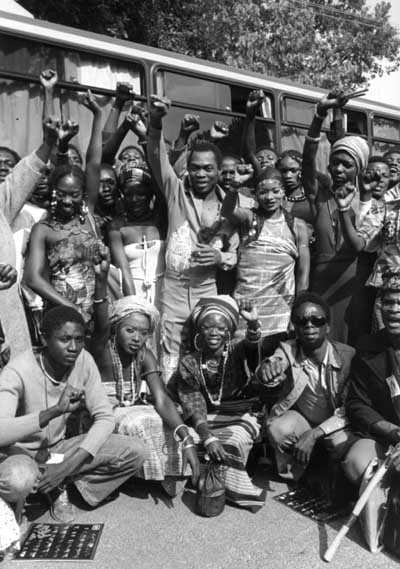
It takes a village, in Fela’s world, to put on a show.

Fela Anikulapo Kuti, October 15, 1938-August 2, 1997

Live, Paris, 1981

Part 1

Vodpod videos no longer available.

***

Part 2

Vodpod videos no longer available.

**********

lagniappe

1938 Born 15 October in Abeokuta, Nigeria to politically active and middle class family.

1958 Sent to London to train as a doctor, but instead enrolled in the Trinity College of Music. Formed Koola Lobitos in 1961.

1969 Took Koola Lobitos to Los Angeles. His political zeal was fired when he befriended radical black activists including Angela Davis.

1971 Kuti renames his band Afrika 70 (and later Eygpt 80), and, newly politicised, he determines to give voice to Nigeria’s underclass.

1974 After he enraged the Nigerian establishment, the army almost destroyed Kuti’s home while trying to arrest him.

1977 In a second government-sanctioned attack, 1,000 soldiers descended on Kuti’s compound. He suffered a fractured skull, arm and leg in the onslaught and his 82-year old mother was thrown from an upstairs window. He left for voluntary exile in Ghana.

1978 Ghanian authorities deported Kuti back to Lagos. On his arrival he married 27 women simultaneously. Divorcing them in 1986, he said: ‘ no man has the right to own a woman’s vagina’.

1979 Founded his own political party MOP (Movement of the People)

1984 Jailed in Nigeria for five years on what was regarded as sham currency smuggling charges, and released in 1986 after a change of government.

1996 Arrested and released on an alleged drug charge.

1997 Died of complications from Aids aged 59.

Peter Culshaw, The Guardian, 8/15/04

*****

Sunday, 7/3/11

This guy I can’t get enough of.

Vernard Johnson, “Don’t Wait ’Til The Battle Is Over, Shout Now!”; live, TV broadcast (Bobby Jones Gospel)

Vodpod videos no longer available.

Time for just one note? 6:23.

More? Here. And here.

**********

lagniappe

art beat

Lee Friedlander, Cherry Blossom Time in Japan (2006)

*****

reading table

Yesterday, opening my Emily Dickinson collection (The Poems of Emily Dickinson, edited by R. W. Franklin) at random, I came upon this.

We do not play on Graves —
Because there isn’t Room —
Besides — it isn’t even — it slants
And People come —

And put a Flower on it —
And hang their faces so —
We’re fearing that their Hearts will drop —
And crush our pretty play —

And so we move as far
As Enemies — away —
Just looking round to see how far
It is — Occasionally —

—Emily Dickinson (#599)

***

*****

listening room: what’s playing

Echocord Jubilee Comp. (Echocord)

Art Ensemble of Chicago, Full Force (ECM)

Art Ensemble of Chicago, Urban Bushmen (ECM)

Paul Motian (with Lee Konitz, soprano & alto saxophones; Joe Lovano, tenor saxophone; Bill Frisell, guitar; Charlie Haden, bass), On Broadway Vol. 3 (Winter & Winter)

Rebirth Brass Band, Feel Like Funkin’ It Up (Rounder)

Marc Ribot, Silent Movies (Pi Recordings)

• Wadada Leo Smith, Kabell Years: 1971-1979 (Tzadik)

Charles “Baron” Mingus, West Coast, 1945-49 (Uptown Jazz)

• John Alexander’s Sterling Jubilee Singers, Jesus Hits Like The Atom Bomb (New World Records)

Rev. Johnny L. Jones, The Hurricane That Hit Atlanta (Dust-to-Digital)

Elliott Carter, composer; Ursula Oppens, piano; Oppens Plays Carter (Cedille)

Arnold Schoenberg, Anton Webern, composers; Maurizio Pollini, piano, piano works (Schoenberg), Variations Op. 27 (Webern) (Deutsche Grammophon)

Morton Feldman, For Bunita Marcus, Stephane Ginsburgh, piano (Sub Rosa)

WKCR-FM (broadcasting from Columbia University)
Bird Flight (Phil Schaap, jazz [Charlie Parker])
Traditions in Swing (Phil Schaap, jazz)
—Daybreak Express
(Various, jazz)
Out to Lunch (Various, jazz)
Jazz Profiles (Various, jazz)
Jazz Alternatives (Various, jazz)
Morning Classical (Various, classical)
Afternoon New Music (Various, classical and hard-to-peg)
Eastern Standard Time (Carter Van Pelt, Jamaican music)

WFMU-FM
Mudd Up! (DJ/Rupture, “new bass and beats”)
Sinner’s Crossroads
(Kevin Nutt, gospel)
—Give The Drummer Some
(Doug Schulkind, sui generis)
Downtown Soulville with Mr. Fine Wine (soul)

Friday, 7/1/11

scenes from New Orleans
(an occasional series)

Rebirth Brass Band, live, Maple Leaf Bar (where RBB plays Tuesday nights), New Orleans, 2011

“Big Chief”

Vodpod videos no longer available.

***

“I Like It Like That”

Vodpod videos no longer available.

More? Here. And here. And here. And here.

Saturday, 6/25/11

nadir, n. the lowest point.

On July 29, 1946, Charlie Parker was arrested in Los Angeles, after starting a fire in his hotel room. Earlier that day, unable to score heroin, scratchy, drunk on whiskey, he recorded this track, which, depending on your point of view, is either one of the worst records he ever made (Parker’s view) or, despite (because of?) its raggedyness, among the greatest (Charles Mingus’s opinion). After his arrest he was confined, for six months, at Camarillo State Mental Hospital.

Charlie Parker, “Lover Man” (CP, alto saxophone; Howard McGhee, trumpet; Jimmy Bunn, piano; Bob Kesterson, bass; Roy Porter, drums), rec. 7/29/46

More? Here.

**********

lagniappe

rewarding the deserving

So often, it seems, when arts awards are announced, my initial reaction is: “Huh?” Not this time. The National Endowment of the Arts just announced their 2012 Jazz Masters Awards, which recognize, with Lifetime Honors, “living musicians for career-long achievement.” And the winners are Jack DeJohnette, Jimmy Owens, Charlie Haden, Sheila Jordan, and Von Freeman.

*****

reading table

The cafeteria in the hospital’s basement was the saddest place in the world, with its grim neon lights and gray tabletops and the diffuse forboding of those who had stepped away from suffering children to have a grilled cheese sandwich.

***

The next day, I set up an iPod dock and played music, not only in the willfully delusional belief that music would be good for a painful, recovering brain but also to counter the soul-crushing hospital noise: the beeping of monitors, the wheezing of respirators, the indifferent chatter of nurses in the hallway, the alarm that went off whenever a patient’s condition abruptly worsened.

***

One early morning, driving to the hospital, I saw a number of able-bodied, energetic runners progressing along Fullerton Avenue toward the sunny lakefront, and I had a strong physical sensation of being in an aquarium: I could see out, the people outside could see me (if they chose to pay attention), but we were living and breathing in entirely different environments.

—Aleksandar Hemon, “The Aquarium: A Child’s Isolating Illness” (behind a paywall), New Yorker, 6/13 & 20/2011

Wednesday, 6/22/11

His blues seem bottomless.

Arnett Cobb, tenor saxophonist, August 10, 1918-March 24, 1989

“Texas Blues,” live (with Ellis Marsalis, piano; Chris Severin, bass; Johnny Vidacovich, drums), 1984, New Orleans

Vodpod videos no longer available.

***

“The Nearness of You” (mislabeled “Misty” on YouTube), live (with Wild Bill Davis, piano; Bernard Upsom, bass; Frankie Dunlop, drums), 1982, Germany (Berlin)

Vodpod videos no longer available.

One of my favorite moments comes at 2:48: “I hear ya, I hear ya.”

Monday, 6/20/11

Here’s another take on the blues.

Ben Webster Quartet (BW, tenor saxophone; Stan Tracey, piano; Rick Laird, bass; Jackie Dougan, drums), “Poutin’,” live

Vodpod videos no longer available.

More? Here. And here. And here.

**********

lagniappe

Sonny Rollins, Joe Lovano, et al., talk about Ben Webster

Vodpod videos no longer available.

*****

mail

You are sending out some great stuff at all times. . . . It’s always interesting, and the one you sent out today, Onmutu Mechanicks, was especially cool, since I hadn’t ever crossed their path.

Thursday, 6/9/11

kaleidoscopic, adj. 1. changing form, pattern, color, etc., in a manner suggesting a kaleidoscope. 2. continually shifting from one set of relations to another. E.g., the music of the Art Ensemble of Chicago.

Art Ensemble of Chicago (Roscoe Mitchell, saxophone; Joseph Jarman, saxophone; Lester Bowie, trumpet; Malachi Favors, bass; Don Moye, drums), live, Europe, 1980s

Part 1

Vodpod videos no longer available.

One of my all-time favorite musicians—no matter the instrument, no matter the genre—is the guy playing bass. If I’m feeling down, he lifts me up. If I’m feeling good, he makes things even better.

***

Part 2

Vodpod videos no longer available.

How many trumpeters play so many different colors?

***

Part 3

Vodpod videos no longer available.

***

Part 4

Vodpod videos no longer available.

***

Part 5

Vodpod videos no longer available.

***

Part 6

Vodpod videos no longer available.

Avant-garde? Their use of polyphony recalls the earliest New Orleans jazz.

***

Part 7

Vodpod videos no longer available.

How many musicians not only roam so widely but swing so hard?

**********

lagniappe

more

Art Ensemble of Chicago with Fontella Bass, “Theme de Yoyo” (1970)

More? Here.