music clip of the day

jazz/blues/rock/classical/gospel/more

Category: gospel

Sunday, 5/22/11

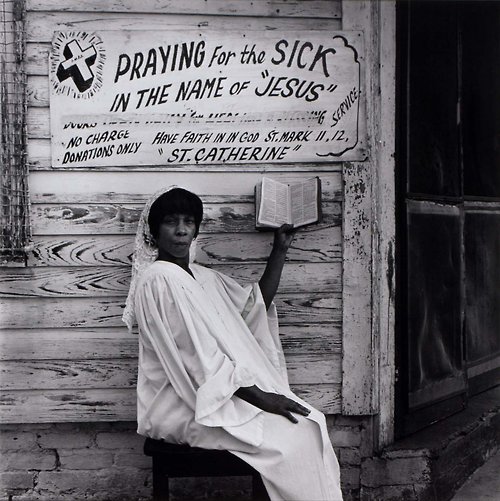
scenes from New Orleans
(an occasional series)

By and By: New Orleans Gospel at the Crossroads (in production)

Trailer

Vodpod videos no longer available.

***

The Electrifying Crown Seekers, “That’s Heaven To Me” (rehearsal)

Vodpod videos no longer available.

***

Sunday Night at Ebenezer Baptist Church

Vodpod videos no longer available.

***

The Voices of Distinction, “A Change Is Gonna Come”

Vodpod videos no longer available.

***

Title Sequence

Vodpod videos no longer available.

**********

lagniappe

art beat

Michael P. Smith, New Orleans photographer

Sunday, 5/15/11

White folks got soul, too.

Brother Claude Ely, singer, songwriter, preacher
July 22, 1922-May 7, 1978

Ain’t No Grave: The Life and Legacy of Brother Claude Ely
(Dust-to-Digital 2011)

Vodpod videos no longer available.

***

“There Ain’t No Grave Gonna Hold My Body Down”
(King 1954 [recorded 1953])

Vodpod videos no longer available.

***

“Cryin’ Holy Unto the Lord”
(recorded 1953)

Vodpod videos no longer available.

Sunday, 5/8/11

Feet, hands, voices—spirits, too.

Christian Home Baptist Church Hymn Choir, “Hezekiah—You Got To Die!”
Live, McConnells, South Carolina (Mt. Do-Well Baptist Church), 1994

Vodpod videos no longer available.

**********

lagniappe

serendipity

If you keep your ears open, music turns up unexpectedly. Last month, for instance, I was in Cambridge, Massachusetts, where I got to talking with a Harvard student who’s from Greenville, South Carolina. He’s studying religion, hoping to be a minister. I told him, referring to performances like the one featured today, that I’d heard gospel music from the Greenville area that I loved. As it turned out, he’d grown up with the music—his grandfather sang in quartets. Now he sings, too.

Damaris Taylor, “’Tis So Sweet to Trust in Jesus”
Live, Cambridge, Massachusetts (Harvard BSA Apollo Night), 2010

Vodpod videos no longer available.

*****

listening room: what’s playing

• The Complete Blue Note Recordings of Herbie Nichols (Mosaic)

• The Lester Young/Count Basie Sessions (1936-1940) (Mosaic)

• Equal Interest (Joseph Jarman, Leroy Jenkins, Myra Melford), Equal Interest (OmniTone)

Billy Bang Quintet, Above and Beyond (Justin Time)

Various Artists, Trojan Box Set: Lovers (Trojan)

• Various Artists, Fire In My Bones: Raw + Rare + Other-Worldly African-American Gospel (1944-2007) (Tompkins Square)

Ernest Bloch: String Quartets 1-4, The Griller String Quartet (Decca)

Sviatoslav Richter, Richter Rediscovered: Carnegie Hall Recital 1960 (RCA Red Seal)

Alfred Schnittke: String Quartet No. 3, The Britten Quartet (Collins Classics)

Morton Feldman: For Bunita Marcus, John TilburyMorton Feldman, All Piano (London HALL)

WKCR-FM (broadcasting from Columbia University)
Bird Flight (Phil Schaap, jazz [Charlie Parker])
Morning Classical (Various)

WFMU-FM
Mudd Up! (DJ/Rupture, “new bass and beats”)
—Toothpick Rhythm
(Betsey Nichols, country)
Sinner’s Crossroads
(Kevin Nutt, gospel)
—Give The Drummer Some
(Doug Schulkind, sui generis)
—Downtown Soulville
(Mr. Fine Wine, soul)
Pseu Braun
(sui generis)
—Fool’s Paradise
(Rex, sui generis)
Transpacific Sound Paradise (Rob Weisberg, “popular and unpopular music from around the world”)
Daniel Blumin (sui generis)

*****

100

200

300

400

500

Today MCOTD celebrates its 600th post.

Sunday, 5/1/11

Won’t somebody tell me . . . ?

Blind Willie Johnson, lead vocals and guitar
Willie B. Harris (BWJ’s wife), vocals
“Soul Of A Man,” Atlanta, 1930

Vodpod videos no longer available.

(The guy in the photo is Chris Thomas King, who portrayed Blind Willie Johnson in Wim Wenders’ The Soul of a Man, which aired on PBS as part of Martin Scorsese’s The Blues.)

More? Here. And here.

**********

lagniappe

Blind Willie Johnson, a gospel singer, preacher, and pioneer of the blues, understood the power of the honest question, and he perceived its flame in the Bible.

Johnson was born in poverty in 1897 and blinded at age 7, when his stepmother, in a fight with his father, threw lye in his face. He died in poverty in 1945, sleeping on a wet bed in the ruins of his house, which had burned down two weeks before. Thankfully, between 1927 and 1930, he recorded a number of his biblically based blues songs with Columbia Records. These have inspired countless rockers, from Led Zeppelin to Beck. In 1977 his “Dark Was the Night, Cold Was the Ground,” a hauntingly inarticulate meditation on the Crucifixion, was sent into deep space on the Voyager 1 as part of the Voyager Golden Record, a collection of music representing the sounds of Earth to any potentially interested extraterrestrials. The time capsule is scheduled to be within 1.6 light-years of two nearby suns in about 40,000 years. The closest thing to timeless any musical artist could possibly achieve. Mercy, how we do so often love to immortalize those despised and forgotten in life.

Johnson’s uniquely spiritual blues music is driven by the deepest questions, often finding voice through an encounter between biblical tradition and his own life experience, which was well acquainted with sorrow. The Bible peopled his imagination. It was his wellspring of imagery. It empowered him to call this world into question and to envision another. On at least one occasion, the powers that be recognized how potentially explosive such an inspired combination of biblical language and lived oppression could be. He was arrested in front of a New Orleans city building for inciting a riot simply by singing “If I Had My Way I’d Tear the Building Down,” a song about the biblical hero Samson, who tore down the house of the Phil­istine lords after they had gouged out his eyes. To the officer who arrested him, the ancient story suddenly sounded dangerously contemporary.

In his well-known songSoul of a Man,” Johnson growls out the question he has pursued his whole life, knowing that no one can really help him find the answer: Just what is the “soul of a man”? Indeed, what is soul? It’s a question filled to overflowing with other questions. Am I more than my mind? More than my body? More than the sum of my parts? Do I have a soul? Does it live beyond this mortal coil? What am I? Who am I? Why am I here? Such profound questions are often asked, but too often are followed by erudite answers from someone who claims to know. Rarely by someone who honestly does not know. As none of us do.

Johnson recalls his lifelong soul search. He’s traveled far and wide, through cities and wildernesses. He’s heard answers from lawyers, doctors, and theologians. None have satisfied. In response to each of the answers he’s been given, he repeats his question with more forceful, gravelly urgency.

In his quest, he turns to the Bible:

“I read the Bible often, I tries to read it right

And far as I could understand, nothing but a burning light”

 Called to preach since age 5, steeped in the African-American Baptist tradition, this blind sage of spiritual blues knew the Bible inside and out from memory. Yet it gave him no answer, only a more profound mystery: nothing but a burning light.

Timothy Beal, “The Bible Is Dead; Long Live The Bible,” The Chronicle of Higher Education, 4/17/11

*****

listening room: what’s playing

Tinariwen, The Radio Tisdas Sessions (World Village)

Tinariwen, Imidiwan: Companions (World Village)

Mos Def & Talib Kweli Are Black Star (Rawkus)

Various Artists, Life Is A Problem (Mississippi Records)

Various Artists, Oh Graveyard, You Can’t Hold Me Always (Mississippi Records)

Various Artists, Powerhouse Gospel on Independent Labels, 1946-1959 (JSP)

Arvo Part, Miserere (ECM)

WFMU-FM
Give the Drummer Some (Doug Schulkind), 9 a.m.-noon (EST) (web stream only)

WKCR-FM (broadcasting from Columbia University)
Eastern Standard Time (reggae), Saturday, 7:30 a.m.-noon (EST)
Traditions in Swing (Phil Schaap), Saturday, 6-9 p.m. (EST)
—Duke Ellington birthday broadcast, 4/29/11

*****

art beat

What brings folks here? It’s not what you might think (if, that is, you were to give this any thought). When it comes to searches, what brings the most people here isn’t music; it’s paintings. “Captain Beefheart paintings,” “de Kooning excavation”: hundreds come here looking for them.

Sunday, 4/24/11

Take me to the water . . .

Take Me To The Water:
Immersion Baptism in Vintage Music and Photography
1890-1950
(Dust-to-Digital 2009)

Vodpod videos no longer available.

**********

lagniappe

reading table

Three Lilies

“Weeping may endure for a night, but joy cometh in
the morning.” Psalm 30

Before dawn, under a thin moon disappearing
east, the planet Mercury, the messenger
and healer, came up vanishingly
into the blue beyond the garden where
three lilies at the bottom of the yard
arrayed white trumpets on iron stalks
under a slow, slow lightning from the sun.
I stood on a rotten step myself,
and smelled them from a hundred feet away.

—Brooks Haxton (Uproar: Antiphonies to Psalms)

*****

listening room: what’s playing

Billy Bang Quintet, Above and Beyond (Justin Time)

• The Complete Atlantic Recordings of Lennie Tristano, Lee Konitz & Warne Marsh (Mosaic)

Bunky Green, The Salzau Quartet Live at Jazz Baltica (Traumton)

Bombino, Agadez (Cumbancha)

Friedrich Gulda, The Complete Gulda Mozart Tapes (Deutsche Grammaphon)

Maryanne Amacher, Sound Characters (Tzadik)

The Original Gospel Harmonettes (featuring Dorothy Love Coates), Love Lifted Me (Charly)

Rev. Johnny L. Jones, The Hurricane That Hit Atlanta (Dust-to-Digital)

Sinner’s Crossroads, Kevin Nutt, WFMU-FM (Thursday, 8-9 p.m. [EST])

Gospel Memories, Bob Marovich, WLUW-FM (Saturday 10-11 a.m. [CST])

Bird Flight, Phil Schaap, WKCR-FM (M-F, 8:20-9:30 a.m. [EST])

Charles Mingus Birthday Broadcast, WKCR-FM, 4/22/11

Sunday, 4/17/11

“Cold, Cold Heart”

“I Can’t Help It (If I’m Still In Love With You)”

“I Saw The Light”

Who else, when it comes to syllables, does so much with so little?

Hank Williams (with others), “I Saw The Light”
TV broadcast (The Kate Smith Evening Hour), 3/26/52

Vodpod videos no longer available.

**********

lagniappe

reading table

George Crosby remembered many things as he died, but in an order he could not control. To look at his life, to take the stock he always imagined a man would at his end, was to witness a shifting mass, the tiles of a mosaic spinning, swirling, reportraying, always in recognizable swaths of colors, familiar elements, molecular units, intimate currents, but also independent now of his will, showing him a different self every time he tried to make an assessment.

—Paul Harding, Tinkers (2009)

Sunday, 4/10/11

Claude Jeter, Inez Andrews, Archie Brownlee, Dorothy Love Coates, this guy: where else can you find so many unforgettable voices?

Soul Stirrers (featuring R. H. Harris), “His Eye Is on the Sparrow” (1946)

Vodpod videos no longer available.

**********

lagniappe

When R. H. Harris, the renowned gospel tenor, died last month, I went back to the records he had made in the 1950’s with his quartet, the Soul Stirrers. Harris was the — founder is not too strong a word — of a soul singing that concentrated on supple phrasing and tonal sweetness. He could, as Tina Turner used to say, ”do it rough,” but there was a core of reticence, even melancholy in him. His roughness was strategic.

The Soul Stirrers set the mold for other outstanding quartets like the Swan Silvertones and the Five Blind Boys of Alabama, and for younger soul singers, from Sam Cooke (trained by Harris) to David Ruffin and Eddie Kendricks of the Temptations (Harris had mastered husky rhythm singing and falsetto), and Smokey Robinson and Marvin Gaye.

***

The discipline required of a first-rate ensemble, vocal or instrumental, translates into the kind of musical discretion that comes only from intense on-the-spot listening. Not biding time or doing cute things onstage until your solo comes, but listening. Take melisma (one syllable stretched over many notes), the vocal weapon so battered and abused by pop singers today. Harris was a master of it. For him it was a musical resource, like dynamics or timbre, not a way of muscling listeners to the ground till they screamed and clapped, maybe because they were overpowered, maybe just to stop the madness.

The Soul Stirrers’ a cappella harmonies are deeply satisfying. And when Harris rises above them with his pure, true pitch (pitch is usually the missing element in today’s melisma mania), you will experience true bliss.

—Margo Jefferson, New York Times, 10/2/00

*****

reading table

The self never ages.

—Roland Barthes, Mourning Diary (trans. Richard Howard, 2010)

Sunday, 4/3/11

We’ve always believed in singing, in expressing ourselves.

***

Sometimes a song . . . is just as great as a sermon.

***

A hurricane starts off slowly . . . and when she gets a certain speed, that’s when she’s dangerous. Most preachers . . . get their power going up . . . . [M]ost of my power is given by coming down, down, after I’ve gone up.

—Rev. Johnny L. Jones

Rev. Johnny L. Jones, live, Atlanta
The Hurricane That Hit Atlanta (Dust-To-Digital 2010)

Vodpod videos no longer available.

**********

lagniappe

musical thoughts

. . . music heard so deeply
That it is not heard at all, but you are the music
While the music lasts.

—T.S. Eliot, “The Dry Salvages” (Four Quartets)

Sunday, 3/27/11

For some folks singing is as vital as breathing.

Five Star Jubilee Singers, Harriman Junction, Tennessee
Live, “I’ve Been Changed,” “Go Down Moses,” “I’m Just Keeping It Real,” “Open the Floodgates to Heaven,” 2008

Vodpod videos no longer available.

**********

lagniappe

It’s a Friday night in downtown Harriman, and inside the Anointed Praise and Worship Church, the Five Star Jubilee Singers are playing like it’s already Sunday morning.

On drums is Anterrio Ray, 33, an ex-Golden Gloves boxer whose first drum set was a five-gallon bucket and a set of hubcaps. Playing electric bass is Antonio Myers, and that’s his father, Gary Myers, singing four-part harmony with the rest of the band.

They’re an extended family, this nine-member gospel group. When lead vocalist, David Bertram, 60, grabs the microphone, the music kicks in to overdrive. It’s only a rehearsal, but by the third song, Bertram is wiping his brow with a handkerchief.

“With traditional gospel music, you either get saved, or you head for the door,” says vocalist Melinda Bertram, David’s wife. “The Lord is not going to let you just sit there.”

The Five Star Jubilee Singers perform quartet-style harmonies, with electric guitars and drums thrown into the mix. Their style and repertory recall such great black gospel groups as the Swan Silvertones, the Soul Stirrers and the Five Blind Boys of Mississippi. They’ve been playing in and around Harriman for more than 50 years, making them one of the longest-running gospel acts in the region.

During the 1950s, the original Five Star Jubilee Singers won national singing conventions and toured extensively throughout the Southeast.

Today, the group sings at churches and revivals across East Tennessee, for congregations both black and white.

Bertram started singing with the Five Star Jubilee Singers when he was 12 years old. At 18 he moved up North and spent the next 30 years singing professionally with several gospel groups. In 1970, after moving back to Harriman, he convinced the Five Star Jubilee Singers to reunite.

Almost every member of the Five Star Jubilee Singers is related to someone from the original band. Bertram’s older brother, Thurman, was a founding member of the group, as was David Goins. Both these band members are now dead, as is Freeman Goins, David Goins’ younger brother, who died of a heart attack on June 27, 2007, while returning home from a rehearsal.

Every Friday night the band rehearses at the Anointed Praise and Worship Church in Harriman. Arlene Goins, 68, plays electric guitar, and so does her son, William Wright, 42. Including the bass, the Five Star Jubilee Singers have four electric guitars, the newest player being John Dye, of Clinton, Tenn., who joined the group as a rock guitarist.

***

“Our main thing is to get people to come to Jesus,” added David. “I’m going to do this till I lay down. I’m going to sing till He calls me.”

Morgan Simmons, Knoxville News Sentinel, 3/26/08

Sunday, 3/20/11

Sherman Washington Jr. (Zion Harmonizers)
December 13, 1925-March 14, 2011

Zion Harmonizers with Aaron Neville, “Wonderful,” live, New Orleans (Gospel Tent, New Orleans Jazz & Heritage Festival), 1991

Vodpod videos no longer available.

*****

lagniappe

Sherman Washington Jr., the leader of the Zion Harmonizers and the godfather of the New Orleans Jazz and Heritage Festival’s Gospel Tent, died early Monday at his home in Boutte after a long illness. He was 85.

sherman washington 2002 fest.jpg

What Ellis Marsalis is to jazz, Mr. Washington was to gospel. For three decades, he hosted a Sunday morning gospel show on WYLD-AM that served as the gospel community’s town hall. He led the Zion Harmonizers, New Orleans’ longest-running gospel vocal group, since the 1940s. The Harmonizers appeared at the very first Jazz Fest, staged in 1970 in what is now Armstrong Park.

After the festival moved to the Fair Grounds in 1972, he oversaw the growth of the Gospel Tent, building it into a cornerstone of the festival’s roots-music presentation. The tent introduced a music largely unknown outside the African-American churches where it was born to a much broader audience.

Until deteriorating health finally slowed him down in recent years, he administered the Gospel Tent with a steadfast integrity and intimate knowledge of the music, musicians and singers. Given that many acts consist of large choirs, the tent features more performers than any other stage at the festival.

“Gospel, even after jazz and blues came down to the front of the bus, was still in the back of the bus,” said Jazz Fest producer/director Quint Davis. “To a large extent, Sherman’s work through the Gospel Tent has helped bring gospel music to the front of the bus. An enormous debt is owed to him by the festival, and the whole gospel world.”

Davis expects the upcoming Jazz Fest to feature a tribute to Mr. Washington.

“You can talk about soul with either a lower-case ‘s’ or an upper-case ‘S,'” Davis said. “Sherman had soul with a capital S.”

***

In the late 1960s, the Harmonizers roster included a Mississippi-born bass singer named John Hawkins. In early 1970, Hawkins met Quint Davis at Mason’s Hotel on Claiborne Avenue and came back to Mr. Washington with news of this young music fan who was organizing a music and heritage festival.

Mr. Washington went to meet Davis and partner Allison Miner, and the Zion Harmonizers were booked for the first Jazz Fest at Congo Square. The forerunner of today’s Gospel Tent was a 15-by-20-foot open-sided tent with an upright piano and no floor, stage or sound system.

When Jazz Fest moved to the Fair Grounds in 1972, Davis approached Mr. Washington with an idea.

“Quint said, ‘I had a dream,’” Mr. Washington recalled. “And I thought, ‘This isn’t Dr. King, is it?’ He said, ‘I had a dream that I’m going to build a Gospel Tent, and I want you to run it.’ ”

Mr. Washington’s diplomatic skills came in handy. In the early 1970s, gospel choirs rarely performed outside of churches or church functions. They certainly didn’t perform at “hippie” events where beer was served. Pastors resisted the idea of choirs performing at Jazz Fest.

“The preachers were against me,” Mr. Washington said, “because people would drink beer in the Gospel Tent. I would ask the choir’s president or manager, and he’d tell me yeah. Then he’d come back and say, ‘Our pastor doesn’t want us to sing in the Gospel Tent.’ ”

So instead of church choirs, Mr. Washington booked vocal quartets that weren’t affiliated with churches.

“Those are the ones I had to depend on,” he said. “They would tear the place up, pack it out. We didn’t pay those preachers no mind. We kept going.”

Opinions eventually changed and choirs lobbied Mr. Washington to be included. “I think the choir members got on the pastors about it. Because if a person drinks a beer or something, that’s their soul, not yours. If you’re singing, you’re doing what God wants you to do.”

Eventually, a small staff was assigned to assist Mr. Washington, but he still screened most acts in person. He attended rehearsals and private auditions, offering advice along the way.

“He had never been in a role like this,” Davis said. “He was a true man of God who was not in it to advance himself or build an empire. He worked through his community and spiritual connections to put it all together. He knew who was the real deal, who needed to play.”

Mr. Washington insisted on a high level of professionalism and skill, as he knew any group could well be some Jazz Fest’s attendee’s first exposure to gospel. He wanted the music to make a good first impression.

“This Gospel Tent has brought more white people to gospel than anybody had ever seen, ” Mr. Washington said in 2002. “Now, it’s more white people than black people. And they get into it. It brings the white and black together. People get together and stand up, you don’t know who is who.”

—Keith Spera, The Times-Picayune (New Orleans), 3/14/11

On March 14, 2011 at 2:36 AM, the music stopped and his lyrics became a reality.

Obituary (The Times-Picayune)

*****

listening room: what’s playing

• Bach, Cello Suites, Steven Isserlis, Jean-Guihen Queyras

• Von Freeman, Walkin’ Tuff, Vonski Speaks, Young & Foolish

• Milton Babbitt, Piano Works, Robert Taub

• Buddy & Julie Miller, Written in Chalk

Nneka, Concrete Jungle

Jason Moran, Ten

Steve Lehman, Travail, Transformation, and Flow

Friedrich Gulda, Piano Recital 1959 (Bach, Haydn, Beethoven)

• Theo Parrish, First Floor

• Theo Parrish, Sound Sculptures, Vol. 1

• Roger Sessions, Works for Violin, Cello, Piano; Curtis Macomber (violin), Joel Krosnick (cello), Barry David Salwen (piano)

• Roger Sessions, Sonatas Nos. 1 & 3; Ralph Shapey, Mutations and Mutations II, 21 Variations, David Holzman (piano)

• Yascha Heifetz (violin), Chamber Music Collection, Vol. 1 (Mozart, et al.)

• Morton Feldman, For Bunita Marcus, Stephane Ginsburgh (piano)

Sinner’s Crossroads, Kevin Nutt, WFMU-FM (Thursday, 8-9 p.m. [EST])

Gospel Memories, Bob Marovich, WLUW-FM (Saturday 10-11 a.m. [CST])

Give the Drummer Some, Doug Schulkind, WFMU-FM (Friday, 9 a.m.-noon [EST]; web stream only)

Bird Flight, Phil Schaap, WKCR-FM (M-F, 8:20-9:30 a.m. [EST])

• WFMU-FM, Annual Fundraising Marathon