music clip of the day

jazz/blues/rock/classical/gospel/more

Tag: Von Freeman

Tuesday, September 1st

tenor fest
day two

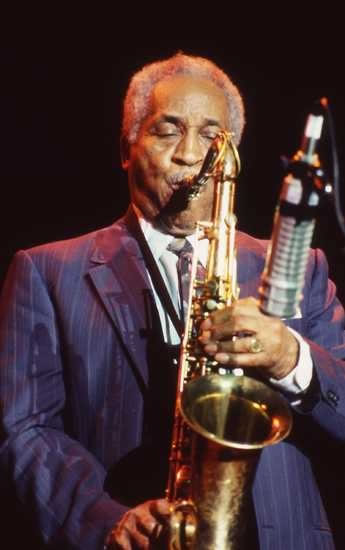
Von Freeman (MCOTD Hall of Fame), live, New Apartment Lounge, Chicago

2010


***

2008


*****

Von Freeman, who was considered one of the finest tenor saxophonists in jazz but attained wide fame only late in life, died on Aug. 11 in Chicago. He was 88.

New York Times obituary, 8/18/12

**********

lagniappe

reading table

A wounded Deer – leaps highest –

—Emily Dickinson (1830-1886), #181 (Franklin)

Thursday, January 22nd

my back pages

On this date in 1977, at a church thirty miles north of Chicago, amidst the cold and the snow and the dark, tenor saxophonist Von Freeman (1923-2012), a MCOTD Hall-of-Famer, played for a wedding. He was accompanied by pianist John Young (1922-2008). Here is how they sounded that night, as people were entering the church (0:15-, “Somewhere Over the Rainbow,” “It Never Entered My Mind,” “More”), as the bride walked down the aisle (8:00-, “In a Sentimental Mood”), and as folks were leaving (10:20-, “My Favorite Things,” “Song for My Father”).

***

Von Freeman

 pod25_fs_freeman

Wednesday, January 22nd

Thirty-seven years ago, at a church outside Chicago, my wife Suzanne and I were married. Saxophonist Von Freeman and pianist John Young played at the ceremony.* Afterward, at the nearby reception hall, this guy tickled the ivories. All three are now gone.

Blind John Davis (1913-1985), live, Canada, early ’80s

#1

***

#2

***

#3

*****

*Here’s how they sounded that night. (Give it a few seconds.)

Monday, April 8th

never enough

Von Freeman, tenor saxophone (1923-2012, MCOTD Hall of Famer); Jodie Christian (1932-2012), piano; Rufus Reid (1944-), bass; Jack DeJohnette (1942-), drums; “A Nightingale Sang in Berkeley Square” (E. Maschwitz & M. Sherwin), live, Harrisburg, Penn., 1994


**********

lagniappe

musical thoughts

Your sound is who you are; it is what makes you different from me and any other saxophonist. We all have the same 12 notes. The only thing that differentiates us, one from the other, is our tone. If you don’t have a sound you can play a thousand notes and no one will hear you, but if you have a sound you can play only one note and everyone will hear you.

Von Freeman

Sunday, January 27th

Today we welcome her to the ultra-exclusive MCOTD Hall of Fame, where she joins previous inductees Von Freeman, Wislawa Szymborska, William Bronk, and Lester Bowie.

Dorothy Love Coates, January 30, 1928-April 9, 2002

“The Accident” (Odessa Edwards, speaking), “Get Away Jordan,” “Getting Late in the Evening,” “You Must Be Born Again,” live, Los Angeles, 1955

*****

“You Must Be Born Again,” “He’s Right On Time” TV show (TV Gospel Time), early 1960s

*****

“Won’t Let Go” (AKA “I’m Just Holding On”)

*****

“Strange Man”

*****

lagniappe

reading table: two takes

The old pond— a frog jumps in, sound of water.

—Matsuo Basho (1644-1694, translated from Japanese by Robert Hass)

New pond. No sound of a frog jumping in.

—Ryokan (1758-1831, translated from Japanese by Kazuaki Tanahashi)

Tuesday, 1/22/13

soundtrack of a marriage

On my first date with Suzanne, in 1974, we went to Chicago’s Jazz Showcase (then upstairs on Lincoln, just south of Fullerton), where we saw Sun Ra & His Arkestra. With a start like that, how could one ever go wrong? When we got married, on this date in 1977, Von Freeman played at the wedding, with pianist John Young. Years later John told me: “When I marry ’em, they stay married.”

Sun Ra & His Arkestra, live, Ann Arbor Blues & Jazz Festival, 1974

*****

Von Freeman, live (with John Young, piano), “Remember,” Chicago (Jazz Showcase), New Year’s Eve 1983 (according to the clip) or 1979 (according to NPR)

**********

lagniappe

Want to hear what Von and John sounded like on that cold, snowy night thirty-six years ago, at a church north of Chicago? Here (give it a few seconds). As you’ll hear, they played before, during (the processional was Ellington’s “In A Sentimental Mood”), and after the ceremony.

Monday, 8/20/12

more Von Freeman

Live, New Apartment Lounge, 504 E. 75th St., Chicago
With Mike Allemana, guitar, Matt Ferguson, bass; Michael Raynor, drums

“Mr. P.C.” (J. Coltrane, excerpt), 11/30/04

***

“Blame It on My Youth” (O. Levant & E. Heyman), 6/8/10

**********

lagniappe

Von Freeman, who was considered one of the finest tenor saxophonists in jazz but attained wide fame only late in life, died on Aug. 11 in Chicago. He was 88.

The cause was heart failure, his son Mark said.

Though his work won him ardent admirers, Mr. Freeman, familiarly known as Vonski, was for decades largely unknown outside Chicago, where he was born and reared and spent most of his life.

As The Chicago Tribune wrote in 1998, his playing “represents a standard by which other tenor saxophonists must be judged.”

Last year, Mr. Freeman was named a National Endowment for the Arts Jazz Master, the nation’s highest honor in the field.

Not until the 1980s did he begin performing more often on famous out-of-town stages, including Alice Tully Hall and the Village Vanguard in New York. Earlier in his career Mr. Freeman had made much of his living, as he told The Tribune, playing for “strip joints, taxi dances, vaudeville shows, comedians, jugglers, weddings, bar mitzvahs, jazz clubs, dives, Polish dances, Jewish dances, every nationality.”

If he never got his big break as a young player, Mr. Freeman said, then that was because he never especially sought one.

“I’m not trying to brag or nothing, but I always knew I could play, 50, 60 years ago,” he told The Tribune in 2002. “I really don’t play any different than the way I played then. And I never let it worry me that I didn’t get anywhere famewise, or I didn’t make hit records.”

What he preferred to chasing fame, he said, was playing jazz as he felt it demanded to be played. The result, critics agreed, was music — often dazzling, occasionally bewildering — that sounded like no one else’s.

Mr. Freeman’s playing was characterized by emotional fire (he was so intense he once bit his mouthpiece clean off); a huge sound (this, he said, took root in strip clubs where the band played from behind a curtain); and singular musical ideas.

His work had a daring elasticity, with deliberately off-kilter phrasing that made it sound like speech. He cherished roughness and imperfection, although, as critics observed, he could play a ballad with the best of them.

Where some listeners faulted him for playing out of tune, others praised him for exploiting a chromatic range far greater than the paltry 12 notes the Western musical scale offers.

“Don’t tune up too much, baby,” Mr. Freeman once told a colleague. “You’ll lose your soul.”

His masterly tonal control let him summon unlovely sounds whenever he chose to, and he chose to often. His timbre has been called wheezing, honking, rasping and, in the words of Robert Palmer of The New York Times in 1982, a “billy goat tone” — a description that, as context makes clear, was not uncomplimentary.

Earl LaVon Freeman was born in Chicago on Oct. 3, 1923. (His given name was occasionally spelled Earle.)

His father was a city policeman — a highly unusual job for a black man then — whose beat included the Grand Terrace Ballroom, a storied nightclub. There, Von soaked up the music of Louis Armstrong, Fats Waller, Earl Hines and other titans of the age.

Young Von pined for a horn, and as luck would have it there was one in the house. The fact that it was attached to his father’s Victrola did not deter him, and one day when he was about 7, he pried it off, drilled holes in it and began to blow.

Deplorable sounds ensued, and his father overheard. “He picked me up, just kind of shook me, then hardly spoke to me for about a year,” Mr. Freeman later told Down Beat magazine. But if only as a deterrent, his father bought him a saxophone.

By 12, Von was playing professionally in Chicago nightclubs, reporting for work armed with a note from his mother. It read, “Don’t let him drink, don’t let him smoke, don’t let him consort with those women, and make him stay in that dressing room.”

He graduated from DuSable High School, a public school famous for its jazz program (other alumni include Nat King Cole and Dinah Washington), and entered the Navy, playing in its jazz band.

After his discharge, Mr. Freeman resumed his career, sitting in with some of the finest musicians to appear in Chicago, including Dizzy Gillespie, Charlie Parker and John Coltrane.

He was often invited to join them on the road, but he turned most offers down. He was disinclined to leave home: besides his wife and four children, he had his mother to look after. She had been widowed since Von was a young man, when his father was shot and killed in the line of duty.

In later years, Mr. Freeman played at jazz festivals throughout the United States and Europe. But despite his newfound fame, till nearly the end of his life held court each Tuesday night at the New Apartment Lounge, a small Chicago club where he had performed since the early 1980s. “Vonski’s Night School,” musicians called his sessions there, and young players came from around the world for the chance to sit in with him.

Mr. Freeman’s marriage to Ruby Hayes ended in divorce. Besides his son Mark, he is survived by another son, Chico, a prominent tenor saxophonist, and a brother, George, a jazz guitarist. Two daughters, Denise Jarrett and Brenda Jackson, died before him, as did another brother, Eldridge (known as Bruz), a drummer.

His recordings include “Doin’ It Right Now,” (1972), “Young and Foolish” (1977), “The Great Divide” (2004), “Vonski Speaks” (2009) and, with Chico, “Freeman & Freeman” (1981).

Though Mr. Freeman had not looked for it, renown, when it came, was a vindication.

“A lot of people who didn’t pay a lot of attention to me or to my music started coming around when I was heading to my 80th birthday,” he told The Tribune in 2002. “Now they were saying, ‘Well, Vonski, you’re all right after all.’ ”

Margalit Fox, New York Times, 8/19/12

Tuesday, 8/14/12

passings

Von Freeman, tenor saxophonist
October 3, 1923-August 11, 2012

Today we remember, and celebrate, Von by revisiting previous posts.

*****

9/21/10

No tenor player moves me more.

“I Can’t Get Started” (excerpt), live, Belgium, 1992

*****

“Blues for Sunnyland,” live, Germany (Berlin), 2002

*****

Live, Chicago, 2009

**********

lagniappe

Being a local legend can be a mixed bag. Consider Von Freeman, the 72-year-old tenor saxophonist who reigns as Chicago’s preeminent local jazz legend. In the 40s, he performed with bop genius Charlie Parker. In the 60s, Miles Davis tried to hire him as a replacement for John Coltrane. In the 80s, he and his son Chico, a formidable saxophonist himself, shared an album with the first family of jazz: trumpeter Wynton Marsalis, his saxophonist brother Branford, and his pianist father Ellis (Fathers and Sons, Columbia). And in the 90s, he’s performed at New York’s most prestigious concert halls–Lincoln Center and Carnegie Hall.

But legendary status can have drawbacks. It’s opened a lot of doors for Freeman, making him a familiar figure at a variety of local clubs (including the Bop Shop, the Green Mill, Pops for Champagne, and Andy’s). But appearing so often at so many places can make a performer seem as unremarkable as a crooked alderman. And the tag “legendary,” which smacks of the sort of hushed reverence usually reserved for the dead, can make a performer seem less a vital artist–one who continues to take chances–than a bloodless icon.

But Freeman is neither unremarkable nor bloodless. Hearing him live is like taking a tour of a fun house: you never know what you’ll find behind the next door.

Upon entering, the first thing you notice is that the floor seems tilted–the result of Freeman’s distinctively oblique intonation. His sour off-center tone–which occasionally prompts charges that he plays out of tune–invests the best of his performances with a hard-edged emotional intensity. When he played Charlie Parker’s “Confirmation” on a recent weekend at the Jazz Showcase, where he led a fine quintet (Brad Goode on trumpet; Joan Hickey on piano; Mendai on bass; Robert Shy on drums one night and Michael Raynor on drums the other), he bristled with energy but also sounded wounded. And when he played the ballad “Lover Man,” he conjured up a world that was unremittingly bleak.

Freeman’s improvisations take you quickly from one room to the next. Some of them, like the meowing slurs during an unaccompanied solo on the ballad “Body and Soul,” are breathtakingly strange. Others, like the wild chorus at the top of his range on Duke Ellington’s “Caravan,” offer hair-raising adventure.

Not all of his ideas are equally striking. But jazz improvisation on the order of Freeman’s is necessarily a hit-or-miss affair. As Somerset Maugham put it, only the mediocre are always at their best.

Throughout the recent performance Freeman played the role of genial host. One moment he was encouraging the bassist: “Hit it, Mendai!” The next he was indulging in Von-speak, adding the ending “-ski” to proper nouns, turning himself into “Vonski” and the Duke Ellington piece into “Caravanski.” And in another he was explaining, in a tone half mocking and half serious, the unpredictable nature of jazz: “Sometimes this horn plays and sometimes it doesn’t. I have no control over it.”

At their best, Freeman’s performances dazzle in ways all too rarely encountered in jazz these days. While the well-mannered music of many of today’s most acclaimed performers (Wynton Marsalis, Marcus Roberts) may have its appeal, it generally lacks those undomesticated virtues that Freeman’s music celebrates: daring, originality, and unpredictability. Like the man himself, Freeman’s musical values are a product of this city. He began developing them while attending DuSable High School, where–like many other Chicago-bred jazz giants, including fellow tenor saxophonists Gene Ammons, Johnny Griffin, and John Gilmore–he studied under the fabled music teacher Captain Walter Dyett. As Freeman once explained in a New York Times interview, Dyett stressed originality, preaching a message both simple and elusive: “Try and find yourself.” Even when performing classic material (Ellington, Parker, Monk), Freeman’s music sounds brand-new. The difference between him and many younger musicians who have achieved greater renown is like that between a fun house and a museum.

“Jazz Tilt-A-Whirl,” (review of Von Freeman, Jazz Showcase, 1/13-14/1995), Chicago Reader1/26/1995 (yeah, I’m cannibalizing myself here)

*****

. . . one of the most original and creative tenormen of the 1950s and, in light of other work I’ve heard by him, a great tenor player by any standards.

***

An exceptional artist, he belongs in jazz’s pantheon.

Harvey Pekar, JazzTimes, 1-2/2001

*****

2/12/11

My favorite tenor player?

A while back, I said that if I had to name my favorite alto player, there would be days where I’d say Art Pepper.

Tenor players?

Some days this’d be the guy.

Like Pepper, he has a sound that’s immediately identifiable. It’s a sound that, like Pepper’s, holds both joy and heartbreak. And like Pepper, he’s hard—no, impossible—to pigeonhole. Swing, bebop, free: the label that’s capacious enough to contain him hasn’t been invented.

Von Freeman, “Lester Leaps In,” live, Chicago (New Apartment Lounge), 2010

Vodpod videos no longer available.

*****

2/25/11

Our music is a Secret Order.

—Louis Armstrong, 1954 (John F. Zwed, Space Is The Place: The Lives And Times Of Sun Ra [1997], epigraph)

Von Freeman (tenor saxophone, with Ed Petersen, tenor saxophone; Willie Pickens, piano; Brian Sandstrom, bass; Robert Shy, drums), live, Chicago (Green Mill Lounge), 12/31/10

Vodpod videos no longer available.

*****

3/1/11

The other night, during a performance and interview at the University of Chicago, he seemed, at times, a bit frail. He’s nearing 90 and was recently in the hospital. But what I said a while back still holds true: no tenor player moves me more.

Von Freeman (tenor saxophone, with Mike Allemena, guitar; Matt Ferguson, bass; Michael Raynor, drums), “Bewitched, Bothered and Bewildered,” live, Chicago (Mandel Hall, University of Chicago), 2/24/11

Vodpod videos no longer available.

**********

lagniappe

better late, etc.

The University of Chicago recently awarded Von the Rosenberger Medal, which was established in 1917 . . . [and recognizes] achievement through research, in authorship, in invention, for discovery, for unusual public service, or for anything deemed of great benefit to humanity.” Past recipients include Toni Morrison, Pierre Boulez, and Frederick Wiseman.

*****

musical thoughts

It takes years to explain those vibrational things in verbal language. And it still might not work. One time I asked Von Freeman about his voice-leading in harmony, he’s the master of that shit. I asked him, “How did you learn that shit? You’re so fluent at it.” And he said, “Well, you know, I sat down one day and I said, let me look at this thing.” He said, “I began with one tone. I studied one tone. And I studied all that I could study about one tone.” When these old guys talk, you don’t ask too many questions. You pretty much just listen to what they say. And so, I didn’t know what he meant, but I just listened. And he said, “I worked on that for a long time, you know, for months. Just seeing what could be done with one tone. When I felt pretty good about that, I moved on to two tones. That was a bit harder. I worked a lot longer, but I worked and saw all that I could do with two tones. Then I moved to three tones, and so on. After I went on for a while I realized that you can pretty much do everything that you need to do with two tones.” That’s what he told me. I spent years thinking about this shit. Years. I’m still thinking about it, you know. I feel like I have a better handle on knowing what he meant now than then, although it is not a simple thing to explain. And when I tell the story to somebody playing in my group or something, and they ask me, “What did he mean?” it takes me literally years to explain what I think he means. And I’m sure I only have part of what he means. What it means to me. Some things, you have to explain them with a million examples over a period of time. The meaning dawns on a person and when they have to explain it it’s funny. We live in this McDonald’s type society where everybody thinks everything is just quick. It’s not like that. You have to actually build the understanding, slowly over time. So this thing that Von Freeman explained to me, it sounds like a very simple thing, but it really doesn’t make any sense at all without the experience. It’s maybe fifteen years ago that he told me, and I found it to be absolutely true. I could never explain it in one day, or in a lecture over an hour.

Steve Coleman (whose latest album was named one of the year’s ten best in the 2010 Village Voice Jazz Critics’ Poll)

*****

my back pages

No other musician, in any genre, has meant so much to me in so many ways for so many years. I first heard Von in the mid-70s, when I was in my twenties (and working for Alligator Records) and he was in his fifties. The setting, coincidentally, was the University of Chicago; he opened for Cecil Taylor. I got to know him and booked a few shows for him. In 1977, when I got married, he and pianist John Young played at our wedding ceremony. Later, when I was reviewing live jazz, I wrote a piece about him for the Chicago Reader. Over the last three decades, I’ve listened, avidly, to his growing catalog of albums and seen him live more times than I could count. He is now an old man. And I am getting there.

*****

7/28/11

A charter member of the just-announced (to excitement so deafening it’s inaudible) MCOTD Hall of Fame, he’s being celebrated tonight at a concert, in Chicago’s Millenium Park, featuring musicians who came up under him, including saxophonists Steve Coleman and Eric Alexander.

*****

rewarding the deserving

So often, it seems, when arts awards are announced, my initial reaction is: “Huh?” Not this time. The National Endowment of the Arts just announced their 2012 Jazz Masters Awards, which recognize, with Lifetime Honors“living musicians for career-long achievement.” And the winners are Jack DeJohnette, Jimmy Owens, Charlie HadenSheila Jordan, and Von Freeman.

*****

1/22/12

my back pages

Thirty-five years ago tonight—how could I possibly begin a sentence “thirty-five years ago tonight” and be referring to something that happened when I was, at least nominally, an adult? Well, this actually happened that night so I guess it must be possible. On that cold, clear January night, at a small church thirty miles north of Chicago, Suzanne and I were married. Yes, there was music. Tenor saxophonist Von Freeman and pianist John Young (now gone) played before and after the ceremony. The processional was Duke Ellington’s “In a Sentimental Mood,” played by Von alone. What did all this sound like? Thanks to my friend (and ace recording engineer) James C. Moore, these sounds can be heard, thirty-five years later, here (M4A—give it a few seconds).

*****

1/23/12

This year, as I’ve mentioned before, Von was awarded, along with bassist Charlie Haden, singer Sheila Jordan, trumpeter Jimmy Owens, and drummer Jack DeJohnette, an NEA (National Endowment of the Arts) Jazz Masters Fellowship—the highest honor that our nation bestows on jazz artists. Here’s the NEA’s video tribute.

*****

5/3/12

Weary of words?

You’ve come to the right place.

These guys take you places words don’t go.

Von Freeman,* tenor saxophone; Clifford Jordan, tenor saxophone (first solo); Willie Pickens, piano; Dan Shapera, bass; Robert Shy, drums; “Oleo” (S. Rollins), live, Chicago (Chicago Jazz Festival), 1988

*MCOTD Hall of Fame (Charter Member).

Tuesday, 7/31/12

Lester Bowie’s Brass Fantasy (LB, trumpet; Malachi Thompson, trumpet; Steve Turre, trombone; Phillip Wilson, drums, et al.), “I Only Have Eyes For You” (H. Warren & A. Dubin), 1984

**********

lagniappe

this just in

Lester Bowie, whose singular playing and presence have often been celebrated here,* has just been inducted, posthumously, into the ultra-exclusive MCOTD Hall of Fame, joining tenor saxophonist Von Freeman and poets Wislawa Szymborska and William Bronk.

*****

*Here (Art Ensemble of Chicago). Here (with Digable Planets). Here (Lester Bowie’s Brass Fantasy). Here (Art Ensemble of Chicago). Here (with Sun Ra All Stars). And here (Lester Bowie Brass & Steel Band).

Wednesday, 7/4/12

 rock ’n’ roll

 country

 gospel

 blues

 jazz

A world without American music: what would it sound like?

The Blasters, “American Music,” Champaign, Ill., 1985

(Originally posted 7/5/10.)

*****

Merle Haggard, “Lonesome Fugitive,” Buck Owens Ranch Show, 1966

(Originally posted 4/6/12.)

*****

Slim and the Victory Aires, “Alright Now,” Paducah, Ky., 2008

(Originally posted 3/11/12)

*****

Johnny Shines (1915-1992), vocals, guitar; David “Honeyboy” Edwards (1915-2011), guitar; Big Walter Horton (1917-1981), harmonica; “For The Love of Mike,” 1978

(Originally posted 10/4/11.)

*****

Von Freeman, tenor saxophone; Clifford Jordan, tenor saxophone (first solo); Willie Pickens, piano; Dan Shapera, bass; Robert Shy, drums; “Oleo” (S. Rollins), Chicago (Chicago Jazz Festival), 1988

(Originally posted 5/3/12.)

**********

lagniappe

radio

All Pops, all day:

Tune in on July 4th, Independence Day . . . as we celebrate the professed (although according to historians, not actual) birthday of Jazz great and American Hero, the trumpeter and vocalist Louis Armstrong, by playing 24 hours straight of his music, from midnight to midnight.

WKCR-FM (broadcasting from Columbia University)

*****

encore*

Dave Alvin with the Blasters, “4th of July,” Berwyn, Ill. (Fitzgerald’s), 2010

*By popular demand (see Comments).