Here’s a very different piece by Steve Reich—one I first heard, in a New York performance by Reich’s ensemble, 40 years ago. At the time, the only way he could get his music heard was to play it himself.
Steve Reich, Drumming (1971), excerpts
So Percussion, live, Baltimore (Johns Hopkins University), c. 2009
Vodpod videos no longer available.
*****
Steve Reich (wearing cap) with members of Ensemble Modern
Live, Germany (Cologne), 2009
Steve Reich, Bang on a Can All-Stars (Robert Black, bass; David Cossin, drums; Evan Ziporyn, piano; Bryce Dessner & Derek Johnson, guitars)
Rehearsal, 2×5 (S. Reich), 2009
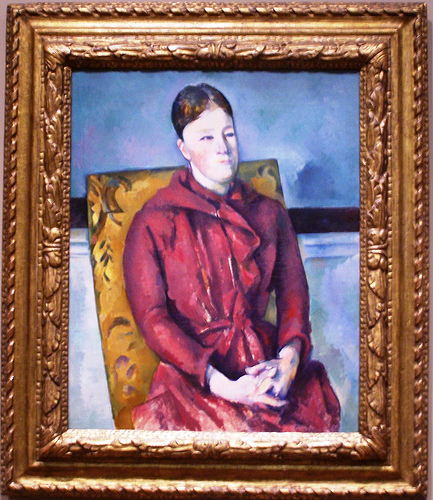
Paul Cezanne, Madame Cezanne in a Yellow Chair, 1888-90
***
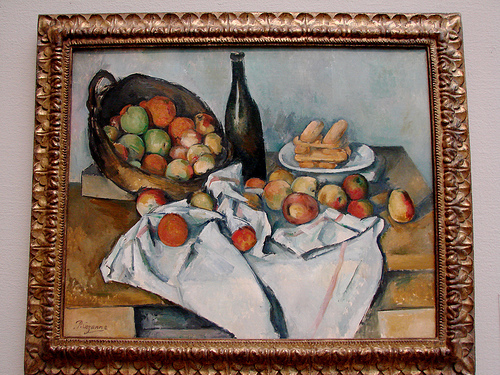
Here’s what’s on its right.
Paul Cezanne, The Basket of Apples, c. 1893
***
And here’s what’s on the adjacent wall.
Paul Cezanne, Harlequin, 1888-90
(on loan from the National Gallery of Art, Washington, D.C.)
***
I still work with difficulty, but I seem to get along. That is the important thing to me. Sensations form the foundation of my work, and they are imperishable, I think. Moreover, I am getting rid of that devil who, as you know, used to stand behind me and forced me at will to “imitate”; he’s not even dangerous any more.
—Paul Cezanne (last letter to his son Paul, dated October 15, 1906, a week before his death; quoted in Ambroise Vollard, Cezanne)
*****
Art ______ of Chicago
In the department of duh, after decades of going there and decades of listening to them, I’ve just noticed the verbal similarity between the Art Institute of Chicago and the Art Ensemble of Chicago.
The notes are easy enough to replicate—the touch impossible.
Pinetop Perkins (piano, vocals), July 7, 1913-March 21, 2011
“Grindin’ Man” (with Willie “Big Eyes” Smith, harmonica), live, New Jersey (New Brunswick), 2008
Vodpod videos no longer available.
*****
“How Long Blues,” live
Vodpod videos no longer available.
**********
lagniappe
He was one of the last great Mississippi Bluesmen. He had such a distinctive voice, and he sure could play the piano. He will be missed not only by me, but by lovers of music all over the world.
—Red Paden, owner of Red’s Blues Club, Clarksdale, Mississippi
*****
my back pages
Many years ago I had the pleasure of working with him, co-producing his tracks on Living Chicago Blues, Vol. 2(Alligator 1978). Warm, amiable, unassuming—he was easy to like.
*****
listening room: what’s playing
• Ornette Coleman, Town Hall 1962
• Mos Def, The Ecstatic
• Lupe Fiasco, Lasers
• Steve Reich, Double Sextet, 2×5
• Rudresh Mahanthappa & Bunky Green, Apex
• Nneka, Concrete Jungle
• Theo Parrish, Sound Sculptures, Vol. 1
• Powerhouse Gospel On Independent Labels, 1946-1959
Excerpt, recording (Grand Valley State University New Music Ensemble)
*****
Part 3
Excerpt (ending), live, Tokyo, 2008
*****
I first encountered Steve Reich’s music in 1971, while in college and living for a few months in New York. At a concert at New York University, I heard Reich and his ensemble perform his then-new piece “Drumming.” Stunning, mesmerizing, it was unlike anything my 19-year-old ears had ever heard.
**********
lagniappe
The other day, I watched as Steve Reich walked away from Carnegie Hall, where celebrations of his seventieth birthday were under way, and out into his native city. Trim and brisk, he darted into West Fifty-seventh Street, fell back before oncoming traffic, bopped impatiently in place, then darted forth again. He soon disappeared into the mass of people, his signature black cap floating above the crowd. Perhaps I should have lamented the fact that one of the greatest living composers was moving around New York unnoticed, but lamentation is not a Reichian state of mind, and I thought instead about how his work has blended into the cultural landscape, its repeating patterns and chiming timbres detectable all over modern music. Brian Eno, David Bowie, David Byrne, and a thousand d.j.s have paid him heed. On Fifty-seventh Street, Reich-inflected sounds may have been coursing through the headphones of a few oblivious passersby.
Three decades ago, New York’s leading institutions would have nothing to do with Reich. A riot broke out when Michael Tilson Thomas presented “Four Organs” at Carnegie in 1973: one woman tried to stop the concert by banging on the edge of the stage with her shoe. Now uptown is lionizing the longtime renegade.
***
Reich changed music, and he also changed how music relates to society. In the face of early incomprehension, he took a do-it-yourself approach to getting his work before the public. Nonclassical musicians were among his models: he saw John Coltrane some fifty times, and marvelled at how the great man would unleash mind-bending sounds, pack up his sax, and disappear into the night. With his namesake ensemble, Reich performed in galleries, clubs, and wherever else he felt welcome. The effects of this paradigm shift can be seen on any day of the week in New York, as composer-led ensembles proliferate.
***
The Reich ensemble retains most of its original members, and they remain an awesome force, even as shaggy hairdos have given way to dignified shocks of white. At Zankel Hall, they played Part I of “Drumming,” a phase-shifting tour de force in which bongos are struck with sticks. I was curious to see how they would compare with two sharp young ensembles who had performed the same stretch of music in recent weeks—So Percussion, at Symphony Space, and four Juilliard percussionists, at Carnegie. The youngsters drummed with effortless grace, as if the score were written into their genetic code. But the veterans more than held their own, bringing to bear a kind of disciplined wildness, in the spirit of the Ghanaian drummers with whom Reich studied before he wrote the piece. The energy that blazed up at climactic moments could have powered the hall in a blackout.


 music clip of the day