This arrived yesterday, in response to an email letting her know that she was featured here (with Hazel Dickens):
Thanks for letting me know about this. We said goodbye to Hazel yesterday and singing was never more difficult. She was my musical guide and my beloved friend. Smart, funny, complicated, always real. She’ll live in my music, and my life, forever. “Fly away, Little Pretty Bird.”
Yesterday we heard music of “nostalgia” and “homesickness,” of “loneliness” and “separation,” from Mali. Today it comes from West Virginia.
Hazel Dickens, singer, songwriter
June 1, 1925-April 22, 2011
Live, with Ginny Hawker, vocals, and Tracy Schwartz, fiddle
“West Virginia My Home” (H. Dickens), Kentucky (Morehead State University), 2008
Vodpod videos no longer available.
***
“I Love To Sing The Old Songs” (H. Dickens), 2008
Vodpod videos no longer available.
**********
lagniappe
Hazel Dickens, a clarion-voiced advocate for coal miners and working people and a pioneer among women in bluegrass music, died on Friday in Washington. She was 75.
The cause was complications of pneumonia, said Ken Irwin, her longtime friend and the founder of Rounder Records, her label for more than four decades.
Ms. Dickens’s initial impact came as a member of Hazel and Alice, a vocal and instrumental duo with Alice Gerrard, a classically trained singer with a passion for the American vernacular music on which Ms. Dickens was raised. Featuring Ms. Dickens on upright bass and Ms. Gerrard on acoustic guitar, Hazel and Alice toured widely on the folk and bluegrass circuits during the 1960s and ’70s, captivating audiences with their bold, forceful harmonies and their empathetic approach to songs of struggle and heartbreak.
***
The influence of the staunchly traditional duo extended beyond bluegrass to commercial country music. Hazel and Alice’s arrangement of the Carter Family’s “Hello Stranger” became the blueprint for Emmylou Harris’s version of the song, and their adaption of “The Sweetest Gift (A Mother’s Smile)” inspired Naomi Judd, then a single mother in rural Kentucky, to start singing with her daughter Wynonna.
***
Hazel Jane Dickens was born June 1, 1935, in Mercer County, W.Va. One of 11 children, she grew up in a family whose survival depended on the coal industry. Her father, a Primitive Baptist preacher and a forceful singer, hauled timber to feed the household. Her brothers were miners and one of her sisters cleaned house for a supervisor at the mines. The music they sang in church and heard on the radio, particularly the music of the Grand Ole Opry in Nashville, offered one of their few diversions.
She moved to Baltimore in the early 1950s and worked in factories there. City living was hardly more prosperous than the life she’d known in the coal fields of Mercer County, but it did afford her exposure to the larger social and political world. She met and started playing music with the singer and folklorist Mike Seeger, who eventually introduced her to Ms. Gerrard.
***
A reluctant feminist role model, Ms. Dickens said she was originally scared to write about issues like sexism and the oppression of women.
“I can remember the first time I sang ‘Don’t Put Her Down, You Helped Put Here There,’ ” she said in her 1999 No Depression interview. “I was at a party standing in the middle of all these men. It was here in Washington. Bob Siggins was playing banjo, and when I got done, everyone just looked at each other, and Bob said, ‘That’s a nice song, but I won’t be able to sing it.’ And I said, ‘Of course you can.’ ”
“We were writing about our own experience,” she explained. “They were things we needed to say.”
The desert is where I feel the most comfortable, the most at ease, the most relaxed. It’s also where I’m inspired to create music. To be honest, I don’t like spending too long away from the desert now. Well, that’s to say, I still like touring and travelling and seeing different parts of the globe, but I also like to be at home. And in the desert there are a lot of people who can help us . . . by hiring us a house, by cooking, by playing music with us. We can’t take all those people with us if we go and record in Bamako or Paris.
***
Assouf means nostalgia, homesickness. We’ve all felt it a lot, ever since the time of exile began after the first [Tuareg] rebellion in 1963. It’s the feeling that is most important in our music. But it also means other things. It’s like a pain that you can’t see and can’t touch, a pain that lives in your heart. It means loneliness and separation too. When I was living in Algeria and Libya in the 1980s and 1990s I felt assouf a lot, and that’s when I wrote a lot of the songs I play today.
***
In the desert, everybody is always moving. That’s our culture. It’s very very hard sometimes to get together, or to stay in the same place. We need our freedom. So Tinariwen has survived because really almost every Tamashek musician in the northeast of Mali or the south of Algeria is part of Tinariwen. And if just two of them come together to sing our songs, that’s enough for it to be Tinariwen. In the past, that’s how our concerts happened. Hassan and Abdallah might perform in Bamako or Abidjan while I was hundreds of miles away in Tamanrasset or someplace. So I know that some people have been frustrated for example when I haven’t been present on stage in America. But that’s how Tinariwen has always been, loose and flexible. Otherwise we could never survive.
Here one of the greatest American artists of the 20th century (composer Morton Feldman [1926-1980]) pays homage to another (painter Mark Rothko [1903-1970]).
Morton Feldman, Rothko Chapel (composed in 1971; first performed, at Houston’s Rothko Chapel, in 1972)
. . . The example of the painters was crucial. Feldman’s scores were close in spirit to Rauschenberg’s all-white and all-black canvases, Barnett Newman’s gleaming lines, and, especially, Rothko’s glowing fog banks of color. His habit of presenting the same figure many times in succession invites you to hear music as a gallery visitor sees paintings; you can study the sound from various angles, stand back or move up close, go away and come back for a second look. Feldman said that New York painting led him to attempt a music ‘more direct, more immediate, more physical than anything that had existed heretofore.’ Just as the Abstract Expressionists wanted viewers to focus on paint itself, on its texture and pigment, Feldman wanted listeners to absorb the basic facts of resonant sound. At a time when composers were frantically trying out new systems and languages, Feldman chose to follow his intuition. He had an amazing ear for harmony, for ambiguous collections of notes that tease the brain with never-to-be-fulfilled expectations. Wilfrid Mellers, in his book ‘Music in a New Found Land,’ eloquently summed up Feldman’s early style: ‘Music seems to have vanished almost to the point of extinction; yet the little that is left is, like all of Feldman’s work, of exquisite musicality; and it certainly presents the American obsession with emptiness completely absolved from fear.’ In other words, we are in the region of Wallace Stevens’s ‘American Sublime,’ of the ’empty spirit / In vacant space.’
***
If there is a Holocaust memorial in Feldman’s work, it is ‘Rothko Chapel,’ which was written in 1971, for Rothko’s octagonal array of paintings in Houston. Rothko had committed suicide the previous year, and Feldman, who had become his close friend, responded with his most personal, affecting work. It is scored for viola, solo soprano, chorus, percussion, and celesta. There are voices, but no words. As is so often the case in Feldman’s music, chords and melodic fragments hover like shrouded forms, surrounded by thick silence. The viola offers wide-ranging, rising-and-falling phrases. The drums roll and tap at the edge of audibility. Celesta and vibraphone chime gentle clusters. There are fleeting echoes of past music, as when the chorus sings distant, dissonant chords reminiscent of the voice of God in Schoenberg’s ‘Moses und Aron,’ or when the soprano sings a thin, quasi-tonal melody that echoes the vocal lines of Stravinsky’s final masterpiece, the ‘Requiem Canticles.’ That passage was written on the day of Stravinsky’s funeral, in April, 1971—another thread of lament in the pattern. But the emotional sphere of ‘Rothko Chapel’ is too vast to be considered a memorial for an individual, whether it is Rothko or Stravinsky.
Shortly before the end, something astonishing happens. The viola begins to play a keening, minor-key, modal song, redolent of the synagogue. Feldman had written this music decades earlier, during the Second World War, when he was attending the High School of Music and Art, in New York. Underneath it, celesta and vibraphone play a murmuring four-note pattern, which calls to mind a figure in Stravinsky’s ‘Symphony of Psalms.’ The song unfurls twice, and the chorus answers with the chords of God. The allusions suggest that Feldman is creating a divine music, appropriate to the sombre spirituality of Rothko’s chapel. In a sense, he is fusing two different divinities, representative of two major strains in twentieth-century music: the remote, Hebraic God of Schoenberg’s opera, and the luminous, iconic presence of Stravinsky’s symphony. Finally, there is the possibility that the melody itself, that sweet, sad, Jewish-sounding tune, speaks for those whom Feldman heard beneath the cobblestones of German towns. It might be the chant of millions in a single voice.
But I can almost hear Feldman speaking out against this too specific reading. At a seminar in Germany in 1972, he was asked whether his music had any relationship to the Holocaust, and he said no. He was a hard-core modernist to the end, despite his sensualist tendencies, and he did not conceive of art a medium for sending messages. It was probably in reaction to the communicative power of ‘Rothko Chapel’ that he later dismissed it, unbelievably, as a minor work. But in that German seminar he did say, in sentences punctuated by long pauses, ‘There’s an aspect of my attitude about being a composer that is like mourning. Say, for example, the death of art . . . something that has to do with, say, Schubert leaving me.’ He also admitted, ‘I must say, you did bring up something that I particularly don’t want to talk about publicly, but I do talk privately.’
Only this one time, in the last minutes of ‘Rothko Chapel,’ did Feldman allow himself the consolation of an ordinary melody. Otherwise, he held the outside world at bay. Yet he always showed an awareness of other possibilities, a sympathy for all that he chose to reject. Listening to his music is like being in a room with the curtains drawn. You sense that with one quick gesture sunlight could fill the room, that life in all its richness could come flooding in. But the curtains stay closed. A shadow moves across the wall. And Feldman sits in his comfortable chair.—Alex Ross (NewYorker, 6/19/06)
Take Me To The Water:
Immersion Baptism in Vintage Music and Photography 1890-1950
(Dust-to-Digital 2009)
Vodpod videos no longer available.
**********
lagniappe
reading table
Three Lilies
“Weeping may endure for a night, but joy cometh in
the morning.” Psalm 30
Before dawn, under a thin moon disappearing
east, the planet Mercury, the messenger
and healer, came up vanishingly
into the blue beyond the garden where
three lilies at the bottom of the yard
arrayed white trumpets on iron stalks
under a slow, slow lightning from the sun.
I stood on a rotten step myself,
and smelled them from a hundred feet away.
Steve Reich, Bang on a Can All-Stars (Robert Black, bass; David Cossin, drums; Evan Ziporyn, piano; Bryce Dessner & Derek Johnson, guitars)
Rehearsal, 2×5 (S. Reich), 2009
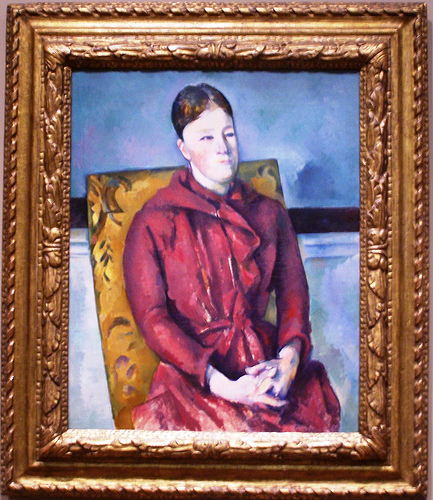
Paul Cezanne, Madame Cezanne in a Yellow Chair, 1888-90
***
Here’s what’s on its right.
Paul Cezanne, The Basket of Apples, c. 1893
***
And here’s what’s on the adjacent wall.
Paul Cezanne, Harlequin, 1888-90
(on loan from the National Gallery of Art, Washington, D.C.)
***
I still work with difficulty, but I seem to get along. That is the important thing to me. Sensations form the foundation of my work, and they are imperishable, I think. Moreover, I am getting rid of that devil who, as you know, used to stand behind me and forced me at will to “imitate”; he’s not even dangerous any more.
—Paul Cezanne (last letter to his son Paul, dated October 15, 1906, a week before his death; quoted in Ambroise Vollard, Cezanne)
*****
Art ______ of Chicago
In the department of duh, after decades of going there and decades of listening to them, I’ve just noticed the verbal similarity between the Art Institute of Chicago and the Art Ensemble of Chicago.
Charles Mingus, bassist, bandleader, composer
April 22, 1922-January 5, 1979
In celebration of Mingus’s birthday, WKCR-FM (broadcasting from Columbia University) is playing his music all day. We’re celebrating by revisiting some favorite clips.
**********
Duke Ellington, Count Basie, Miles Davis: so many of the greatest figures in jazz weren’t just great musicians, or composers, or arrangers. They were great bandleaders. As important to their artistic success as anything else was their ability to find, and showcase, players who could make the music come alive—people like Johnny Hodges and Ben Webster and Jimmy Blanton and Lester Young and Freddie Green and Jo Jones and John Coltrane and Bill Evans and Tony Williams.
That small circle of elite bandleaders includes this man. He hired musicians who played their instruments like no one else (Eric Dolphy, Jaki Byard, et al.). He gave them a musical setting in which structure and freedom were exquisitely balanced. And together they made music that sounds (even on something familiar) like nothing else.
Charles Mingus Sextet (with Johnny Coles, trumpet; Jaki Byard, piano; Eric Dolphy, alto saxophone and bass clarinet; Clifford Jordan, tenor saxophone; Dannie Richmond, drums), “Take the A Train,” live, Norway (Oslo), 1964
**********
lagniappe
I nominate Charles Mingus one of America’s greatest composers—Ran Blake (in the liner notes to his recent album Driftwoods)
(Originally posted 12/1/09.)
**********
No jazz composer since Thelonious Monk has a stronger voice.
Lyrical beauty, inexhaustible drive, deep feeling: what more could you ask for?
Charles Mingus Quintet (CM, bass; Dannie Richmond, drums; Eric Dolphy, alto saxophone, bass clarinet; Clifford Jordan, tenor saxophone; Jaki Byard, piano), live (TV broadcast), Belgium, 1964
“So Long, Eric”
*****
“Peggy’s Blue Skylight”
*****
“Meditations on Integration” (excerpt)
**********
lagniappe
. . . [Mingus’s] music was pledged to the abolition of all distinctions: between the composed and the improvised, the primitive and the sophisticated, the rough and the tender, the belligerent and the lyrical.—Geoff Dyer, But Beautiful: A Book About Jazz (1996)
*****
Making the simple complicated is commonplace; making the complicated simple, awesomely simple, that’s creativity.
***
I, myself, came to enjoy the players who didn’t only just swing but who invented new rhythmic patterns, along with new melodic concepts. And those people are: Art Tatum, Bud Powell, Max Roach, Sonny Rollins, Lester Young, Dizzy Gillespie and Charles Parker, who is the greatest genius of all to me because he changed the whole era around.
***
In my music, I’m trying to play the truth of what I am. The reason it’s difficult is because I’m changing all the time.
I’ve heard, mainly through my (19-year-old) son Luke, more hip-hop tracks celebrating weed (and other stuff) than I could count. Here’s a different take.


 music clip of the day