Sometimes the groove is so deep and so wide and so relaxed that, even if someone’s talking over it in a language you don’t understand at all, you just want to lie down in it and stay there.
You don’t have to go to Chicago’s south or west sides to hear music that comes from the gospel tradition. The other day, at a Catholic church in a far northwest suburb (Barrington), a funeral service (for my uncle) closed with this.
Thomas A. Dorsey (1899-1993), “Precious Lord,” live, c. 1981 (Say Amen, Somebody [1982])
**********
lagniappe
More from Mr. Dorsey (and Say Amen, Somebody):
*****
Since it’s the best-known gospel song [‘Precious Lord’], it was perfectly natural for Dr. Martin Luther King to request its performance the night of his death.
—Anthony Heilbut, The Gospel Sound: Good News and Bad Times (6th ed. 2002)
*****
Want more gospel?
Here’s the theme song for one of my favorite radio shows, Kevin Nutt’s Sinner’s Crossroads (WFMU-FM), which can be heard liveon Thursday night from 7-8 p.m. (EST) or at the archives anytime.
(This comes from The Widow’s Might, a DVD containing [in mp3 format] every song played on Sinner’s Crossroads in 2009, which is available as a premium for a $75 pledge to WFMU.)
Jenny said when she was just five years old
There was nothin’ happening at all
Every time she puts on the radio
There was nothin’ goin’ down at all
Not at all
Then one fine mornin’, she puts on a New York station
You know, she couldn’t believe what she heard at all
She started shakin’ to that fine, fine music
You know, her life was saved by rock and roll . . .
These guys sounded awfully good the other day—let’s hear some more.
Trombone Shorty and Orleans Avenue, “Orleans & Claiborne,” live, New Orleans, 2010
There are a lot of things to like about this performance. One is the way Shorty, following two hot solos (tenor, baritone), doesn’t try to out-blow those guys. Instead, he changes directions (3:20). Sometimes nothing packs more punch than restraint. (Yeah, I don’t know why this clip cuts off when it does, either.)
Soon I’ll be leaving for a funeral—my uncle, Hugh Frebault. Nine days ago we sat and talked and laughed for over an hour; now he’s silent. Does life get any more understandable as you get older? I don’t think so—if anything, it seems to become only more mysterious, more unfathomable.
Blind Willie Johnson, “Dark Was The Night – Cold Was The Ground” (1927, Dallas)
Suppose you could listen to only one for the rest of your life.
Which would you choose?
Tristan Murail (1947-), “L’Espirit de Dunes” (1993-94)/Bent Frequency, Robert Ambrose conducting; live, Georgia (Morrow), 2006
Part 1
*****
Part 2
**********
lagniappe
Our conception of music is held prisoner by our education. All has been cut into slices, put into categories, classified, limited. There is a conceptual error from the very beginning: the composer does not work with 12 notes, x rhythmic figures, x dynamic markings, all infinitely permutable–he works with sound and timbre. Sound has been confused with its representations . . .
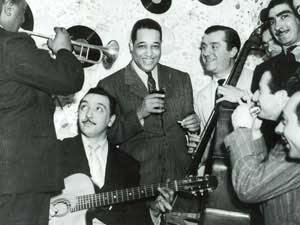
In embracing music from another continent, this guy—a Gypsy born in Belgium who grew up near Paris—was way ahead of his time.
Django Reinhardt, January 23, 1910-May 16, 1953
Quintette du Hot Club de France
Live, “J’attendrai Swing,” 1939
*****
Live, “Echoes of France,” 1945
It’s something of a miracle that Django was able, physically, to make music at all. When he was eighteen, his left hand was badly injured in a fire, leaving his fourth and fifth fingers permanently curled toward the palm.
**********
lagniappe
Jazz attracted me because in it I found a formal perfection and instrumental precision that I admire in classical music, but which popular music doesn’t have.—Django Reinhardt
Part of the job of a musician is that of a messenger. If you ain’t ready to be a messenger, forget it. You need to get a job in the post office or somewhere. If you ain’t ready to travel, pack up your family, or pack up yourself and hit the road, you’re in the wrong business. Because that’s what music is about. It’s about spreading knowledge and education, and re-education. It’s about spreading. You have got to travel with it to spread the word. Like all the people in the past that have had to travel to spread the music.
*****
It’s life itself that this [music] is about.
—Lester Bowie (in George E. Lewis, A Power Stronger Than Itself: The AACM and American Experimental Music[2008])