Thursday, 11/1/12
Forget harps—my heaven’s full of string quartets.
Franz Schubert, String Quartet No. 14 in D minor (“Death and the Maiden,” 1824), excerpt (mvt. 2), Takacs Quartet, live, Scotland (outside Edinburgh), 1998
Forget harps—my heaven’s full of string quartets.
Franz Schubert, String Quartet No. 14 in D minor (“Death and the Maiden,” 1824), excerpt (mvt. 2), Takacs Quartet, live, Scotland (outside Edinburgh), 1998
The last band I heard with this lineup—trumpet, violin, accordion, bass—was, uh, let’s see . . .
Dave Douglas (trumpet), Charms of the Night Sky*
Live, Germany (Frankfurt), 1999
#1
***
#2
***
#3
***
#4
**********
lagniappe
musical thoughts
I am moved by more music now than I have ever been. Trying to see it from a wider and deeper perspective only makes it clear that the lake itself is wider and deeper than we thought.
—David Byrne, How Music Works (2012)
*****
*With Mark Feldman (violin), Guy Klucevsek (accordion), Greg Cohen (bass).
fasten your seatbelt
Here’s another take on a piece we listened to the other day.
Alfred Schnittke (1934-98), Concerto Grosso No. 1 (excerpt); A Far Cry with guests Nelson Lee (violin), Meg Freivogel (violin), and Andrus Masden (harpsichord, prepared piano); live, Boston, 2009
(This entire performance can be heard here.)
street music: outskirts of Tehran
Violinist, c. 2009
Alfred Schnittke (1934-98), Concerto Grosso No. 1, live, Russia, 2004
Kremerata Baltica (Gidon Kremer & Tatiana Grindenko, violins)
**********
lagniappe
musical thoughts
What do we want from music—a mirror or a window?
riveting
Anton Bruckner (1824-96), Symphony No. 5 in B flat major; Berlin Philharmonic (Wilhelm Furtwangler, cond.), live, Berlin, 1942
(Yeah, I realize this performance took place in Nazi Germany during World War II and, no, I don’t have anything profound, or even interesting, to say about how such beauty and such horror could coexist.)
Sometimes more is more.
Anton Bruckner (1824-96), Symphony No. 8 in C minor; Vienna Philharmonic (Herbert von Karajan, cond.), live, Austria (Abbey of St. Florian), 1979
**********
lagniappe
musical thoughts
Once upon a time, before the human attention span began to shrink, people could actually sit still and pay attention to something—a single thing—for over an hour.
Happy (100th) Birthday, John!
John Cage, composer, September 5, 1912-August 12, 1992
Today, celebrating his centennial, we revisit past clips.
*****
10/9/09
No matter where you are, this landscape is just around the corner.
John Cage (1912-1992), In a Landscape (1948); Stephen Drury, piano
**********
lagniappe
musical thoughts
Music is a means of rapid transportation.
***
What I’m proposing, to myself and other people, is what I often call the tourist attitude—that you act as though you’ve never been there before. So that you’re not supposed to know anything about it. If you really get down to brass tacks, we have never been anywhere before.
***
As far as consistency of thought goes, I prefer inconsistency.
—John Cage
*****
5/22/10
Here’s a piece that sounds different every time you hear it.
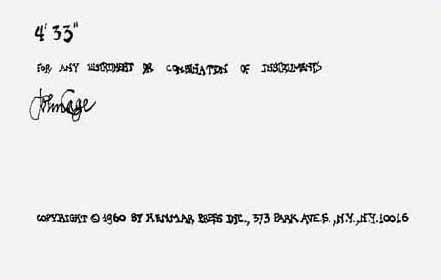
John Cage, 4’ 33” (1952); David Tudor, piano
lagniappe
***

*****
musical thoughts
I didn’t wish it [4′ 33″] to appear, even to me, as something easy to do or as a joke. I wanted to mean it utterly and be able to live with it.
***
Until I die there will be sounds. And they will continue following my death. One need not fear about the future of music.
—John Cage
*****
3/8/12
John Cage, Two (1987)
Live, Netherlands (Amsterdam), 2009
Dante Boon (piano), Rutger van Otterloo (soprano saxophone)
*****
Recording, 1991 (hat Art)
Marianne Schroeder (piano), Eberhard Blum (flute)
**********
lagniappe
musical thoughts
Every something is an echo of nothing.
—John Cage, Silence (1961)
*****
7/23/12
Monday, n. the day the weekly tide of confusion rolls in.
How about something simple?
John Cage (1912-1992), Six Melodies (for violin and keyboard; dedicated to Josef & Anni Albers), 1950; Annelie Gahl (violin) & Klaus Lang (electric piano), 2010
*****
lagniappe (new stuff)
radio
Today it’s all Cage all day at WKCR-FM.
***
art beat: more from Sunday’s stop at the Art Institute of Chicago
Agnes Martin, Untitled #12, 1977 (detail)

***
another birthday, closer to home
Today also marks the birthday of MCOTD—our third.
You don’t need to be asleep to be lost in a dream.
Maurice Ravel, Piano Concerto in G Major (1929-31); Martha Argerich, piano; Orchestre National de France (Charles Dutoit, cond.); live, Germany (Frankfurt), 1990
timeless
Sly and the Family Stone
“Thank You (Falettinme Be Mice Elf Again),” TV Show (Soul Train), 1974
*****
“In Time,” Fresh, 1973
Jazz legend Miles Davis was so impressed by the song “In Time” . . . that he made his band listen to the track repeatedly for a full 30 minutes. Composer and music theorist Brian Eno cited Fresh as having heralded a shift in the history of recording, “where the rhythm instruments, particularly the bass drum and bass, suddenly [became] the important instruments in the mix.”
**********
lagniappe
art beat: more from Tuesday’s stop at the Art Institute of Chicago
Roy Lichtenstein, Landscape in Fog (1996)

 music clip of the day