music clip of the day

jazz/blues/rock/classical/gospel/more

Category: viola

Thursday, 7/14/11

two takes

Arvo Pärt, Cantus in Memoriam Benjamin Britten (1977)

A Far Cry, live, Boston (Jordan Hall), 10/17/08

Vodpod videos no longer available.

***

BBC Symphony Orchestra, live, London (Royal Albert Hall), 8/17/10

Vodpod videos no longer available.

This goes, and goes, and goes, keeping you afloat, carrying you along,
then stops with stunning suddenness—is any music more lifelike?

Thursday, 6/30/11

two questions

1. Why would anyone create a piece of music that lasts not one, or two, or three, or four, or five, but six hours?

2. Why don’t more more people?

Morton Feldman, String Quartet No. 2 (1983), excerpts, Flux Quartet

***

On June 12th the Flux Quartet performed this piece in Philadelphia, the finale of American Sublime, a festival devoted to Feldman’s late music. The concert, which took place in the sanctuary of Philadelphia Cathedral, began at 2 p.m.; it ended around 8 p.m. The program notes said: “Audience may come and go as they please.”

More? Here. And here. And here. And here. And here.

**********

lagniappe

this & that

I don’t win stuff. I don’t even enter things—contests, sweepstakes, lotteries—that would give me a shot at winning stuff. Until yesterday, that is.

Yesterday morning, driving home after dropping my son Luke off at work (7 a.m. can be a pretty brutal starting time for a 20-year-old), I was listening, as I often do while driving, to our local public radio station (WBEZ-FM), which, I learned, was in the midst of a fundraising drive. “Pledge,” they said, and “you’ll be entered in drawings for an iPad 2,” which were going to be made throughout the day. The earlier you pledge, they said, with what seemed unassailable logic, the better your chances of winning. I hadn’t sent them any money in a while so, when I got home, I went on-line and pledged. A couple hours later, a friend sent me an email: “Congratulations on your iPad.”

When bad stuff happens, particularly bad stuff that’s unexpected and outside my control (as often seems to be the case), my tendency is to try to let it go. Why invest bad experiences with ill-fitting, after-the-fact meanings? This is different. This experience I’d like to invest with all kinds of after-the-fact-meanings, ill-fitting or not. I’d like to see this as a favorable omen, one that portends all sorts of wonderful stuff—things that, at the moment, I can’t even begin to imagine. Goofy? Yeah, I suppose. But is it any nuttier than any number of other stories we tell ourselves to get us through the day?

Monday, 6/6/11

sui generis, adj. A person or thing that is unique, in a class by itself. E.g., Anthony Braxton, composer, reed player, professor, MacArthur “genius” grant winner, one-time professional chess hustler.

Happy (Belated 66th) Birthday, Anthony!
(born June 4, 1945)

Anthony Braxton with his 12+1tet, Ghost Trance Music
New York (Iridium), 2008

Vodpod videos no longer available.

**********

lagniappe

musical thoughts

I wanted to live. I wanted to be alive. This experience goes by very quickly. Part of the radiance of a moment, in my opinion, involves that which we call music.

***

Suddenly, Coltrane solos become the “it” of music, when in fact, the records and the notated solos are the sonic footprints, the bone structure of what actually happened in the music.

***

I wanted a system that would be equal to the dynamics of curiosity. I wanted to have a music where I could have some fun.

***

There is the wonderful discipline of music and the ability of music to keep on opening up fresh prospects. I must say, what a discipline!

—Anthony Braxton

Saturday, 5/14/11

three takes

Dmitri Shostakovich (1906-1975), String Quartet No. 15 in E flat minor (1974)
Excerpt (1st Movement)

‘Play it so that flies drop dead in midair, and the audience starts leaving the hall from sheer boredom,’ the composer told the players preparing its premiere in 1974.

—Edward Rothstein, New York Times, 5/6/11

Emerson String Quartet, live

Part 1

Vodpod videos no longer available.

Part 2

Vodpod videos no longer available.

*****

Borodin String Quartet

Part 1

Vodpod videos no longer available.

Part 2

Vodpod videos no longer available.

*****

Taneyev Quartet
(gave the premiere performance [Leningrad, 1974])

Vodpod videos no longer available.

**********

lagniappe

Want to hear the rest?

Emerson String Quartet, live

2nd & 3rd Movements

Vodpod videos no longer available.

***

4th & 5th Movements

Vodpod videos no longer available.

***

6th Movement

Vodpod videos no longer available.

Wednesday, 5/4/11

Prickly, probing, zigging and zagging: the same instrument we heard yesterday; a voice that could hardly be more different.

Leroy Jenkins, violinist, violist, composer
March 11, 1932-February 24, 2007

Live, New York (Location One), 10/10/03

Vodpod videos no longer available.

More? Here.

**********

lagniappe

The violinist and composer Leroy Jenkins, one of the pre-eminent musicians of 1970s free jazz, who worked on and around the lines between jazz and classical music, died on Saturday in Manhattan. He was 74 and lived in Brooklyn.

***

Mr. Jenkins grew up on the South Side of Chicago. He started playing violin around age 7 and performed in recitals at St. Luke Church, one of the city’s biggest Baptist churches, accompanied by a young pianist named Ruth Jones, later known as the singer Dinah Washington. Mr. Jenkins subsequently joined the orchestra and choir at Ebenezer Baptist Church, directed by Dr. O. W. Frederick, who tutored him in the music of black composers like William Grant Still and Will Marion Cook.

At DuSable High School, Mr. Jenkins played alto saxophone under the band director Walter Dyett, a legendary figure in jazz education. He then attended Florida A & M University on a bassoon scholarship, though ultimately he played saxophone and clarinet in the concert band and studied the violin again.

After college, Mr. Jenkins spent four years as a violin teacher in Mobile, Ala. On returning to Chicago in 1964, he joined the Association for the Advancement of Creative Musicians (A.A.C.M.) a cooperative for jazz musicians determined to follow through on the structural advances of Ornette Coleman, Cecil Taylor and others who were widening the jazz tradition. In time, he became one of the most visible members of the organization, which persists today.

With Anthony Braxton, Steve McCall and Leo Smith, he formed the Creative Construction Company; the musicians in the group shifted to Paris, where they and other members of the Association for the Advancement of Creative Musicians built their international reputations in 1969 and 1970.

In 1970, Mr. Jenkins returned to the United States, at first living in Ornette Coleman’s loft in SoHo in New York. He formed the Revolutionary Ensemble, a trio with the bassist Sirone and the drummer Jerome Cooper; the group lasted for six years and fused Mr. Jenkins’s classical technique with a flowing, free-form aesthetic.

In the mid-1970s, after years of cooperative projects, he became a bandleader, and also wrote music for classical ensembles. He led the group Sting, which played a kind of splintered jazz-funk, and made a series of his own records for the Italian label Black Saint. He began to work in more explicitly classical situations, often with old Chicago colleagues like the pianist Muhal Richard Abrams. And he wrote music performed by the Brooklyn Philharmonic, the Kronos Quartet and other ensembles.

Mr. Jenkins’s trajectory eventually led him toward collaborations with choreographers, writers and video artists. They included “The Mother of Three Sons,” a collaboration with Bill T. Jones’s dance company, staged at New York City Operain 1991; “The Negro Burial Ground,” a cantata; “Fresh Faust,” a jazz-hip-hop opera; and “Three Willies,” a multimedia opera. In recent years, Mr. Jenkins went back to smaller music-only projects, including the trio Equal Interest, with the pianist Myra Melford and the saxophonist Joseph Jarman; in 2004, he reunited with the Revolutionary Ensemble.

—Ben Ratliff, New York Times, 2/26/07

Tuesday, 5/3/11

What to make of it—a world that includes, each day, countless acts of unspeakable cruelty but also this?

Ernest Bloch, Concerto Grosso No. 2 for string orchestra (1952)
Zuercher Akademie Kammerensemble (Christopher Morris Whiting, conductor)

1st Movement

Vodpod videos no longer available.

***

2nd Movement

Vodpod videos no longer available.

***

3rd Movement

Vodpod videos no longer available.

***

4th Movement

Vodpod videos no longer available.

Tuesday, 4/26/11

 favorites
(an occasional series)

Here one of the greatest American artists of the 20th century (composer Morton Feldman [1926-1980]) pays homage to another (painter Mark Rothko [1903-1970]).

Morton Feldman, Rothko Chapel (composed in 1971; first performed, at Houston’s Rothko Chapel, in 1972)

Part 1

***

Part 2

***

Part 3

***

Part 4

***

Part 5

More? Here. And here. And here. And here.

**********

lagniappe

. . . The example of the painters was crucial. Feldman’s scores were close in spirit to Rauschenberg’s all-white and all-black canvases, Barnett Newman’s gleaming lines, and, especially, Rothko’s glowing fog banks of color. His habit of presenting the same figure many times in succession invites you to hear music as a gallery visitor sees paintings; you can study the sound from various angles, stand back or move up close, go away and come back for a second look. Feldman said that New York painting led him to attempt a music ‘more direct, more immediate, more physical than anything that had existed heretofore.’ Just as the Abstract Expressionists wanted viewers to focus on paint itself, on its texture and pigment, Feldman wanted listeners to absorb the basic facts of resonant sound. At a time when composers were frantically trying out new systems and languages, Feldman chose to follow his intuition. He had an amazing ear for harmony, for ambiguous collections of notes that tease the brain with never-to-be-fulfilled expectations. Wilfrid Mellers, in his book ‘Music in a New Found Land,’ eloquently summed up Feldman’s early style: ‘Music seems to have vanished almost to the point of extinction; yet the little that is left is, like all of Feldman’s work, of exquisite musicality; and it certainly presents the American obsession with emptiness completely absolved from fear.’ In other words, we are in the region of Wallace Stevens’s ‘American Sublime,’ of the ’empty spirit / In vacant space.’

***

If there is a Holocaust memorial in Feldman’s work, it is ‘Rothko Chapel,’ which was written in 1971, for Rothko’s octagonal array of paintings in Houston. Rothko had committed suicide the previous year, and Feldman, who had become his close friend, responded with his most personal, affecting work. It is scored for viola, solo soprano, chorus, percussion, and celesta. There are voices, but no words. As is so often the case in Feldman’s music, chords and melodic fragments hover like shrouded forms, surrounded by thick silence. The viola offers wide-ranging, rising-and-falling phrases. The drums roll and tap at the edge of audibility. Celesta and vibraphone chime gentle clusters. There are fleeting echoes of past music, as when the chorus sings distant, dissonant chords reminiscent of the voice of God in Schoenberg’s ‘Moses und Aron,’ or when the soprano sings a thin, quasi-tonal melody that echoes the vocal lines of Stravinsky’s final masterpiece, the ‘Requiem Canticles.’ That passage was written on the day of Stravinsky’s funeral, in April, 1971—another thread of lament in the pattern. But the emotional sphere of ‘Rothko Chapel’ is too vast to be considered a memorial for an individual, whether it is Rothko or Stravinsky.

Shortly before the end, something astonishing happens. The viola begins to play a keening, minor-key, modal song, redolent of the synagogue. Feldman had written this music decades earlier, during the Second World War, when he was attending the High School of Music and Art, in New York. Underneath it, celesta and vibraphone play a murmuring four-note pattern, which calls to mind a figure in Stravinsky’s ‘Symphony of Psalms.’ The song unfurls twice, and the chorus answers with the chords of God. The allusions suggest that Feldman is creating a divine music, appropriate to the sombre spirituality of Rothko’s chapel. In a sense, he is fusing two different divinities, representative of two major strains in twentieth-century music: the remote, Hebraic God of Schoenberg’s opera, and the luminous, iconic presence of Stravinsky’s symphony. Finally, there is the possibility that the melody itself, that sweet, sad, Jewish-sounding tune, speaks for those whom Feldman heard beneath the cobblestones of German towns. It might be the chant of millions in a single voice.

But I can almost hear Feldman speaking out against this too specific reading. At a seminar in Germany in 1972, he was asked whether his music had any relationship to the Holocaust, and he said no. He was a hard-core modernist to the end, despite his sensualist tendencies, and he did not conceive of art a medium for sending messages. It was probably in reaction to the communicative power of ‘Rothko Chapel’ that he later dismissed it, unbelievably, as a minor work. But in that German seminar he did say, in sentences punctuated by long pauses, ‘There’s an aspect of my attitude about being a composer that is like mourning. Say, for example, the death of art . . . something that has to do with, say, Schubert leaving me.’ He also admitted, ‘I must say, you did bring up something that I particularly don’t want to talk about publicly, but I do talk privately.’

Only this one time, in the last minutes of ‘Rothko Chapel,’ did Feldman allow himself the consolation of an ordinary melody. Otherwise, he held the outside world at bay. Yet he always showed an awareness of other possibilities, a sympathy for all that he chose to reject. Listening to his music is like being in a room with the curtains drawn. You sense that with one quick gesture sunlight could fill the room, that life in all its richness could come flooding in. But the curtains stay closed. A shadow moves across the wall. And Feldman sits in his comfortable chair.—Alex Ross (New Yorker, 6/19/06)

(Originally posted 12/5/09.)

Saturday, 4/9/11

If you’re away from home, how good it is to find a musical sanctuary, as I have the last two Fridays at Harvard’s Paine Concert Hall; last night I heard this string quartet play, wonderfully, music by Brahms and two contemporary composers (Adam Roberts, James Yannatos).

Chiara Quartet, Jefferson Friedman: String Quartet No. 2 (excerpt)
Live, New York (Le Poisson Rouge), 2010

Vodpod videos no longer available.

Are we ever better—more focused, more receptive, more supple—than when we’re listening to live music?

**********

lagniappe

art beat

Edward Hopper, Room in Brooklyn (1932), Museum of Fine Arts, Boston

Wednesday, 4/6/11

I’m surprised that I got this old and know so little.

—Terry Riley

Terry Riley, talking and playing, California, 2010

Vodpod videos no longer available.

*****

In C (excerpt), Terry Riley, 1964

Take 1

Terry Riley, Center of Creative and Performing Arts (SUNY-Buffalo), 1968

Vodpod videos no longer available.

***

Take 2

Ars Nova, Percurama Percussion Ensemble, Paul Hillier (cond.), 2007

Vodpod videos no longer available.

**********

lagniappe

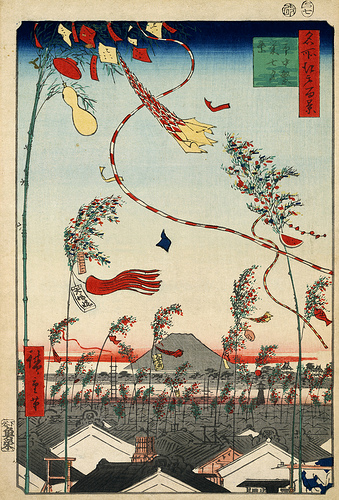
art beat: yesterday at Boston’s Museum of Fine Arts

Hiroshige, The City Flourishing, Tanabata Festival (1857)


Wednesday, 3/30/11

I find it hard to understand why some folks wall themselves off from classical music. Jazz, blues, rock, classical: it’s all music. Sure, the musical lines and paragraphs—the units of expression—are usually (though not always) longer and more complex in classical music. But that’s simply a matter of form. Raymond Carver and Marcel Proust, for all their formal differences, both take you places you can’t get to any other way. So too do both Beethoven and Art Pepper, both Magic Sam and Mozart.

Bela Bartok, String Quartet No. 1 in A minor, 3rd movement
The Parker Quartet, live, 11/23/09

Vodpod videos no longer available.