music clip of the day

jazz/blues/rock/classical/gospel/more

Category: viola

Tuesday, 4/26/11

 favorites
(an occasional series)

Here one of the greatest American artists of the 20th century (composer Morton Feldman [1926-1980]) pays homage to another (painter Mark Rothko [1903-1970]).

Morton Feldman, Rothko Chapel (composed in 1971; first performed, at Houston’s Rothko Chapel, in 1972)

Part 1

***

Part 2

***

Part 3

***

Part 4

***

Part 5

More? Here. And here. And here. And here.

**********

lagniappe

. . . The example of the painters was crucial. Feldman’s scores were close in spirit to Rauschenberg’s all-white and all-black canvases, Barnett Newman’s gleaming lines, and, especially, Rothko’s glowing fog banks of color. His habit of presenting the same figure many times in succession invites you to hear music as a gallery visitor sees paintings; you can study the sound from various angles, stand back or move up close, go away and come back for a second look. Feldman said that New York painting led him to attempt a music ‘more direct, more immediate, more physical than anything that had existed heretofore.’ Just as the Abstract Expressionists wanted viewers to focus on paint itself, on its texture and pigment, Feldman wanted listeners to absorb the basic facts of resonant sound. At a time when composers were frantically trying out new systems and languages, Feldman chose to follow his intuition. He had an amazing ear for harmony, for ambiguous collections of notes that tease the brain with never-to-be-fulfilled expectations. Wilfrid Mellers, in his book ‘Music in a New Found Land,’ eloquently summed up Feldman’s early style: ‘Music seems to have vanished almost to the point of extinction; yet the little that is left is, like all of Feldman’s work, of exquisite musicality; and it certainly presents the American obsession with emptiness completely absolved from fear.’ In other words, we are in the region of Wallace Stevens’s ‘American Sublime,’ of the ’empty spirit / In vacant space.’

***

If there is a Holocaust memorial in Feldman’s work, it is ‘Rothko Chapel,’ which was written in 1971, for Rothko’s octagonal array of paintings in Houston. Rothko had committed suicide the previous year, and Feldman, who had become his close friend, responded with his most personal, affecting work. It is scored for viola, solo soprano, chorus, percussion, and celesta. There are voices, but no words. As is so often the case in Feldman’s music, chords and melodic fragments hover like shrouded forms, surrounded by thick silence. The viola offers wide-ranging, rising-and-falling phrases. The drums roll and tap at the edge of audibility. Celesta and vibraphone chime gentle clusters. There are fleeting echoes of past music, as when the chorus sings distant, dissonant chords reminiscent of the voice of God in Schoenberg’s ‘Moses und Aron,’ or when the soprano sings a thin, quasi-tonal melody that echoes the vocal lines of Stravinsky’s final masterpiece, the ‘Requiem Canticles.’ That passage was written on the day of Stravinsky’s funeral, in April, 1971—another thread of lament in the pattern. But the emotional sphere of ‘Rothko Chapel’ is too vast to be considered a memorial for an individual, whether it is Rothko or Stravinsky.

Shortly before the end, something astonishing happens. The viola begins to play a keening, minor-key, modal song, redolent of the synagogue. Feldman had written this music decades earlier, during the Second World War, when he was attending the High School of Music and Art, in New York. Underneath it, celesta and vibraphone play a murmuring four-note pattern, which calls to mind a figure in Stravinsky’s ‘Symphony of Psalms.’ The song unfurls twice, and the chorus answers with the chords of God. The allusions suggest that Feldman is creating a divine music, appropriate to the sombre spirituality of Rothko’s chapel. In a sense, he is fusing two different divinities, representative of two major strains in twentieth-century music: the remote, Hebraic God of Schoenberg’s opera, and the luminous, iconic presence of Stravinsky’s symphony. Finally, there is the possibility that the melody itself, that sweet, sad, Jewish-sounding tune, speaks for those whom Feldman heard beneath the cobblestones of German towns. It might be the chant of millions in a single voice.

But I can almost hear Feldman speaking out against this too specific reading. At a seminar in Germany in 1972, he was asked whether his music had any relationship to the Holocaust, and he said no. He was a hard-core modernist to the end, despite his sensualist tendencies, and he did not conceive of art a medium for sending messages. It was probably in reaction to the communicative power of ‘Rothko Chapel’ that he later dismissed it, unbelievably, as a minor work. But in that German seminar he did say, in sentences punctuated by long pauses, ‘There’s an aspect of my attitude about being a composer that is like mourning. Say, for example, the death of art . . . something that has to do with, say, Schubert leaving me.’ He also admitted, ‘I must say, you did bring up something that I particularly don’t want to talk about publicly, but I do talk privately.’

Only this one time, in the last minutes of ‘Rothko Chapel,’ did Feldman allow himself the consolation of an ordinary melody. Otherwise, he held the outside world at bay. Yet he always showed an awareness of other possibilities, a sympathy for all that he chose to reject. Listening to his music is like being in a room with the curtains drawn. You sense that with one quick gesture sunlight could fill the room, that life in all its richness could come flooding in. But the curtains stay closed. A shadow moves across the wall. And Feldman sits in his comfortable chair.—Alex Ross (New Yorker, 6/19/06)

(Originally posted 12/5/09.)

Saturday, 4/9/11

If you’re away from home, how good it is to find a musical sanctuary, as I have the last two Fridays at Harvard’s Paine Concert Hall; last night I heard this string quartet play, wonderfully, music by Brahms and two contemporary composers (Adam Roberts, James Yannatos).

Chiara Quartet, Jefferson Friedman: String Quartet No. 2 (excerpt)
Live, New York (Le Poisson Rouge), 2010

Vodpod videos no longer available.

Are we ever better—more focused, more receptive, more supple—than when we’re listening to live music?

**********

lagniappe

art beat

Edward Hopper, Room in Brooklyn (1932), Museum of Fine Arts, Boston

Wednesday, 4/6/11

I’m surprised that I got this old and know so little.

—Terry Riley

Terry Riley, talking and playing, California, 2010

Vodpod videos no longer available.

*****

In C (excerpt), Terry Riley, 1964

Take 1

Terry Riley, Center of Creative and Performing Arts (SUNY-Buffalo), 1968

Vodpod videos no longer available.

***

Take 2

Ars Nova, Percurama Percussion Ensemble, Paul Hillier (cond.), 2007

Vodpod videos no longer available.

**********

lagniappe

art beat: yesterday at Boston’s Museum of Fine Arts

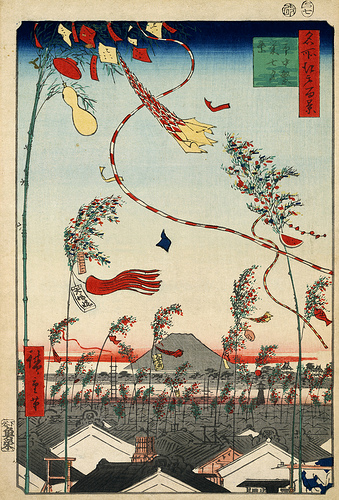
Hiroshige, The City Flourishing, Tanabata Festival (1857)


Wednesday, 3/30/11

I find it hard to understand why some folks wall themselves off from classical music. Jazz, blues, rock, classical: it’s all music. Sure, the musical lines and paragraphs—the units of expression—are usually (though not always) longer and more complex in classical music. But that’s simply a matter of form. Raymond Carver and Marcel Proust, for all their formal differences, both take you places you can’t get to any other way. So too do both Beethoven and Art Pepper, both Magic Sam and Mozart.

Bela Bartok, String Quartet No. 1 in A minor, 3rd movement
The Parker Quartet, live, 11/23/09

Vodpod videos no longer available.

Thursday, 3/17/11

two takes

Mozart was a kind of idol to me—this rapturous singing . . . that’s always on the edge of sadness and melancholy and disappointment and heartbreak, but always ready for an outburst of the most delicious music.

Saul Bellow

Mozart, Quintet for Clarinet and Strings in A major, K. 581 (1789)
2nd Movement (Larghetto)

Bruce Nolan (clarinet) and the Sierra String Quartet

Vodpod videos no longer available.

***

Yona Ettlinger (clarinet) and the Tel Aviv Quartet

Vodpod videos no longer available.

More? Here. And here. And here.

Thursday, 2/10/11

Some music circles back on itself, over and over, slowing time.

John Luther Adams
(not to be confused with the other John Adams)

“In the White Silence,” 1998 (excerpt)/The Oberlin Contemporary Music Ensemble, Tim Weiss, conductor (2003 recording)

Vodpod videos no longer available.

*****

“Red Arc/Blue Veil” for piano, percussion, and tape sounds (excerpt)/live, Kentucky (Lexington [University of Kentucky]), 2008/Clint Davis, piano; Charlie Olvera, vibraphone, crotales

Vodpod videos no longer available.

**********

lagniappe

musical thoughts

Adams talks about his music

Vodpod videos no longer available.

*****

I admire a radio station where you can’t be certain when you first tune in—as happened to me yesterday afternoon, while working, when I turned on WKCR-FM (broadcasting from Columbia University)—whether they’re playing a recording or having technical difficulties.

Thursday, 2/3/11

Music, like people, comes in all kinds. Some is easy to embrace, some thorny. I wouldn’t want to live without either.

Milton Babbitt, May 10, 1916-January 29, 2011

About Time, Alan Feinberg, piano

Vodpod videos no longer available.

***

String Quartet No. 2, Composers Quartet

Vodpod videos no longer available.

**********

lagniappe

His music can be playful, too.

Semi-Simple Variations, The Bad Plus

Vodpod videos no longer available.

*****

If you know anybody who knows more popular music of the ’20s or ’30s than I do, I want to know who it is. I grew up playing every kind of music in the world, and I know more pop music from the ’20s and ’30s, it’s because of where I grew up. We had to imitate Jan Garber one night; we had to imitate Jean Goldkette the next night. We heard everything from the radio; we had to do it all by ear. We took down their arrangements; we stole their arrangements; we transcribed them, approximately. We played them for a country club dance one night and for a high school dance the next.

Milton Babbitt

Monday, 1/24/11

Does anyone play Mozart with more verve?

Mozart, Piano Concerto No. 20 in D minor, KV. 466, first movement;
Friedrich Gulda (piano and conducting), Munich Philharmonic Orchestra, live, Germany (Munich), 1986

Part 1

Vodpod videos no longer available.

***

Part 2

Vodpod videos no longer available.

More? Here.

**********

lagniappe

Friedrich Gulda has refused to succumb to the increasing specialization of our age, refused to limit his horizons to one small portion of the musical spectrum. A prodigious talent, whom Harold Schonberg once hailed in The New York Times as “a continuation of the great German traditions of piano playing exemplified by Schnabel and Backhaus,” he chose to reject the cloistered life of a virtuoso in favor of a career that paid equal attention to jazz and classical music, to performance, composition and improvisation.

“There can be no guarantee that I will become a great jazz musician, but at least I shall know that I am doing the right thing,” he once said.  “I don’t want to fall into the routine of the modern concert pianist’s life, nor do I want to ride the cheap triumphs of the Baroque bandwagon.” His insistence on shaping his career in his own image has been costly: once a household name among piano aficionados, he has not toured America in nearly two decades. Yet a spate of recent releases – both jazz and classical – suggest that it may be time for him to reclaim the fame once so deservedly his.

Born in Vienna in 1930, Mr. Gulda began piano studies at the age of 7, entered the Vienna Music Academy at 12 and won a major competition at 16 – first prize in the Geneva International Music Festival. His career catapulted with meteoric speed: he toured Europe and South America in 1949, and made his much-heralded Carnegie Hall debut in 1950. Mr. Gulda’s playing, however, always shunned excessive showmanship, favoring an intellectual, objective stance. His concentration on Bach, Mozart and Beethoven reflected these innate tendencies.

Mr. Gulda’s life changed in 1951: after an appearance with the Chicago Symphony, he joined Dizzy Gillespie in jazz improvisations – his first taste of freedom, so it would seem. Jazz offered “the rhythmic drive, the risk, the absolute contrast to the pale, academic approach I had been taught.” By 1956 Mr. Gulda had made his American jazz debut at New York’s Birdland, subsequently participating in the Newport Jazz Festival. Later he founded a jazz combo and in 1964 a big band grandly titled the Eurojazz Orchestra. Refusing to be limited to the piano, Mr. Gulda quickly mastered both flute and baritone sax.

What happened to his career as a classical pianist? By the late 1950’s he had rejected the traditional recital format, instead combining classical music and jazz on the same programs. By the 1970’s he had begun to irritate concert promoters by refusing to announce the content of his programs in advance and by fearlessly juxtaposing Bach, Debussy, his own jazz and freely improvised new music. Not surprisingly, many ridiculed him, claiming he had thrown away a promising career, had succumbed to egotistical eccentricity.

A sudden burst of new releases proves how wrong his critics were. “The Meeting: Chick Corea and Friedrich Gulda” (Philips CD 410 397-2), recorded at a live performance in Munich in 1982, consists exclusively of two-piano improvisations. Chick Corea is hardly a novice at either improvisations – readers may recall his 1978 two-record set with Herbie Hancock (CBS PC2 35663) – or at a crossover stance that melds both classical and jazz approaches. The result is a disk that consists of three gigantic essays, each beginning in a rhapsodic manner and only gradually coalescing into a structured commentary on familiar tunes –  “Someday My Prince Will Come,” Miles Davis’s “Put Your Little Foot Out,” Brahms’s Lullaby. Most remarkable are the completely free sections in which the players must rely entirely on listening, responding, sensing each other’s every whim. Ironically enough, the music is often angular and dissonant – occasionally approaching the intricacies of atonal modernism – yet always possessing a tightly disciplined structure. Both Mr. Corea and Mr. Gulda display dazzling technique together with fertile imaginations that dart unfettered from classical to jazz idioms.

“Gulda Plays Gulda” (Philips CD 412 115-2) consists almost entirely of his own piano compositions. The finest are those in which he adopts the conventions of both jazz and classical music to traditional forms – a virtuosic set of Variations, a Prelude and Fugue, a three-movement Sonatina. If Mr. Gulda is not an innovator, he shows remarkable ability at absorbing, integrating, synthesizing diverse idioms. Even at his most derivative – the spirits of Count Basie and Miles Davis haunt these works – the pieces are never less than formally skilled and overflowing with vitality. Only  “For Paul” and “For Rico,” bathed in pop-rock cliches, sound both dated and embarrassingly trivial.

Mr. Gulda’s  “Winter Meditation”, paired with Beethoven’s Sonata in C minor, Op. 111 (Philips 412 114-1), provides the link from his own compositions to the realm of classical music. There are no references to jazz here: instead  “Winter Meditation” conjures up images of a barren, ominous, frozen landscape. Dissonant and fragmented, it explores extremes of register and dynamic range; it deliberately eschews traditional form or melodic content. Ultimately, though, it reaches for profundity, it appears far less successful than his jazz, remaining shapeless and self-indulgent. The Beethoven, however, is a revelation: rarely have I heard such a riveting performance of the composer’s last Sonata. Mr. Gulda’s Beethoven is driving, lean, hard-edged, its propulsive power more than matched by a probing, intellectual musicianship that penetrates to the core of this most complex work.

Schumann’s  “Fantasiestukce”, Op. 12 and “Liederkreis”, Op. 39 (Philips CD 412 113-2) find Mr. Gulda in similarly evocative form. It takes him no more than a few moments to capture the essence of these moody, impassioned, sometimes haunted texts. Mr. Gulda is joined in the “Liederkreis” by the soprano Ursula Anders, who opts for a childlike purity of tone, performing these songs almost entirely without vibrato. Such a vocal timbre can be appealing but here seems a bit excessive in its application; though she may have been reaching for naturalistic, folklike simplicity the result severely limits her expressive range.

In all of Mr. Gulda’s recent releases he favors a percussive, hammered attack in forte passages, eliciting a clangorous, metallic sound from his beloved Bosendorfer. His own jazz benefits from such an approach, and to a certain extent even the Beethoven Sonata – with its explosive sforzandos and ensuing pianos – is not harmed. In the Schumann, however, Mr. Gulda’s pianistic touch can seem needlessly brutal. Yet his manner provides the hidden benefit of creating chiseled, transparent textures; even in massive passages, all lines stand out in relief.

Mr. Gulda’s approach fits perfectly with the conductor Nikolaus Harnoncourt’s, and the result in their new recording of Mozart’s Concertos Nos. 23 and 26 (Telarc CD 8. 42970 ZK) is nothing less than a radical rethinking of these familiar works. Mr. Harnoncourt stamps his imprint on the Concertgebouw Orchestra: he has it imitate the manner of an original-instrument ensemble, with biting articulations, crisp bow strokes and transparent textures in which brass and tympani stand out with startling clarity. To further enhance textural lucidity, Mr. Harnoncourt occasionally reduces the strings to a small concertino group during solo piano passages. Mr. Gulda plays throughout, even during orchestral tuttis, sometimes adding arpeggiated figuration or bass reinforcement in full instrumental sections.

Mr. Harnoncourt and Mr. Gulda possess no less a unity of vision than do Mr. Corea and Mr. Gulda in ”The Meeting.” Mr. Gulda’s playing is rhythmically precise, keenly articulated, objective and unsentimentalized, yet never insensitive to phrasing or mood. The result is the ultimate vindication of this enigmatic, fiercely independent musician, a man whose wide-ranging efforts have – to judge from recent recordings – succeeded far more often than they have failed.

—K. Robert Schwartz, New York Times, 9/29/85

*****

reading table

The John Cage of status updates?

The Led Zeppelin of sensitive screenwriters?

The Willie Nelson of pin-up girls?

All these, and more, can be found at The Rosa Parks of Blogs.

Thursday, 11/11/10

Looking for a reason to be hopeful?

None of these musicians (or the conductor) is over the age of 18.

John Adams, Shaker Loops (1978), first movement (“Shaking and Trembling”), live

**********

lagniappe

John Adams, rehearsing this music:

*****

It is a strange business, composing music in twenty-first-century America. The job is difficult in itself: it is slow, solitary, and intensely cerebral. You have to believe deeply in yourself to get through the process. You have to be possibly a little mad. When you are done, you have in your hands not a finished object—a painting that can be put up on a wall or a novel that can be read at one sitting—but a set of abstract notations that other musicians must learn and perform. Then you step back into the culture at large, where few people embrace, or even notice, what you do. In this country, classical music is widely regarded as a dead or alien form—so much so that jazz aficionados routinely say, “Jazz is America’s classical music.” To make the counterargument that America’s classical music is America’s classical music is somehow to admit that the battle is lost. In such a climate, composers easily become embittered.

***

When I visited Adams at his house in Brushy Ridge, last June, he was pondering the composer’s relationship with the mass culture. “I like to think of culture as the symbols that we share to understand each other,” he said. “When we communicate, we point to symbols that we have in common. If people want to make a point, they reach for a reference. It might be a Woody Allen movie, or a John Lennon lyric, or ‘I’m not a crook.’ When I was young, I came to realize that twelve-tone music, or for that matter, all contemporary music, was so far divorced from communal experience that it didn’t appear on the national radar screen. It would be nice to hear someone say, ‘Look at that gas station in the moonlight. It’s pure John Adams.’”

***

The music of John Adams, unlike so much classical composition of the last fifty years, has the immediate power to enchant.

—Alex Ross, “The Harmonist,” The New Yorker, 1/8/01

Thursday, 11/4/10

Violins teach us what it would be like to fly.

Henry Cowell, Symphony No. 13 (“Madras,” 1956-58), excerpt (first two movements), San Francisco Composers Chamber Orchestra, live, San Francisco, 2005

Want to hear all five movements? Here.

**********

lagniappe

Henry Cowell, the all-American composer of the 20th century, did it all. “I want to live in the whole world of music,” he said. He was “the open sesame of new music in America,” John Cage said.

He was famous once and is now all but forgotten. There was a time when Leopold Stokowski championed him in New York, as did Eugene Ormandy in Philadelphia and Serge Koussevitzky in Boston. Schoenberg thought the world of him. So did Busoni. But since Cowell’s death in 1965, the musical establishment has concluded his music, and particularly the plentiful late orchestral music, doesn’t hold up.

***

A century ago, he was a teenage piano pioneer in Menlo Park, Calif. He was the first to hit clusters of tones on the piano with fist and forearm (Bartók noticed) and the first to play directly on the piano strings. He all but invented the concept of world music and was on the front line of flexible phrasing, extreme polyrhythms, percussion music and mechanical music. He was a celebrated pedagogue. Cage, Burt Bacharach, George Gershwin and Lou Harrison were among those who found their own voices through him. Cowell, who was born in 1897, was known in New York, Berlin and Moscow by the ’20s. He helped found the study of ethnomusicology at UC Berkeley. He published and organized the concerts of progressive music from all over.

Cowell is primarily known for is his Bohemianism, which led to the creation of the California school of music and, sadly, for his arrest on morals charges. He was publicly shamed in a celebrity trial for having had consensual oral sex with young men and sentenced to 15 years in San Quentin.

After four years of incarceration, he was paroled and eventually pardoned by Gov. Earl Warren so that he could become a musical ambassador for the State Department. He moved to New York and taught at the New School for Social Research, traveled and absorbed the musics of Asia and Latin America, wrote 21 symphonies and much else. When Malaysia was looking for a national anthem in the ’50s, the country turned to him and Benjamin Britten for help.

—Mark Swed, Los Angeles Times (blog), 1/31/10