music clip of the day

jazz/blues/rock/classical/gospel/more

Category: viola

Tuesday, 3/13/12

Music doesn’t care who you are, where you come from, what you know. It asks only that you pay attention.

Stefan Wolpe (1902-1972), Piece in Three Parts for Piano and Sixteen Instruments (1961), Peter Serkin (piano), Chamber Music Society of Lincoln Center (Oliver Knussen, cond.)

More? Here.

Saturday, 1/14/12

If you wanted to conjure a world full of mystery, what better instrument to lead the way than one that possesses neither the brightness of the violin nor the darkness of the cello?

Morton Feldman, Rothko Chapel (1971), live, Houston (Rothko Chapel), 2011; Kim Kashkashian (viola), Brian Del Signore (percussion), Sarah Rothenberg (celeste), Maureen Broy Papovich (soprano), Houston Chamber Choir (Robert Simpson, cond.)

Part 1

***

Part 2

***

Part 3

Another take? Here.

**********

lagniappe

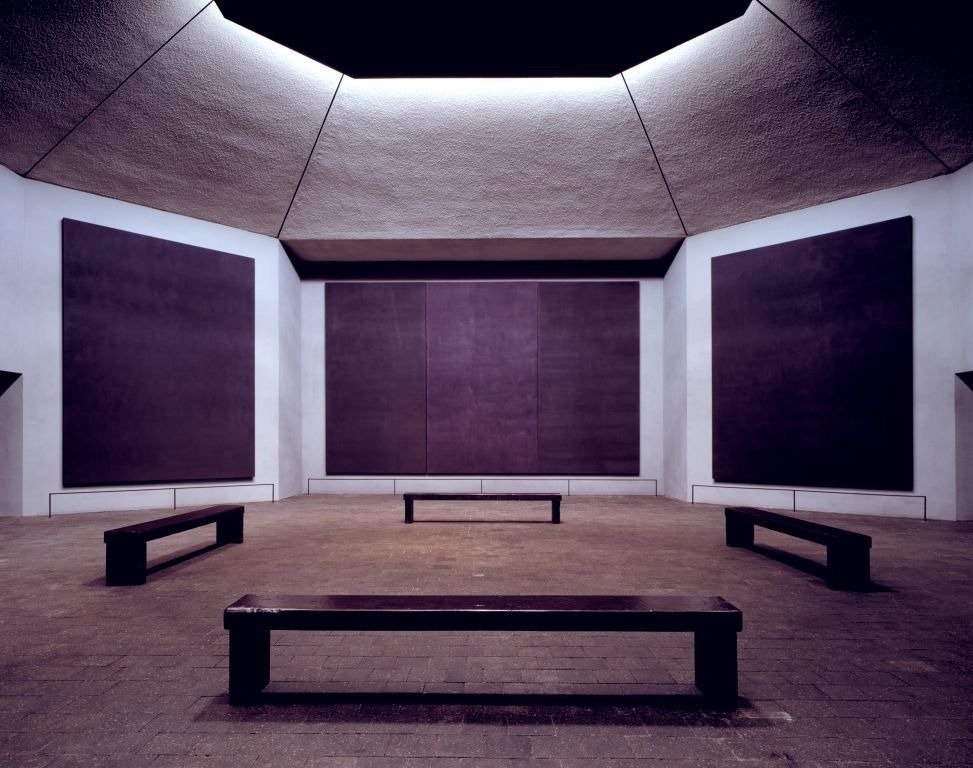
Rothko Chapel, Houston, Texas

***

The Rothko Chapel is an interfaith sanctuary, a center for human rights — and a one-man art museum devoted to 14 monumental paintings by abstract expressionist Mark Rothko. The Houston landmark, commissioned by John and Dominique de Menil, opened its doors 40 years ago, in February 1971.

For the past four decades, the chapel has encouraged cooperation between people of all faiths — or of no faith at all. While the chapel itself has become an art landmark and a center for human-rights action, the sanctuary’s creator never lived to see it finished. Rothko committed suicide in 1970.

Approaching the chapel from the south, visitors first see a steel sculpture called Broken Obelisk by Barnett Newman in the middle of a pool — it appears to be floating on the surface of the water. The chapel itself is a windowless, octagonal brick building. Solid black doors open on a tiny glass-walled foyer. (The foyer was walled off from the rest of the interior when the Gulf Coast’s notorious humidity began to affect the paintings.)

The main room is a hushed octagonal space with gray stucco walls, each filled by massive paintings. Some walls feature one canvas, while on others, three canvases hang side by side to form a triptych. A baffled skylight subdues the bright Houston sun, and the surfaces of the paintings change dramatically as unseen clouds pass outside. There are eight austere wooden benches informally arranged, and today, a few meditation mats. A young woman brings the meditation hour to a close by striking a small bowl with a mallet, creating a soft peal of three bells in the intense silence of the room.

Concerts, conferences, lectures, weddings and memorial services all take place in the chapel throughout the year, but on most days you will find visitors — about 55,000 annually come to see, to meditate, to write in the large comment book in the foyer, to read the variety of well-thumbed religious texts available on benches at the entrance.

***

These paintings do not feature the luminous color fields that made Rothko famous. The paintings in the chapel are dark, in purplish or black hues. And there’s a reason for that, says [chapel historian Suna] Umari.

“They’re sort of a window to beyond,” she explains. “He said the bright colors sort of stop your vision at the canvas, where dark colors go beyond. And definitely you’re looking at the beyond. You’re looking at the infinite.”

***

At first glance, the paintings appear to be made up of solid, dark colors. But look closely, and it becomes evident that the paintings are composed of many uneven washes of pigment that create variations in every inch. Stepping back, waves of subtle color difference appear across the broad surfaces — leading to an unmistakable impression of physical depth.

***

Though Mark Rothko didn’t live to see the sanctuary he created, Christopher Rothko says his father knew what it should be.

“It took me a while to realize it, but that’s really my father’s gift, in a sense, to somebody who comes to the chapel. It’s a place that will really not just invite, but also demand a kind of journey.”

—Pat Dowell, “Meditation and Modern Art Meet In Rothko Chapel,” NPR, 3/1/11

*****

reading table

Our lives are Swiss –
So still – so Cool –
Till some odd afternoon
The Alps neglect their Curtains
And we look farther on!

Italy stands the other side!
While like a guard between –
The solemn Alps –
The siren Alps
Forever intervene!

—Emily Dickinson

Tuesday, 1/10/12

What you want, sometimes, is to lose yourself, even if only briefly, in beauty.

Leo Janacek (1854-1928), String Quartet No. 1, “The Kreutzer Sonata,” excerpt (arr. Tognetti), Australian Chamber Orchestra

**********

lagniappe

random thoughts

When you’re young you want to find yourself; when you’re old you want to lose yourself.

*****

reading table

Variations for Two Pianos

for Thomas Higgins, pianist

by Donald Justice

There is no music now in all of Arkansas.
Higgins is gone, taking both his pianos.

Movers dismantled the instruments, away
Sped the vans. The first detour untuned the strings.

There is no music now in all of Arkansas.

Up Main Street, past the cold shopfronts of Conway,
The brash, self-important brick of the college,

Higgins is gone, taking both his pianos.

Warm evenings, the windows open, he would play
Something of Mozart’s for his pupils, the birds.

There is no music now in all of Arkansas.

How shall the mockingbird mend her trill, the jay
His eccentric attack, lacking a teacher?

Higgins is gone, taking both his pianos.
There is no music now in all of Arkansas.

Saturday, 12/17/11

Happy (Belated) 103rd Birthday, Elliott!

Elliott Carter, composer, December 11, 1908-

The other night I put this on, thinking I’d do something else while it played; but, as it turned out, “something else” had to wait.

String Quartet No. 2 (1959), Composers Quartet

More? Here. And here.

**********

lagniappe

Juilliard String Quartet with Elliott Carter, 2008
Rehearsing String Quartet No. 5

*****

musical thoughts

Mr. Carter has written 15 new works since his 100th birthday.

—Allan Kozinn, New York Times, 12/13/11

***

Haydn, Beethoven, Schubert, Webern, Bartok, Shostakovich, Carter, et al.: you could spend the rest of your life listening to nothing but string quartets without ever feeling deprived.

Thursday, 12/15/11

mysterious, adj. exciting wonder, curiosity, or surprise, while baffling efforts to comprehend or identify. E.g., the string quartet music of Anton Webern.

Anton Webern (1883-1945), Five Movements for String Quartet, Op. 5
Penderecki String Quartet, live
Falls Village, Connecticut (Music Mountain), 2010

Part 1

***

Part 2

More? Here.

**********

lagniappe

musical thoughts

Ignorance has a big upside: the more music you’ve never heard, the more there is to discover.

Saturday, 10/29/11

Some music isn’t made for summer: it wants more night.

Bela Bartok, String Quartet No. 5, excerpt (3rd movement)
Calder Quartet, live, 2008, Los Angeles

More Bartok? Here.

**********

lagniappe

reading table

This road—
no one goes down it,
autumn evening.

—Matsuo Basho (1644-1694), trans. Robert Hass

Saturday, 10/1/11

serendipity

The other night, as I listened to the radio,* this (“Patient Observation”) floated out of the speakers.

Falling From Trees, Neon Productions, music by Peter Broderick
Premiered at The Place, London, 1/09

Excerpt, Part 2, “Patient Observation”

Vodpod videos no longer available.

***

Full Length

Vodpod videos no longer available.

***

Falling From Trees is a 30-minute production set in a psychiatric hospital that delves into the mind of a resident patient. The piece explores how a neurological disease can alter your sense of self and relationship to the world and people around you. Peter Broderick’s score has been created solely on piano and strings; it is also the first time Broderick has created music specifically for dance.
Neon Productions

*Mudd Up! with DJ/Rupture, WFMU-FMMonday, 8 p.m. (EST), archived shows here

Sunday, 9/11/11

Steve Reich, WTC 9/11 (2010), excerpts
Kronos Quartet, with prerecorded tape

1st Movement 

Vodpod videos no longer available.

***

3rd Movement

Vodpod videos no longer available.

**********

lagniappe

reading table

They jumped from the burning floors—
one, two, a few more,
higher, lower.

The photograph halted them in life,
and now keeps them
above the earth toward the earth.

Each is still complete,
with a particular face
and blood well hidden.

There’s enough time
for hair to come loose,
for keys and coins
to fall from pockets.

They’re still within the air’s reach,
within the compass of places
that have just now opened.

I can do only two things for them—
describe this flight
and not add a last line.

—Wislawa Szymborska, “Photograph from September 11” (trans. Clare Cavanagh & Stanislaw Baranczak)

*****

Barbarism is not the prehistory of humanity but the faithful shadow that accompanies its every step.

—Alain Finkielkraut, Le mécontemporain, (epigraph, Clive James, As of This Writing: The Essential Essays, 1968-2002 [2003]) 

Saturday, 9/10/11

lucid, adj. suffused with light, luminous. E.g., Morton Feldman’s Piano and String Quartet.

Morton Feldman, Piano and String Quartet (1985)
Kronos Quartet with Aki Takahashi (piano)

Vodpod videos no longer available.

In a world that keeps getting faster and noisier, Feldman offers a refuge.
Here time slows. Quietly.

More? Here. And here. And here. And here. And here.

Saturday, 7/30/11

The four familial instruments seem to whisper directly into our ears, communing with us about our personal sadnesses and anxieties.

—Wendy Lesser, Music For Silenced Voices: Shostakovich and His Fifteen Quartets (2011)

Dmitri Shostakovich, String Quartet No. 14 in F-Sharp Major (1972-73)
Fitzwilliam String Quartet

1st Movement (Allegretto)

Vodpod videos no longer available.

***

2nd Movement (Adagio)

Vodpod videos no longer available.

***

3rd Movement (Allegretto)

Vodpod videos no longer available.

More? Here.

**********

lagniappe

musical thoughts

I think he [President Obama] needs to listen to some jazz. Maybe the entire capital needs it to calm down.

—Chicago Mayor Rahm Emanuel, 7/28/11