music clip of the day

jazz/blues/rock/classical/gospel/more

Category: trumpet

Monday, 8/22/11

Need to chase away those Monday morning blues?

You’ve come to the right place.

TBC (To Be Continued) Brass Band
Live, Satchmo Second Line Parade, New Orleans, 8/7/11

With Sidewalk Steppers

Vodpod videos no longer available.

***

With Undefeated Divas, Sudan Social Aid and Pleasure Club

Vodpod videos no longer available.

More? Here.


Friday, 8/19/11

sounds of Nigeria

Fela Kuti, live (filmed by Ginger Baker), Nigeria (Calabar), 1971

Vodpod videos no longer available.

More? Here.

**********

lagniappe

art beat: yesterday at Chicago’s Art Institute

Oda Kazuma, Catching Whitebait at Nakaumi, Izumo (1924)

*****

Mark Rothko, Untitled, 1953-54

*****

reading table

. . . life, that storm before the calm.

—Wislawa Szymborska, from “Negative” (trans. Clare Cavanagh & Stanislaw Baranczak, Monologue of a Dog [2006])

Thursday, August 4, 2011

Happy Birthday (Again), Pops!

During his life, Louis Armstrong’s birthday was believed to be July 4, 1900, but, as it turned out, that was a year and a month off—the actual date was August 4, 1901. Given the circumstances, WKCR-FM (broadcasting from Columbia University) does the only sensible thing: they celebrate both days, playing nothing but Pops 24 hours straight.

 favorites
(an occasional series)

According to Miles Davis, the history of jazz can be told in four words:
here are the first two.

Louis Armstrong, “Dinah,” live, Copenhagen, 1933

(Originally posted January 15, 2010.)

Sunday, 7/17/11

The right music, heard at the right moment, can change your whole day.

The Staple Singers, “I’m Coming Home” (Vee-Jay), 1959

Vodpod videos no longer available.

**********

lagniappe

Happy Birthday, Lionel!

Today trumpet player Lionel Ferbos, who was born when William Howard Taft was president and tonight can be heard at New Orleans’ Palm Court Jazz Cafe, turns 100.

The Lionel Ferbos Band, “When You’re Smiling”
Live, New Orleans (Norwegian Seamen’s Church), 8/28/09

Vodpod videos no longer available.

***

For some years, trumpeter Lionel Ferbos has been touted as the oldest active jazz musician in New Orleans. Come this weekend, he’ll qualify for another honorific: The only active jazz musician in New Orleans whose age has crossed into triple digits.

lionel ferbos 2011 portrait.jpgJohn McCusker / The Times-Picayune
Lionel Ferbos, photographed in May 2011.

Ferbos first learned trumpet in 1926, at age 15, inspired by seeing Phil Spitalny and his All-Girl Orchestra at the Orpheum Theater. He played in 1930s bands led by Captain John Handy and Walter “Fats” Pichon. He worked on a crew digging a City Park lagoon before getting hired for a Depression-era Works Progress Administration band, making around $13 a week.

Sheetmetal work eventually paid the bills, even as he continued to moonlight as a musician. He joined Lars Edegran’s New Orleans Ragtime Orchestra in the early 1970s, which toured in Europe, and in 1979 played trumpet and sang in the touring musical “One Mo’ Time.” He has maintained a regular gig at the Palm Court Jazz Cafe on Decatur Street for more than two decades.

—Keith Spera, The Times-Picayune, 7/13/11

Tuesday, 7/12/11

John Luther Adams, Inuksuit (excerpt)
New York (Park Avenue Armory), 2/20/11

Vodpod videos no longer available.

More? Here.

**********

lagniappe

Scored for a flexible ensemble of between nine and ninety-nine percussionists, “Inuksuit” is intended for outdoor performance, and it had its première on a mountainside in Banff, Canada, in 2009. Adams at first resisted the idea of taking the piece indoors, because the interaction with nature was integral to his conception. After inspecting the Armory, though, he grasped its possibilities; the space is more a man-made canyon than a concert hall. He settled on a corps of seventy-six musicians, including five piccolo players. Arrays of drums, gongs, cymbals, bells, and numerous smaller instruments were set up on the main floor of the Drill Hall; atop catwalks on all sides; and in the hallways that connect to smaller rooms at the front of the building. In any rendition of “Inuksuit,” the performers are given four or five pages of music—the notation imitates the shapes of the Inuit markers—which they execute at their own pace. Musicians with portable instruments are instructed to move about freely. Prearranged signals prompt a move from one page to the next. The result is a composition that on the microcosmic level seems spontaneous, even chaotic, but that gathers itself into a grand, almost symphonic structure.

At 4 P.M. on a Sunday, thirteen hundred people assembled in the Drill Hall to hear the piece, variously standing, sitting, or lying on the floor. First came an awakening murmur: one group of performers exhaled through horns and cones; others rubbed stones together and made whistling sounds by whirling tubes. Then one member of the ensemble—Schick, perched above the entrance to the Drill Hall—delivered a call on a conch shell. With that commanding, shofar-like tone, the sound started to swell: tom-toms and bass drums thudded, cymbals and tam-tams crashed, sirens wailed, bells clanged. It was an engulfing, complexly layered noise, one that seemed almost to force the listeners into motion, and the crowd fanned out through the arena.

***

It is tricky to write about an event such as this. Because both ensemble and audience were in motion, no two perceptions of the performance were the same, and no definitive record of it can exist. Furthermore, anyone who ventures to declare in a public forum that “Inuksuit” was one of the most rapturous experiences of his listening life—that is how I felt, and I wasn’t the only one—might be suspected of harboring hippie-dippie tendencies. The work is not explicitly political, nor is it the formal expression of an individual sensibility, although John Luther Adams certainly deserved the ecstatic and prolonged ovation that greeted him when he acknowledged the crowd from the center of the Drill Hall. In the end, several young couples seemed to deliver the most incisive commentary when, amid the obliterating tidal wave of sound, they began making out.

—Alex Ross, New Yorker, 3/14/11

*****

Happy Birthday, Suzanne!

As I mentioned on this date last year, the first time my wife Suzanne and I went out together (September 1974, Chicago’s Jazz Showcase), we saw the man who put the sui in sui generis.

Sun Ra, Space Is the Place (1974), excerpt

Vodpod videos no longer available.

More? Here. And here.

*****

speaking of birthdays

How often do you get to say “Happy 100th Birthday”?

Well, here’s your chance.

As I learned the other day from WKCR-FM’s Phil Schaap, who’s been encouraging folks to send this guy a birthday card (I mailed mine yesterday), the oldest performing jazz musician, trumpeter Lionel Ferbos, who plays at New Orleans’ Palm Court Jazz Cafe, turns 100 on July 17th. Birthday greetings can be mailed (remember mail?) to 5543 Press Dr., New Orleans, LA 70126.

Saturday, 7/9/11

Rebirth Brass Band

Dave Douglas & Brass Ecstasy

Free Spirit Brass Band

Lester Bowie’s Brass Fantasy

Asphalt Orchestra

Pinettes Brass Band

Here’s another take on the brass band.

Ray Anderson’s Pocket Brass Band (RA, trombone; Lew Soloff, trumpet;
Matt Perrine, sousaphone; Bobby Previte, drums)

Live, Powerplay Studio, Switzerland (Maur), 5/27/10

Vodpod videos no longer available.

*****

Live, Trondheim Jazz Festival (Norway), 5/14/10

Vodpod videos no longer available.

**********

lagniappe

art beat

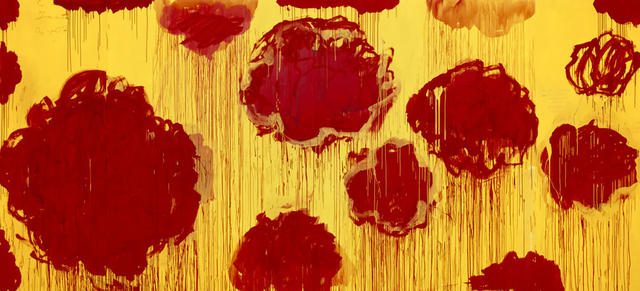
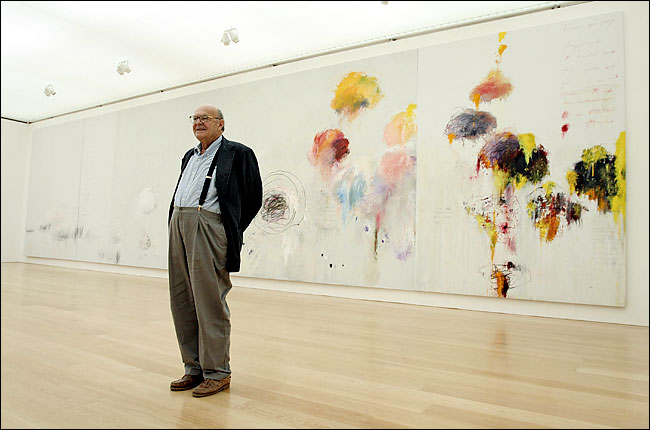
Cy Twombly, April 25, 1928-July 5, 2011

***

***

***

The death of Cy Twombly has an oddly catastrophic feel—oddly because he was eighty-three and a canonical master, but catastrophic because he takes with him a certain epochal, now thoroughly historical, sense of wide-open liberty in very high culture. Such was the cynosure of new art in New York sixty years ago, when Twombly had his first show of startlingly scrawly, somehow furiously languid paintings and drawings. Unlike the heroes of Abstract Expressionism and his comrades Rauschenberg and Johns, he never drove that afflatus. Rather, he took it as a routine state of mind and soul. This could seem dandyishly insolent of him: shrugging off the requirement for logical necessity in big-time avant-garde art. He made clear that he did what he felt like doing. His feeling-like-doing-it was the point, ever just a dramatic whisker short of pointlessness. Who did he think he was?

—Peter Schjeldahl, New Yorker (blog), 7/6/11

Friday, 7/8/11

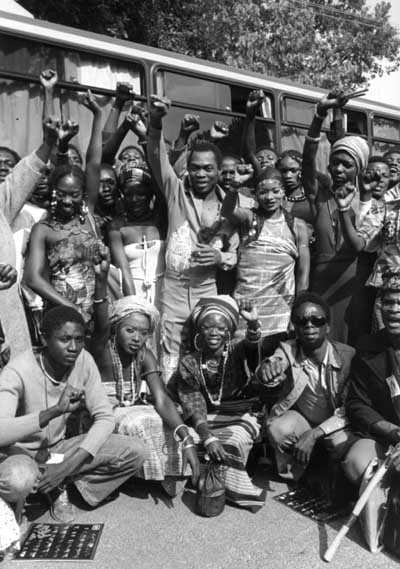
It takes a village, in Fela’s world, to put on a show.

Fela Anikulapo Kuti, October 15, 1938-August 2, 1997

Live, Paris, 1981

Part 1

Vodpod videos no longer available.

***

Part 2

Vodpod videos no longer available.

**********

lagniappe

1938 Born 15 October in Abeokuta, Nigeria to politically active and middle class family.

1958 Sent to London to train as a doctor, but instead enrolled in the Trinity College of Music. Formed Koola Lobitos in 1961.

1969 Took Koola Lobitos to Los Angeles. His political zeal was fired when he befriended radical black activists including Angela Davis.

1971 Kuti renames his band Afrika 70 (and later Eygpt 80), and, newly politicised, he determines to give voice to Nigeria’s underclass.

1974 After he enraged the Nigerian establishment, the army almost destroyed Kuti’s home while trying to arrest him.

1977 In a second government-sanctioned attack, 1,000 soldiers descended on Kuti’s compound. He suffered a fractured skull, arm and leg in the onslaught and his 82-year old mother was thrown from an upstairs window. He left for voluntary exile in Ghana.

1978 Ghanian authorities deported Kuti back to Lagos. On his arrival he married 27 women simultaneously. Divorcing them in 1986, he said: ‘ no man has the right to own a woman’s vagina’.

1979 Founded his own political party MOP (Movement of the People)

1984 Jailed in Nigeria for five years on what was regarded as sham currency smuggling charges, and released in 1986 after a change of government.

1996 Arrested and released on an alleged drug charge.

1997 Died of complications from Aids aged 59.

Peter Culshaw, The Guardian, 8/15/04

*****

Monday, July 4, 2011

Happy Birthday, Pops!*

Louis Armstrong, “Basin Street Blues” (three takes)

#1 (live, 1959, Germany [Stuttgart])

Vodpod videos no longer available.

***

#2 (live, 1953, New Orleans)

Vodpod videos no longer available.

***

#3 (recording, 1928, Chicago)

Vodpod videos no longer available.

**********

lagniappe

more

Louis Armstrong & His Hot Five, “West End Blues,” 1928, Chicago

*****

radio

The federal government, in its wisdom, gives you the day off so you can listen to Louis Armstrong.

—Phil Schaap, 7/2/11, Traditions in Swing, WKCR-FM
(broadcasting from Columbia University), which today is all Pops, all day 

*****

reading table

Summer afternoon — summer afternoon; to me those have always been the two most beautiful words in the English language.

—Henry James

*Louis Armstrong gave July 4th as his birthday, something that was determined, after his death, not to be true—at least not literally.

Saturday, 7/2/11

Here’s a different take—one deeply indebted to Lester Bowie—on the
brass band.

Dave Douglas & Brass Ecstasy
DD, trumpet; Louis Bonilla, trombone; Vincent Chancey, horn (AKA French horn); Marcus Rojas, tuba; Nasheet Waits, drums

“Bowie,” recording session (Spirit Moves, 2009)

Vodpod videos no longer available.

***

“Spirit Moves,” “This Love Affair,” “Twilight of the Dogs”
Live, Washington, D.C., 2009

Vodpod videos no longer available.

**********

lagniappe

reading table

How can I possibly sleep
This moonlit evening?
Come, my friends,
Let’s sing and dance
All night long.

—Ryokan (1758-1831), trans. John Stevens

Friday, 7/1/11

scenes from New Orleans
(an occasional series)

Rebirth Brass Band, live, Maple Leaf Bar (where RBB plays Tuesday nights), New Orleans, 2011

“Big Chief”

Vodpod videos no longer available.

***

“I Like It Like That”

Vodpod videos no longer available.

More? Here. And here. And here. And here.