music clip of the day

jazz/blues/rock/classical/gospel/more

Category: saxophone

Friday, 5/18/12

James Brown, live, Boston, 4/5/68

“Cold Sweat”

Part 1

***

Part 2

*****

“I Got the Feelin'”

*****

More?

Here’s the whole show.

*****

On the morning after the assassination of Dr. Martin Luther King, Jr., city officials in Boston, Massachusetts, were scrambling to prepare for an expected second straight night of violent unrest. Similar preparations were being made in cities across America, including in the nation’s capital, where armed units of the regular Army patrolled outside the White House and U.S. Capitol following President Johnson’s state-of-emergency declaration. But Boston would be nearly alone among America’s major cities in remaining quiet and calm that turbulent Friday night, thanks in large part to one of the least quiet and calm musical performers of all time. On the night of April 5, 1968, James Brown kept the peace in Boston by the sheer force of his music and his personal charisma.

Brown’s appearance that night at the Boston Garden had been scheduled for months, but it nearly didn’t happen. Following a long night of riots and fires in the predominantly black Roxbury and South End sections of the city, Boston’s young mayor, Kevin White, gave serious consideration to canceling an event that some feared would bring the same kind of violence into the city’s center. The racial component of those fears was very much on the surface of a city in which school integration and mandatory busing had played a major role in the recent mayoral election. Mayor White faced a politically impossible choice: anger black Bostonians by canceling Brown’s concert over transparently racial fears, or antagonize the law-and-order crowd by simply ignoring those fears. The idea that resolved the mayor’s dilemma came from a young, African American city councilman name Tom Atkins, who proposed going on with the concert, but finding a way to mount a free, live broadcast of the show in the hopes of keeping most Bostonians at home in front of their TV sets rather than on the streets.

Atkins and White convinced public television station WGBH to carry the concert on short notice, but convincing James Brown took some doing. Due to a non-compete agreement relating to an upcoming televised concert, Brown stood to lose roughly $60,000 if his Boston show were televised. Ever the savvy businessman, James Brown made his financial needs known to Mayor White, who made the very wise decision to meet them.

The broadcast of Brown’s concert had the exact effect it was intended to, as Boston saw less crime that night than would be expected on a perfectly normal Friday in April. There was a moment, however, when it appeared that the plan might backfire. As a handful of young, male fans—most, but not all of them black—began climbing on stage mid-concert, white Boston policemen began forcefully pushing them back. Sensing the volatility of the situation, Brown urged the cops to back away from the stage, then addressed the crowd. “Wait a minute, wait a minute now WAIT!” Brown said. “Step down, now, be a gentleman . . . Now I asked the police to step back, because I think I can get some respect from my own people.”

Brown successfully restored order while keeping the police away from the crowd, and continued the successful peacekeeping concert in honor of the slain Dr. King on this day in 1968.
history.com

Friday, 5/11/12

The parade never ends.

Rebirth Brass Band, New Orleans (Treme Sidewalk Steppers Annual Second Line Parade), 2/6/12

*** 

*** 

**********

lagniappe

A highly anticipated moment of the social aid and pleasure club parade season is when the Treme Sidewalk Steppers emerge from the African-American Museum. First, comes the call of the trumpet and then a flash of color can be spied as a member waves a feathered fan and dances out the door. One by one, the Steppers strut their stuff as they energetically file down the sidewalk with a “look-at-me” attitude. Those in the waiting crowd on Gov. Nicholls Street, peer through the iron fence that surrounds the lovely building and gardens, trying to get a better look at the spectacle. They cheer at the triumph.

The Treme Sidewalk Steppers . . . was established in 1994 by a group of friends who were enthusiastic second line followers.

“We’d always go to the parades and parade on the sidewalk and have fun,” Sidewalk Steppers president Charlie Brown explains, “so we decided we might as well come up with our own.”

Brown as well as some dozen or so originators, including New Birth Brass Band’s Tanio Hingle and Kerry “Fat Man” Hunter, all hailed from the Treme so the name of their club was a natural. “That’s our neighborhood; that’s where we’re from,” Brown proudly states. “Being the oldest Black neighborhood in America and being raised around all these different musicians and just to have the culture makes it special to us. It’s in your blood–that’s what makes it so authentic with us.

***

Since most of the club’s members grew up in the Treme neighborhood, they boast deep roots in and respect for the second-line culture. The Steppers take that base and serve it up with its certain, individual style and personality.

“We try to keep it in the tradition but we have our own little swagger,” Brown says. “We try to be unique in our dress and our ways. We love the fun in dancing and showing off our little parade gear. We take pride in it. We don’t take shortcuts with our parade.”

The Sidewalk Steppers’ outfits are usually specially designed and tailored for them rather than store-bought. Creating their decorative fans is a group effort that’s accomplished under the direction of original member Corey Holmes. . . .

While some clubs keep the colors of their outfits secret, the Treme Sidewalk Steppers declare them right on the route sheet . . .

“We want the people to know,” Brown explains. “Maybe our followers would like to dress in the colors we’re wearing. We invite that. We really love the people that love us and we appreciate them all. The followers made us–they made us as good as we are or are supposed to be.”

The Treme Sidewalk Steppers also kept the second liners in mind when drawing up the parade route. The procession primarily travels on wide thoroughfares like Basin Street, Broad Street, N. Claiborne Ave. and St. Bernard Ave. that offer the crowd room to move.

“We use main streets so people can be comfortable and we try to spread out so you can enjoy us and view us well,” he explains.

***

“The Sidewalk Steppers mean everything to me,” Brown says with deep sincerity. “We give thanks to all the people who came before and how they gave this history to us and showed us the way.”

Geraldine Wyckoff

Thursday, 5/3/12

Weary of words?

You’ve come to the right place.

These guys take you places words don’t go.

Von Freeman,* tenor saxophone; Clifford Jordan, tenor saxophone (first solo); Willie Pickens, piano; Dan Shapera, bass; Robert Shy, drums; “Oleo” (S. Rollins), live, Chicago (Chicago Jazz Festival), 1988

More Clifford? Here.

More Von? Here. And here. And here.

*MCOTD Hall of Fame (Charter Member).

Tuesday, 5/1/12

ready to levitate?

Peter Brötzmann  Chicago Tentet,* “Aziz” (M. Zerang), recorded live in Chicago (Empty Bottle), 9/17/97 (Okka Disk OD-12022)

**********

lagniappe

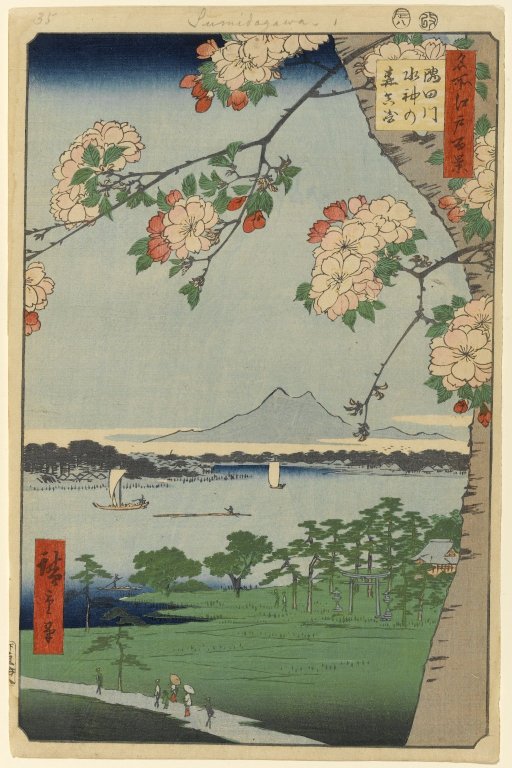
art beat: yesterday at the Art Institute of Chicago (after meeting with a client at the nearby federal jail)

Utagawe Hiroshige, Suijin Shrine and Massaki on the Sumida River (from the series One Hundred Famous Views of Edo), c. 1856

*****

reading table

Were I to choose an auspicious image for the new millennium, I would choose . . . the sudden agile leap of the poet-philosopher who raises himself above the weight of the world, showing that with all his gravity he has the secret of lightness, and that what many consider to be the vitality of the times—noisy, aggressive, revving and roaring—belongs to the realm of death, like a cemetery for rusty old cars.

—Italo Calvino, “Lightness,” in Six Memos for the New Millenium (1988, translated from Italian by Patrick Creagh)

*****

*PB, tenor sax/clarinet/tarogato; Mars Williams, tenor/alto/soprano sax/clarinet; Ken Vandermark, tenor sax/clarinet/bass clarinet; Mats Gustafsson, baritone sax/fluteophone; Joe McPhee, pocket cornet/valve trombone/soprano sax; Jeb Bishop, trombone; Fred Lonberg-Holm, cello; Kent Kessler, bass; Michael Zerang, drums/percussion; Hamid Drake, drums/percussion.

Tuesday, 4/24/12

not for the faint of heart

Phil Minton (vocals), Mats Gustafsson (baritone saxophone), John Russell (guitar), live, London (Cafe Oto), 2010

**********

lagniappe

art beat: Sunday at the Art Institute of Chicago

Pierre-Auguste Renoir, Seascape, 1879

Sometimes, when posting an image of a painting, I wonder: “Why bother?” No art form resists reproduction more successfully.

Monday, 4/23/12

Charles Mingus Quintet,* “So Long Eric,” “Peggy’s Blue Skylight,” “Meditations On Integration” (all by Mingus), live (TV show), Belgium, 1964

Mingus’s music, it seems, has everything. Call it “simple” or “complex” and you’d be both right and wrong—it’s both. Compositional elegance is balanced, exquisitely, with improvisational unruliness. Rhythmic momentum is no less—and no more—important than melodic invention. Like Ellington and Monk, he will, I’m confident, still be listened to a hundred years from now.

(Excerpts from this program have been posted previously.)

**********

lagniappe

art beat: yesterday at the Art Institute of Chicago

Ludovico Carracci, The Vision of Saint Francis, c. 1602

Going to the Art Institute again, after being away for a while, I felt a bit like someone who doesn’t realize he’s starving until he finds himself at a feast.

*****

*CM, bass; Eric Dolphy, alto saxophone, flute, bass clarinet; Clifford Jordan, tenor saxophone; Jaki Byard, piano; Dannie Richmond, drums.

Friday, 4/20/12

passings

Levon Helm, drummer, singer, songwriter, actor, etc.
May 26, 1940-April 19, 2012

Live,  2/12, Woodstock, NY (Levon’s home)

“Ophelia”

***

“The Weight”

*****

“When I Go Away,” recording (Electric Dirt, 2009)

**********

lagniappe

Levon Helm will always hold a special place in my heart. He was as great of an actor as a musician. For me watching him play the role of my daddy in Coal Miner’s Daughter is a memory I will always treasure.

Loretta Lynn

*** 

When I heard The Band’s Music from Big Pink, their music changed my life. And Levon was a big part of that band. Nigel Olson, my drummer, will tell you that every drummer that heard him was influenced by him. He was the greatest drummer and a wonderful singer and just a part of my life that was magical. They once flew down to see me in Philadelphia and I couldn’t believe it. They were one of the greatest bands of all time. They really changed the face of music when their records came out. I had no idea he was sick so I’m very dismayed and shocked that he died so quickly. But now my son [Zachary Jackson Levon Furnish-John] has his name.

Elton John

***

He was my bosom buddy friend to the end, one of the last true great spirits of my or any other generation. This is just so sad to talk about. I still can remember the first day I met him and the last day I saw him. We go back pretty far and had been through some trials together. I’m going to miss him, as I’m sure a whole lot of others will too.

Bob Dylan

Wednesday, 4/18/12

Peter Brötzmann, reed player, composer, bandleader
German Blues, performances 1999-2002, interview 2000

You can have the blues even if you’re German . . .

—Peter Brötzmann

**********

lagniappe

found words: AOL Headlines

Autistic Cheerleader Inspires Her Squad

*****

Kayaker Drowns After Swan Attack

Sunday, 4/15/12

Deep River Choir, Amiri Baraka (spoken words), David Murray (tenor saxophone), “Oh Freedom,” live

One reason this works so well is that none of the participants—not the singers, not Amiri Baraka, not David Murray—tries to take the performance over. How refreshing, and inspiring, in an age whose motto seems to be “look at me,” to come across folks so intent on serving—not dominating—a performance.

Friday, 4/6/12

Happy (75th) Birthday, Merle!

Merle Haggard, live

“Lonesome Fugitive,” Buck Owens Ranch Show, 1966

***

“Working Man Blues,” Austin City Limits, 1978

***

“Today I Started Loving You Again,” with Tammy Wynette, England (Wemberly), 1988