Tuesday, March 14th
never enough
Wolfgang Amadeus Mozart (1756-1791), Piano Concerto No. 20 in D minor; Munich Philharmonic Orchestra with Friedrich Gulda (conducting, piano), live
**********
lagniappe
random sights
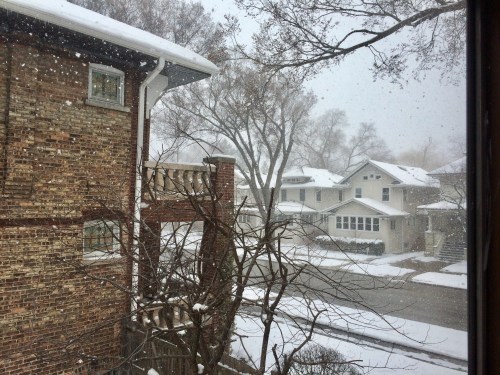
today, Oak Park, Ill.
never enough
Wolfgang Amadeus Mozart (1756-1791), Piano Concerto No. 20 in D minor; Munich Philharmonic Orchestra with Friedrich Gulda (conducting, piano), live
**********
lagniappe
random sights
today, Oak Park, Ill.
MCOTD Hall of Fame
William Parker’s In Order To Survive (WP, bass, composition; Hamid Drake, drums, MCOTD Hall of Fame;* Lewis Barnes, trumpet; Rob Brown, alto saxophone; Cooper-Moore, piano), “Criminals in the White House,” live, New York, 2013
**********
lagniappe
radio
Today—his birthday—it’s all Ornette Coleman all day on WKCR-FM (Columbia University).
*****
*With saxophonists Von Freeman and Henry Threadgill; trumpeter Lester Bowie; gospel singer Dorothy Love Coates; composer Morton Feldman; poets John Berryman, William Bronk, and Wislawa Szymborska; and photographer Helen Levitt.
tonight in Chicago
These guys, from Australia, are playing at Constellation.
The Necks, live, London, 2016
**********
lagniappe
reading table
The Imaginary Iceberg
by Elizabeth Bishop (1911-1979)We’d rather have the iceberg than the ship,
although it meant the end of travel.
Although it stood stock-still like cloudy rock
and all the sea were moving marble.
We’d rather have the iceberg than the ship;
we’d rather own this breathing plain of snow
though the ship’s sails were laid upon the sea
as the snow lies undissolved upon the water.
O solemn, floating field,
are you aware an iceberg takes repose
with you, and when it wakes may pasture on your snows?This is a scene a sailor’d give his eyes for.
The ship’s ignored. The iceberg rises
and sinks again; its glassy pinnacles
correct elliptics in the sky.
This is a scene where he who treads the boards
is artlessly rhetorical. The curtain
is light enough to rise on finest ropes
that airy twists of snow provide.
The wits of these white peaks
spar with the sun. Its weight the iceberg dares
upon a shifting stage and stands and stares.The iceberg cuts its facets from within.
Like jewelry from a grave
it saves itself perpetually and adorns
only itself, perhaps the snows
which so surprise us lying on the sea.
Good-bye, we say, good-bye, the ship steers off
where waves give in to one another’s waves
and clouds run in a warmer sky.
Icebergs behoove the soul
(both being self-made from elements least visible)
to see them so: fleshed, fair, erected indivisible.
basement jukebox
Little Johnny Jones (vocals, piano; 1924-1964), “Big Town Playboy,” 1950
**********
lagniappe
art beat: other day, Whitney Museum of American Art (New York)
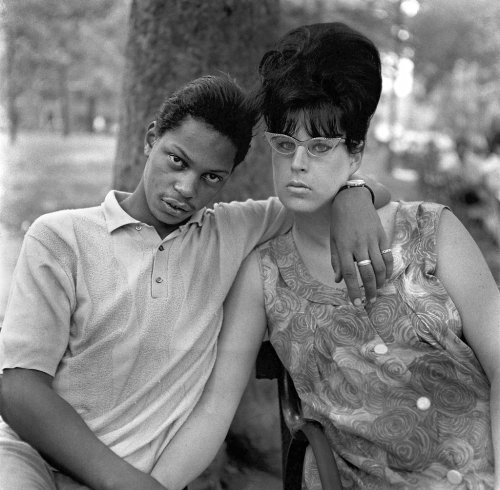
Diane Arbus (1923-1971), A young man and his pregnant wife in Washington Square Park, NYC, 1965
A handful of pieces I never tire of, no matter how many times I hear them. This is one.
Morton Feldman (1926-1987; MCOTD Hall of Fame), For Bunita Marcus (1985); Stephen Drury (piano), live, Boston, 2016
**********
lagniappe
art beat: other day, Museum of Contemporary Art Chicago
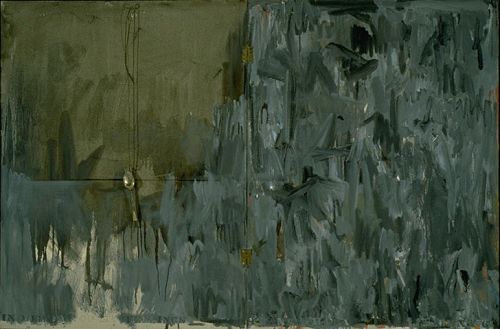
Jasper Johns (1930-), In Memory of My Feelings—Frank O’Hara, 1961
If I knew I had a week to live, this is one of the recordings I would want to hear.
Frederic Chopin (1810-1849), 24 Preludes
Alfred Cortot (1877-1962), piano, 1933/34
**********
langiappe
reading table
dizzying, adj. making you feel dizzy. E.g., reading a John Ashbery poem.
Listen to it the way everybody
here was naughty today,
of how broad it is.Foreign man with an affluent cigar,
he used to live on top of this bed
on the local rails he was so proud of
among the recyclables, this morning,
spouting words that I thought were other.
Yes, and they became addictive. Oh,make me a boy again! Do something!
But the little candle just stood there,
reflected in its lozenge-shaped mirror.
Maybe that was “something,”
a lithe sentence.He’s only going to do it for the first time.
It’s snowing hard.Hand me the orange.
—John Ashbery (1927-), “Just So You’ll Know,” New Yorker, 2/13 & 20/17
Quiet, beauty—sometimes they seem to have all but disappeared.
Valentin Silvestrov (piano), live, Ukraine (Kiev), 2012
**********
lagniappe
random thoughts
I’ve been a criminal defense lawyer for over 30 years. Week in and week out, I’m in federal and state courts. I have deeply mixed feelings about our legal system. But last night, as I read the Ninth Circuit’s 29-page ruling, I felt enormous gratitude for the one branch of government that currently seems capable of—or even interested in—thoughtful analysis.
what’s new
Craig Taborn, Daylight Ghosts, 2017
The other day I bumped into this guy in New York, at The Guggenheim, where we were both seeing the Agnes Martin exhibit. We talked for a moment—I told him how much I like his music. Then our eyes went back to the paintings.
**********
lagniappe
art beat: other day, The Guggenheim (New York)
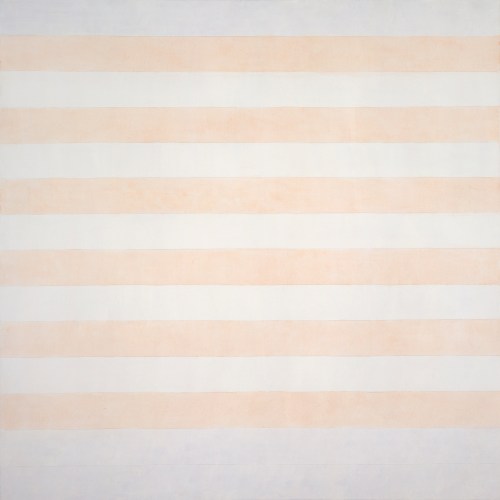
Agnes Martin (1912-2004), Happy Holiday, 1999
What we need—now more than ever.
Clickety Clack! Clickety Clack!
What is this madness that Nixon has put upon us?
Clickety Clack! Clickety Clack!
Won’t someone bring the spirit back?—Rahsaan Roland Kirk (1935-1977), 1973
Rahsaan Roland Kirk, Bright Moments, recorded live (San Francisco), 1973*
*****
*Track list (courtesy of YouTube):
A1. Introduction
2. Pedal Up
3. You’ll Never Get To Heaven
4. Clickety Clack
5. Prelude To A Kiss
6. Talk (Electric Nose)
7. Fly Town Nose Blues
B1. Talk (Bright Moments)
2. Bright Moments Song
3. Dem Red Beans And Rice
4. If I Loved You
5. Talk (Fats Waller)
6. Jitterbug Waltz
7. Second Line Jump
This I could listen to all day.
Jürg Frey (1953-), Sam Lazaro Bros (1984); Dante Boon, piano
**********
lagniappe
musical thoughts
As with breaths, so too with sounds: one after another—each new.
*****
art beat: other day, The Guggenheim (New York)
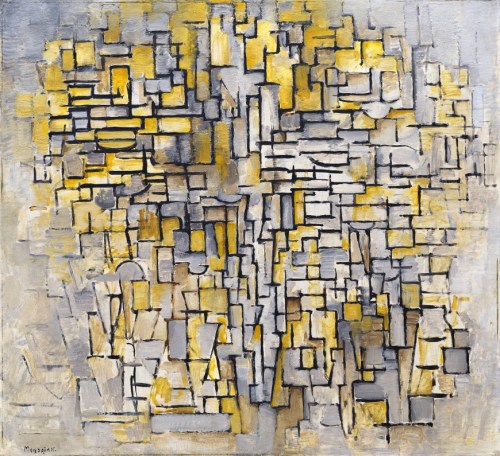
Piet Mondrian (1872-1944), Tableau No. 2/Composition No. VII, 1913
 music clip of the day