Sunday, 8/22/10
I have no idea what they’re saying.
It makes no difference.
I could listen to this all day.
(That’s why God made “replay.”)
The South African Gospel Singers, live, Wales (Brecon Jazz Festival), 2006
I have no idea what they’re saying.
It makes no difference.
I could listen to this all day.
(That’s why God made “replay.”)
The South African Gospel Singers, live, Wales (Brecon Jazz Festival), 2006
Here’s more from the guy who, the other day, we heard live in Slovenia.
Bob Dylan, “Beyond Here Lies Nothin'” (2009)
**********
lagniappe
Howlin’ Wolf (with Hubert Sumlin, guitar; Hosea Lee Kennard, piano; Alfred Elkins, bass; Earl Phillips, drums), “Who’s Been Talking” (Chess Records, Chicago, 1957)
More Howlin’ Wolf? Here.
*****
lagniappe
art beat
The New Yorker (8/16/10) writes of Matisse’s Bathers by a River, which is currently on view, in the exhibit “Matisse: Radical Invention, 1913-1917,” at the Museum of Modern Art: “it consumes at least as much aesthetic energy as it imparts.” Except when it’s on loan elsewhere, this painting hangs at Chicago’s Art Institute. Over the years I’ve seen it dozens (maybe hundreds) of times. Never once, as I looked at it, did it occur to me how much “aesthetic energy” it was “consum[ing].”
Henri Matisse, Bathers by a River (1909-16)

my new mantra
Say ‘bye bye, bogeyman.’
—Whispering Jack Smith
Whispering Jack Smith, “Happy Days” (Happy Days [shot in 1929, released in 1930])
**********
lagniappe
more music to chase away the bogeyman
Sidney Bechet (clarinet, with Henry “Red” Allen, trumpet; J.C. Higginbotham, trombone; James Tolliver, piano; Wellman Braud, bass; J.C. Heard, drums), “Egyptian Fantasy” (1941)
Let’s lift the bandstand.
—Thelonious Monk
Woody Shaw/Johnny Griffin Quintet (Woody Shaw, trumpet; Johnny Griffin, tenor saxophone; John Hicks, piano; Reggie Johnson, bass; Alvin Queens, drums), “Night in Tunisia,” live, Germany (Koln), 1986
**********
lagniappe
Now there’s a great trumpet player. He [Woody Shaw] can play different from all of them.
—Miles Davis
*****
Anthony Braxton on playing with Woody Shaw.
*****
reading table
Look after the sound and the sense will take care of itself.
—Adam Phillips, London Review of Books, 7/22/10 (reviewing Christopher Ricks’ True Friendship: Geoffrey Hill, Anthony Hecht and Robert Lowell Under The Sign Of Eliot And Pound)
recipe
1 cup funkiness
1 cup elegance
Mix until thoroughly blended.
Professor Longhair (AKA Henry Roeland [“Roy”] Byrd), December 19, 1918-January 30, 1980
“Tipitina,” live
*****
“Hey Little Girl,” live
**********
lagniappe
Mike Kinnamon, Bonnie Bramlett’s Nashville-based manager, in response to an email letting him (and Bonnie) know that her music was featured here (Delaney, alas, is no longer alive), left a voice-mail message yesterday:
. . . I just love it when somebody like you cares enough to send stuff like that around. It’s really cool, and it lifts her [Bonnie] up, too. Thank you so much, buddy . . .
What do I listen to these days?
This more than anything.
Each night it’s the last thing I hear before falling asleep. Having left the Bose on “repeat” (usually Hildegard Kleeb [Hat Hut], sometimes John Tilbury [Extraplatte]), it’s the first thing I hear upon awakening. It seems, sometimes, as if it’s always playing—whether I’m listening or not.
Morton Feldman, “For Bunita Marcus” (1985)/Mark Knoop (piano), live, London, 2010
Part 1
***
Part 2
***
Part 3
***
Part 4
***
Part 5
***
Part 6
***
Part 7
***
Part 8
Want more? Here. Here. Here. Here.
**********
lagniappe
Almost all Feldman’s music is slow and soft. Only at first sight is this a limitation. I see it rather as a narrow door, to whose dimensions one has to adapt oneself (as in Alice in Wonderland) before one can pass through it into the state of being that is expressed in Feldman’s music. Only when one has become accustomed to the dimness of light can one begin to perceive the richness and variety of colour which is the material of the music. When one has passed through the narrow door and got accustomed to the dim light, one realises the range of his imagination and the significant differences that distinguish one piece from another . . .
Feldman sees the sounds as reverberating endlessly, never getting lost, changing their resonances as they die away, or rather do not die away, but recede from our ears, and soft because softness is compelling, because an insidious invasion of our senses is more effective than a frontal attack. Because our ears must strain to catch the music, they must become more sensitive before they perceive the world of sound in which Feldman’s music takes place.
*****
Legend has it that after one group of players had crept their way as quietly as possible through a score of his Feldman barked, ‘It’s too fuckin’ loud, and it’s too fuckin’ fast.’
—Alex Ross, “American Sublime,” The New Yorker, 6/19/06
I’ve tried listening to his recordings while doing something else, but that hasn’t worked. Whatever else I was doing, I just put aside. If it was nighttime, I turned off the light. Some music occupies every available inch of space—there isn’t room for anything else.
Alfred Cortot: Frederic Chopin, “Farewell” (Waltz in A-flat major, Op. 69, No. 1 [excerpt]); Robert Schumann, “Der Dichter Spricht” (Op. 15, No. 13 in G major [excerpt])
**********
lagniappe
Cortot looked for the opium in music.
—Daniel Barenboim
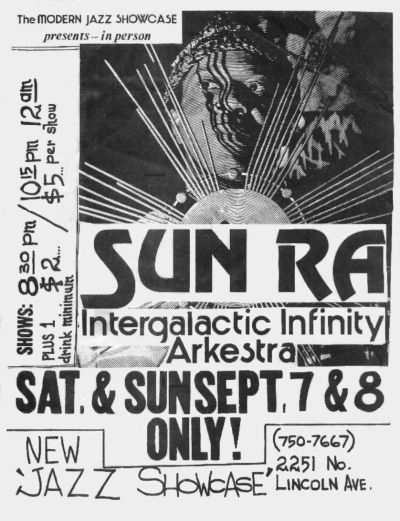
Here’s a big birthday shout-out to my wife Suzanne, who’s not nearly as crazy as I am about music—not nearly as crazy, period—but is crazy enough that she kept going out with me after I took her on our first date, in the summer of 1974, to Chicago’s Jazz Showcase (then on Lincoln Avenue) to see this guy, whose multimedia performance that night featured some of this footage—the stuff with the pyramids.
Sun Ra & His Arkestra in Egypt and Italy, 1971
**********
lagniappe
Even in the excesses of this era there were few audiences prepared for an ominous, ragtag group of musicians in Egyptian robes, Mongolian caps (Mongolian, as from the planet Mongo of Flash Gordon), and B-movie spacesuits who played on a variety of newly invented or strangely modified electronic instruments (the sun harp, the space organ, the cosmic side drum) and proclaimed the greatness of the most ancient of races (this, the Sun Ra of the Solar-Myth Arkestra); or, on yet another night, a merry band in jester’s motley, jerkins, and pointed caps (a la Robin Hood or perhaps the Archers of Arboria) who marched or crawled through the audience, chanting cheerful songs about travel to Venus. It was intensely dramatic music, moving from stasis to chaos and back, horn players leaping about, or rolling on the bandstand, sometimes with fire eaters, gilded muscle men, and midgets, an all-out assault on the senses. At the end of the evening the musicians and dancers moved among the audience, touching them, surrounding them, inviting them to join the Arkestra in marching off to Jupiter.
—John F. Szwed, Space Is The Place: The Lives And Times Of Sun Ra (1997)
*****
Sun Ra’s consistent statement, musically and spoken, is that this is a primitive world. Its practices, beliefs, religions, are uneducated, unenlightened, savage, destructive, already in the past. . . . That’s why Sun Ra returned only to say he left. Into the future. Into Space.
—Amiri Baraka (formerly known as LeRoi Jones)
*****
Silence is music. There are different kinds of silence, each silence is a world all of its own . . . silence is an integral part of all music . . .
***
When you meet a man
You meet a scheme of words
Patterns of concept
A concepted being
Whose very birth conception is called.
***
The earth cannot move without music. The earth moves in a certain rhythm, a certain sound, a certain note. When the music stops the earth will stop and everything upon it will die.
—Sun Ra
*****
replay: a clip too good for just one day
Here is the onliest Thelonious.
Thelonious Monk, “Epistrophy,” live (TV broadcast), Paris, 1966
*****
Thelonoius Monk, “’Round Midnight,” live (TV broadcast)
*****
You can tell a lot about Monk’s music—about the centrality of dance, about the interplay between melody and rhythm, about the way a melody’s irregular accents override the pulse (making the dance melodic)—just by watching, in the second performance, the way his right foot moves.
**********
lagniappe
He played each note as though astonished by the previous one, as though every touch of his fingers on the keyboard was correcting an error and this touch in turn became an error to be corrected and so the tune never quite ended up the way it was meant to be.
***
You had to see Monk to hear his music properly. The most important instrument in the group—whatever the format—was his body.
—Geoff Dyer, But Beautiful: A Book About Jazz (1996)
(Originally posted 11/2/09.)
 music clip of the day