He’s [Tom Jones] got a new gospel album out on Lost Highway that is really good.
***
Absolutely love your latest clips. Was that Kermit Ruffins and Trombone Shorty on the Rebirth clip [don’t believe so]? If you haven’t already, please check out Praise & Blame by Tom Jones. I picked it up after reading a review by Jim Fusilli in the WSJ. It is very good. Thanks for what you do. I look forward to your email each day.
*****
art beat
The other day I happened upon a wonderful photography exhibit at the Chicago Cultural Center (through September 19th), The Jazz Loft Project, W. Eugene Smith in NYC, 1957-1965.
From Smith’s loft (821 Sixth Ave. [near W. 28th St.])
***
Thelonious Monk
***
Zoot Sims
*****
musical thoughts
It is hard to believe of the world that there should be/music in it . . .
—William Bronk (from “The Nature of Musical Form”)
If you were a musician, could anything be worse than to find, one day, that unlike the day before, and the day before that, and all the other days you could remember, you were no longer able to play your instrument? That’s what happened, in 1958, to this man, the great British classical pianist Solomon Cutner (known professionally simply as Solomon). Then 56 years old and at the height of his career, he suffered a stroke. It left his right arm paralyzed, silencing him for the rest of his life, which lasted another 32 years.
Beethoven, Piano Sonata No. 23 in F minor (“Appassionata” [1804])/Solomon, piano
1st Movement
2nd Movement
3rd Movement
lagniappe
Andras Schiff on Beethoven’s piano sonatas
In London a couple years ago, pianist Andras Schiff explored Beethoven’s 32 piano sonatas in a series of much-acclaimed lecture-recitals, which can be heard here.
*****
Thelonious Monk and Beethoven, Bach, Chopin, et al.
Thelonious Monk possessed an impressive knowledge of, and appreciation for, Western classical music, not to mention an encyclopedic knowledge of hymns and gospel music, American popular songs, and a variety of obscure art songs that defy easy categorization. For him, it was all music. Once in 1966, a phalanx of reporters in Helsinki pressed Monk about his thoughts on classical music and whether or not jazz and classical can come together. His drummer, Ben Riley, watched the conversation unfold: ‘Everyone wanted him to answer, give some type of definition between classical music and jazz . . . So he says, ‘Two is one,’ and that stopped the whole room. No one else said anything else.’ Two is one, indeed. Monk loved Frédéric Chopin, Sergei Rachmaninoff, Beethoven, and Bach, and like many of his peers of the bebop generation, he took an interest in Igor Stravinsky.—Robin D. G. Kelley, Thelonious Monk: The Life and Times of an American Original (2009)
(Originally posted on 11/3/09.)
**********
lagniappe: more
Since yesterday I’ve been listening nearly nonstop to WKCR-FM, which (as mentioned in yesterday’s post) is devoting three straight days to the music of Lester Young and Charlie Parker, in celebration of their respective birthdays (LY’s was Friday, CP’s is tomorrow). Something happens—something delicious—when you surrender your ears and yourself to someone’s music for such a sustained period of time. Little by little, that musician moves in, taking up residence in your brain. Their distinctive voice becomes, for a time, inseparable from everything else you’re hearing and seeing and thinking and feeling. If you’d like to experience this for yourself, go here (you won’t regret it).
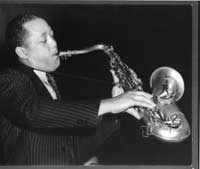
Lester Young, August 27, 1909-March 15, 1959
(nicknamed “Pres” [or “Prez”] by Billie Holiday, who called him the “president of tenor saxophonists”)
Who else is at once so earthy and so ethereal?
Jammin’ the Blues (1944)
**********
lagniappe
On Lester Young
B.B. King:
***
Lee Kontiz:
***
Joe Lovano:
*****
Want more?
One of my favorite radio stations, WKCR-FM (based at Columbia University and available on-line), is celebrating Pres’s birthday in the best possible way—playing his music all day. (Actually, they’re playing his music for 36 hours straight, until the middle of the day tomorrow, when they’ll begin playing the music of Charlie Parker, whose birthday is Sunday, for the next 36 hours.)
The New Yorker (8/16/10) writes of Matisse’s Bathers by a River, which is currently on view, in the exhibit “Matisse: Radical Invention, 1913-1917,” at the Museum of Modern Art: “it consumes at least as much aesthetic energy as it imparts.” Except when it’s on loan elsewhere, this painting hangs at Chicago’s Art Institute. Over the years I’ve seen it dozens (maybe hundreds) of times. Never once, as I looked at it, did it occur to me how much “aesthetic energy” it was “consum[ing].”
Woody Shaw/Johnny Griffin Quintet (Woody Shaw, trumpet; Johnny Griffin, tenor saxophone; John Hicks, piano; Reggie Johnson, bass; Alvin Queens, drums), “Night in Tunisia,” live, Germany (Koln), 1986
**********
lagniappe
Now there’s a great trumpet player. He [Woody Shaw] can play different from all of them.
—Miles Davis
*****
Anthony Braxton on playing with Woody Shaw.
*****
reading table
Look after the sound and the sense will take care of itself.
—Adam Phillips, London Review of Books, 7/22/10 (reviewing Christopher Ricks’ True Friendship: Geoffrey Hill, Anthony Hecht and Robert Lowell Under The Sign Of Eliot And Pound)
Professor Longhair (AKA Henry Roeland [“Roy”] Byrd), December 19, 1918-January 30, 1980
“Tipitina,” live
*****
“Hey Little Girl,” live
**********
lagniappe
mail
Mike Kinnamon, Bonnie Bramlett’s Nashville-based manager, in response to an email letting him (and Bonnie) know that her music was featured here (Delaney, alas, is no longer alive), left a voice-mail message yesterday:
. . . I just love it when somebody like you cares enough to send stuff like that around. It’s really cool, and it lifts her [Bonnie] up, too. Thank you so much, buddy . . .