music clip of the day

jazz/blues/rock/classical/gospel/more

Category: passings

Saturday, 4/16/11

Billy Bang (AKA William Vincent Walker), violinist, 9/20/47-4/11/11

Billy Bang Quintet (BB, violin; Frank Lowe, tenor saxophone; Ahmed Abdullah, trumpet; William Parker, bass; Abbey Rader, drums), live, New York (Knitting Factory), 10/1/00

Vodpod videos no longer available.

*****

Billy Bang Quartet (BB, violin; Ngo Thanh Nahn, dan tranh; Todd Nicholson, bass; Shoji Hano, drums), live, New York (Vision Festival X), 6/18/05

Vodpod videos no longer available.

**********

lagniappe

As I lived in Harlem in the early Fifties as a kid, I heard music all around me from the jazz clubs and from the candy stores. They had speakers outside the candy stores that they would play music, music like Eddie Harris and once in a while, Brubeck’s “Take Five.” So I started hearing jazz very, very early, and when you lived in Harlem in those days, it was in the blood. It was in the people. It was in the clothing. It was prevalent. As a young man, I bought a pair of bongos and two of my friends and I used to play the bongos on the New York City subway system. We would take turns dancing and playing the bongos and earn some money. That was my professional debut in the music.

***

I bought the Delmark records and heard Leroy Jenkins. Then I started hearing all the Joseph Jarman and Roscoe Mitchell. I loved the AACM. I loved Delmark for putting them out, Muhal Richard Abrams. This music really turned me on. It seemed very political, very conscious for me at the time and also very free, but with structure. So when Leroy Jenkins came to New York, I tracked him down and I did a little study with him for about six months. It was enough to reshape my direction. I already had a direction, but it really straightened it. From that point on, I just kept trying to go for it. Nobody would hire me, but that didn’t stop me. I would hire myself and hire a band and we would play at places like lofts in New York. Eventually, loft jazz became very, very big in New York and that catapulted my name and my career. During that period, I did all sorts of things, sitting in with Sam Rivers at The Five Spot. I sat in with Jackie McLean. I just had to be around the music and the cats that I loved and respected. I was disappointed that John Coltrane passed away because I think I would have followed him day after day after day to try and get in his band.

***

[The loft scene] was a very big thing. I think that catapulted my name internationally along with the David Murrays, the Henry Threadgills, the Frank Lowes, the Lester Bowies, the Joe Bowies. A lot of us wrote our own compositions. We weren’t playing standards. The bebop guys had to play standards to be legitimate. We were able to create our own music, direction, and compositions that also helped to lend a more directional input into the music. The loft jazz’s impact of it came when the Newport Jazz Festival came to New York that year and they didn’t hire any of us, so we had our own loft jazz festival. There were meetings and I remember Archie Shepp was talking and Rashied Ali was talking. I was very, very happy to be in New York at that time and to be around such a powerful movement with powerful names in it, Braxton, a lot of cats, all the cats that I love. We started setting up concerts all over, all the places. Sam Rivers had Rivbea and Rashied Ali had Ali Alley, which is where I played most of the time. When I played there with my Survival group, Werner Uehlinger came from hatHUT and he signed me to do a solo record. We were very adamant and strong about what we were doing. We were committed in belief. The World Saxophone Quartet started. The String Trio of New York started. Air was here. There was a lot of power going on simultaneously. There was a movement going on. We actually saw it in the making. I find it extremely important. The only reason why it does not have as much importance as I see it is because a lot of the writers didn’t pick up on it. Francis Davis from Philadelphia, he did and Stanley Crouch to some degree. There were people that picked up on it, but it wasn’t enough of a movement. The next year, George Wein hired some of the loft guys to play at the jazz festival. I was even offered a gig there with the String Trio. I didn’t make it because I like to hold out. I will be very honest, Fred. After I did my tour in Vietnam, I felt above a lot of the everyday activities in this world. I faced death and I think I had died more than once, so after that, I was sort of an untouchable. Me with my music, I didn’t feel the threatening situation that others felt. I didn’t feel obligated to have to compromise or the necessity to have to kiss anybody’s ass. I was determined to be focused in a Billy Bang direction until today, I am the same way. I think that strength is what kept me going, that commitment of strength, that conviction. They didn’t like the things that I did in the beginning. In fact, I didn’t like a lot of it, but I was committed enough to keep trying and not be shot down by critics, writers, peers, whomever.

***

Cats [today] are trying to be technical. You can exercise all your technical prowess and you sound like what’s been out already. I hear more guys sound like Clifford Brown or Freddie Hubbard then I heard them do. That was not the thing. We were always going for individual voices and individual sound. That is the only thing that almost made me stop. I didn’t sound like anybody. I thought I sounded so horrible that one particular day, I was ready to smash up my violin and I remember James Jackson from the Sun Ra band came in and tried to recruit me and he had a long talk with me. He told me that I had my own sound and that I had a Billy Bang sound. I took that to heart and started working from that perspective and saying that I needed to keep working at it and developing my sound.

Billy Bang (2003)

Wednesday, 4/13/11

what’s new
an occasional series

The future of hip-hop?

Odd Future (with The Roots), “Sandwitches,” live (TV broadcast), 2/16/11

Vodpod videos no longer available.

**********

lagniappe

reading table

The bad news is the ship hasn’t arrived;
the good news is it hasn’t left yet.

—John Ashbery, “He Who Loves And Runs Away” (excerpt; Planisphere [2009])

*****

radio

WKCR-FM (broadcasting from Columbia University) will be playing the music of jazz violinist Billy Bang, who died Monday night, all day.

Saturday, 3/26/11

The notes are easy enough to replicate—the touch impossible.

Pinetop Perkins (piano, vocals), July 7, 1913-March 21, 2011

“Grindin’ Man” (with Willie “Big Eyes” Smith, harmonica), live, New Jersey (New Brunswick), 2008

Vodpod videos no longer available.

*****

“How Long Blues,” live

Vodpod videos no longer available.

**********

lagniappe

He was one of the last great Mississippi Bluesmen. He had such a distinctive voice, and he sure could play the piano. He will be missed not only by me, but by lovers of music all over the world.

B.B. King

*****

If you don’t want to die, don’t be born.

Red Paden, owner of Red’s Blues Club, Clarksdale, Mississippi

*****

my back pages

Many years ago I had the pleasure of working with him, co-producing his tracks on Living Chicago Blues, Vol. 2 (Alligator 1978). Warm, amiable, unassuming—he was easy to like.

*****

listening room: what’s playing

• Ornette Coleman, Town Hall 1962

• Mos Def, The Ecstatic

Lupe Fiasco, Lasers

Steve Reich, Double Sextet, 2×5

Rudresh Mahanthappa & Bunky Green, Apex

Nneka, Concrete Jungle

Theo Parrish, Sound Sculptures, Vol. 1

Powerhouse Gospel On Independent Labels, 1946-1959

WFMU-FM: Sinner’s Crossroads (Kevin Nutt), Mudd Up! (DJ/rupture)

WKCR-FM: Bird Flight (Phil Schapp), Jazz Alternatives (various), Out To Lunch (various), Western Swing Festival (various)

Thursday, 3/24/11

Elizabeth Taylor, February 27, 1932-March 23, 2011

Michael Jackson, singing to Elizabeth Taylor (2003)

Vodpod videos no longer available.

Their relationship, apparently a very close one, seems less surprising when you consider the fact that they were both extremely complex figures in a culture that resists complexity, particularly in its celebrities, even more particularly in ones who happen to be female or black.

Sunday, 3/20/11

Sherman Washington Jr. (Zion Harmonizers)
December 13, 1925-March 14, 2011

Zion Harmonizers with Aaron Neville, “Wonderful,” live, New Orleans (Gospel Tent, New Orleans Jazz & Heritage Festival), 1991

Vodpod videos no longer available.

*****

lagniappe

Sherman Washington Jr., the leader of the Zion Harmonizers and the godfather of the New Orleans Jazz and Heritage Festival’s Gospel Tent, died early Monday at his home in Boutte after a long illness. He was 85.

sherman washington 2002 fest.jpg

What Ellis Marsalis is to jazz, Mr. Washington was to gospel. For three decades, he hosted a Sunday morning gospel show on WYLD-AM that served as the gospel community’s town hall. He led the Zion Harmonizers, New Orleans’ longest-running gospel vocal group, since the 1940s. The Harmonizers appeared at the very first Jazz Fest, staged in 1970 in what is now Armstrong Park.

After the festival moved to the Fair Grounds in 1972, he oversaw the growth of the Gospel Tent, building it into a cornerstone of the festival’s roots-music presentation. The tent introduced a music largely unknown outside the African-American churches where it was born to a much broader audience.

Until deteriorating health finally slowed him down in recent years, he administered the Gospel Tent with a steadfast integrity and intimate knowledge of the music, musicians and singers. Given that many acts consist of large choirs, the tent features more performers than any other stage at the festival.

“Gospel, even after jazz and blues came down to the front of the bus, was still in the back of the bus,” said Jazz Fest producer/director Quint Davis. “To a large extent, Sherman’s work through the Gospel Tent has helped bring gospel music to the front of the bus. An enormous debt is owed to him by the festival, and the whole gospel world.”

Davis expects the upcoming Jazz Fest to feature a tribute to Mr. Washington.

“You can talk about soul with either a lower-case ‘s’ or an upper-case ‘S,'” Davis said. “Sherman had soul with a capital S.”

***

In the late 1960s, the Harmonizers roster included a Mississippi-born bass singer named John Hawkins. In early 1970, Hawkins met Quint Davis at Mason’s Hotel on Claiborne Avenue and came back to Mr. Washington with news of this young music fan who was organizing a music and heritage festival.

Mr. Washington went to meet Davis and partner Allison Miner, and the Zion Harmonizers were booked for the first Jazz Fest at Congo Square. The forerunner of today’s Gospel Tent was a 15-by-20-foot open-sided tent with an upright piano and no floor, stage or sound system.

When Jazz Fest moved to the Fair Grounds in 1972, Davis approached Mr. Washington with an idea.

“Quint said, ‘I had a dream,’” Mr. Washington recalled. “And I thought, ‘This isn’t Dr. King, is it?’ He said, ‘I had a dream that I’m going to build a Gospel Tent, and I want you to run it.’ ”

Mr. Washington’s diplomatic skills came in handy. In the early 1970s, gospel choirs rarely performed outside of churches or church functions. They certainly didn’t perform at “hippie” events where beer was served. Pastors resisted the idea of choirs performing at Jazz Fest.

“The preachers were against me,” Mr. Washington said, “because people would drink beer in the Gospel Tent. I would ask the choir’s president or manager, and he’d tell me yeah. Then he’d come back and say, ‘Our pastor doesn’t want us to sing in the Gospel Tent.’ ”

So instead of church choirs, Mr. Washington booked vocal quartets that weren’t affiliated with churches.

“Those are the ones I had to depend on,” he said. “They would tear the place up, pack it out. We didn’t pay those preachers no mind. We kept going.”

Opinions eventually changed and choirs lobbied Mr. Washington to be included. “I think the choir members got on the pastors about it. Because if a person drinks a beer or something, that’s their soul, not yours. If you’re singing, you’re doing what God wants you to do.”

Eventually, a small staff was assigned to assist Mr. Washington, but he still screened most acts in person. He attended rehearsals and private auditions, offering advice along the way.

“He had never been in a role like this,” Davis said. “He was a true man of God who was not in it to advance himself or build an empire. He worked through his community and spiritual connections to put it all together. He knew who was the real deal, who needed to play.”

Mr. Washington insisted on a high level of professionalism and skill, as he knew any group could well be some Jazz Fest’s attendee’s first exposure to gospel. He wanted the music to make a good first impression.

“This Gospel Tent has brought more white people to gospel than anybody had ever seen, ” Mr. Washington said in 2002. “Now, it’s more white people than black people. And they get into it. It brings the white and black together. People get together and stand up, you don’t know who is who.”

—Keith Spera, The Times-Picayune (New Orleans), 3/14/11

On March 14, 2011 at 2:36 AM, the music stopped and his lyrics became a reality.

Obituary (The Times-Picayune)

*****

listening room: what’s playing

• Bach, Cello Suites, Steven Isserlis, Jean-Guihen Queyras

• Von Freeman, Walkin’ Tuff, Vonski Speaks, Young & Foolish

• Milton Babbitt, Piano Works, Robert Taub

• Buddy & Julie Miller, Written in Chalk

Nneka, Concrete Jungle

Jason Moran, Ten

Steve Lehman, Travail, Transformation, and Flow

Friedrich Gulda, Piano Recital 1959 (Bach, Haydn, Beethoven)

• Theo Parrish, First Floor

• Theo Parrish, Sound Sculptures, Vol. 1

• Roger Sessions, Works for Violin, Cello, Piano; Curtis Macomber (violin), Joel Krosnick (cello), Barry David Salwen (piano)

• Roger Sessions, Sonatas Nos. 1 & 3; Ralph Shapey, Mutations and Mutations II, 21 Variations, David Holzman (piano)

• Yascha Heifetz (violin), Chamber Music Collection, Vol. 1 (Mozart, et al.)

• Morton Feldman, For Bunita Marcus, Stephane Ginsburgh (piano)

Sinner’s Crossroads, Kevin Nutt, WFMU-FM (Thursday, 8-9 p.m. [EST])

Gospel Memories, Bob Marovich, WLUW-FM (Saturday 10-11 a.m. [CST])

Give the Drummer Some, Doug Schulkind, WFMU-FM (Friday, 9 a.m.-noon [EST]; web stream only)

Bird Flight, Phil Schaap, WKCR-FM (M-F, 8:20-9:30 a.m. [EST])

• WFMU-FM, Annual Fundraising Marathon

Tuesday, 3/15/11

Big Jack Johnson, July 30, 1940-March 14, 2011

Live (Deep Blues, 1992)

“Catfish Blues”

Vodpod videos no longer available.

***

“Daddy, When Is Mama Coming Home”

Vodpod videos no longer available.

**********

lagniappe

art beat

American Modern: Abbott, Evans, Bourke-White
Art Institute of Chicago (through 5/15/11)

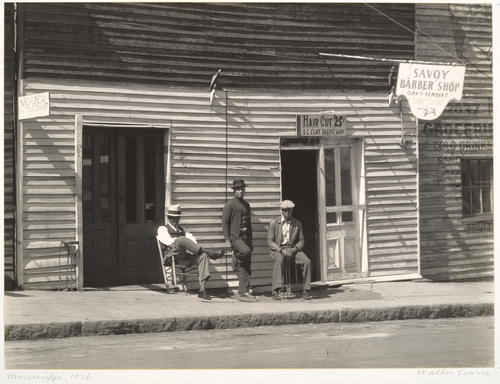
Walker Evans, Barbershops, Vicksburg, Mississippi (1936)

Thursday, 2/17/11

When I was in my 20s, this wouldn’t have appealed to me at all—
too “light,” too “cool,” not “adventurous” enough. But to borrow from
Bobby D., “I was so much older then, I’m younger than that now.” Most of what I liked then I still like. But I like a lot of other things, too. It helps,
I’ve found, if you listen, closely, to what is there—not what isn’t.

George Shearing, August 13, 1919-February 14, 2011

George Shearing Quintet (GS, piano; Chuck Wayne, guitar; Joe Roland, vibes; John Levy, bass; Denzil Best, drums), 1950s

“Conception”

Vodpod videos no longer available.

***

“I’ll Be Around”

Vodpod videos no longer available.

***

“Swedish Pastry”

Vodpod videos no longer available.

***

“Move”

Vodpod videos no longer available.

**********

lagniappe

reading table

Dean and I went to see Shearing at Birdland in the midst of the long, mad weekend. The place was deserted, we were the first customers, ten o’clock. Shearing came out, blind, led by the hand to his keyboard. He was a distinguished-looking Englishman with a stiff white collar, slightly beefy, blond, with a delicate English-summer’s-night air about him that came out in the first rippling sweet number he played as the bass-player leaned to him reverently and thrummed the beat. The drummer, Denzil Best, sat motionless except for his wrists snapping the brushes. And Shearing began to rock; a smile broke over his ecstatic face; he began to rock in the piano seat, back and forth, slowly at first, then the beat went up, and he began rocking fast, his left foot jumped up with every beat, his neck began to rock crookedly, he brought his face down to the keys, he pushed his hair back, his combed hair dissolved, he began to sweat. The music picked up. The bass-player hunched over and socked it in, faster and faster, it seemed faster and faster, that’s all. Shearing began to play his chords; they rolled out of the piano in great rich showers, you’d think the man wouldn’t have time to line them up. They rolled and rolled like the sea. Folks yelled for him to “Go!” Dean was sweating; the sweat poured down his collar. “There he is! That’s him! Old God! Old God Shearing! Yes! Yes! Yes!” And Shearing was conscious of the madman behind him, he could hear every one of Dean’s gasps and imprecations, he could sense it though he couldn’t see. “That’s right!” Dean said. “Yes!” Shearing smiled, he rocked. Shearing rose from the piano, dripping with sweat; these were his great 1949 days before he became cool and commercial. When he was gone Dean pointed to the empty piano seat. “God’s empty chair,” he said. On the piano a horn sat; its golden shadow made a strange reflection along the desert caravan painted on the wall behind the drums. God was gone; it was the silence of his departure. It was a rainy night. It was the myth of the rainy night. Dean was popeyed with awe. This madness would lead nowhere.

—Jack Kerouac, On the Road (1957)

Wednesday, 2/16/11

Comedy, like jazz, is an art of syncopation.

Lenny Bruce, 1959 (with Cannonball Adderly, saxophone; Bill Evans, piano; Teddy Kotick, bass; Philly Joe Jones, drums)

Vodpod videos no longer available.

(Yeah, I could do without all the extra blah-blah-blah, too.)

More Lenny? Here.

**********

lagniappe

radio

Today WKCR-FM (broadcasting from Columbia University) is remembering George Shearing, who passed away Monday at the age of 91, with a memorial broadcast that runs until 9 p.m. (EST).

Thursday, 2/3/11

Music, like people, comes in all kinds. Some is easy to embrace, some thorny. I wouldn’t want to live without either.

Milton Babbitt, May 10, 1916-January 29, 2011

About Time, Alan Feinberg, piano

Vodpod videos no longer available.

***

String Quartet No. 2, Composers Quartet

Vodpod videos no longer available.

**********

lagniappe

His music can be playful, too.

Semi-Simple Variations, The Bad Plus

Vodpod videos no longer available.

*****

If you know anybody who knows more popular music of the ’20s or ’30s than I do, I want to know who it is. I grew up playing every kind of music in the world, and I know more pop music from the ’20s and ’30s, it’s because of where I grew up. We had to imitate Jan Garber one night; we had to imitate Jean Goldkette the next night. We heard everything from the radio; we had to do it all by ear. We took down their arrangements; we stole their arrangements; we transcribed them, approximately. We played them for a country club dance one night and for a high school dance the next.

Milton Babbitt

Tuesday, 2/1/11

I can’t make up my mind about the Internet.

Does it make it possible, with simply a click, to travel anywhere in the world?

Or is it just a vast collection of electronic wallpaper?

Are these the right questions?

Baloji, “Tout Ceci Ne Vous Rendra Pas le Congo” (Hotel Impala), 2007

Vodpod videos no longer available.

**********

lagniappe

radio

Having just completed two days of trumpeter Roy Eldridge’s music, WKCR-FM (broadcasting from Columbia University) begins a 24-hour Memorial Broadcast honoring composer Milton Babbitt, who passed away Saturday at the age of 94.