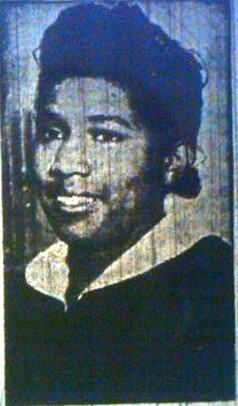
Delois Barrett Campbell, whose subtle phrasing and silvery soprano helped define the sound of the Barrett Sisters, a prominent Chicago gospel trio featured in the 1982 documentary “Say Amen, Somebody,” died on Tuesday in Chicago. She was 85.
The cause was a pulmonary embolism, her daughter Mary Campbell said.
Ms. Campbell, the eldest of the Barrett Sisters, initially caught the attention of the gospel world in the 1940s when she became the first soprano to join the Roberta Martin Singers and sang lead on their 1947 recording of “Yield Not to Temptation.”
She and her sisters, Rodessa and Billie, formed a group in the early 1960s that recorded on the Savoy label. They enjoyed modest hits with “Jesus Loves Me” and “I’ll Fly Away,” but real fame came with “Say Amen, Somebody,” which exposed them to a new generation of listeners and an enthusiastic European audience.
“That film put them on the map, and, in a way, Lois became the symbol of Chicago gospel,” said Anthony Heilbut, author of “The Gospel Sound: Good News and Bad Times.”
Delores Barrett was born on March 12, 1926, in Chicago, where she grew up on the South Side. She and her sisters sang at the Morning Star Baptist Church, where their father was a deacon and their mother sang in the choir, directed by their aunt, Mattie Dacus.
The sisters developed a high-pitched, close-harmony style influenced by the Andrews Sisters, with Delores’s light, ringing soprano, which had a semi-operatic quality, anchoring the group’s sound.
***
While a senior at Englewood High School, Delores was recruited by the Roberta Martin Singers, a seminal group from the Pilgrim Baptist Church that was known for its stellar roster of lead male voices, notably Robert Anderson and Norsalus McKissick. She continued to perform with her sisters as well.
In 1950 she married the Rev. Frank Campbell, who changed the spelling of her first name to conform to her nickname, Lois. In addition to their daughter Mary, of Chicago, she is survived by another daughter, Sue Ladd, also of Chicago; her sisters, Rodessa Barrett Porter and Billie Barrett GreenBey, both of Chicago; four grandchildren; and six great-grandchildren.
In 1962, when the Roberta Martin Singers were on the verge of breaking up, Ms. Campbell re-formed the trio with her sisters, who had gone on to rear children and pursue their own careers.
The group became a fixture on the Chicago gospel scene, appearing often on “Jubilee Showcase,” a local television show that featured the nation’s top gospel groups in the 1960s and ’70s.
The trio often recorded pop ballads like “You’ll Never Walk Alone,” and Dinah Washington once urged Ms. Campbell to follow in her footsteps and make a career as a crossover artist.
***
The group’s stirring performances of “The Storm Is Passing Over,” “(I Don’t Feel) No Ways Tired” and “He Has Brought Us” in “Say Amen, Somebody” gave the sisters a second career. They appeared on “The Tonight Show” and began touring internationally to great acclaim.
The well of Chicago gospel runs so deep it sometimes seems bottomless.
DeLois Barrett Campbell and The Barrett Sisters, “The Storm Is Passing Over,” live, 1982 (Say Amen, Somebody)
**********
lagniappe
[DeLois Barrett Campbell and the Barrett Sisters’] harmony is special, probably the best in female gospel.
—Anthony Heilbut, The Gospel Sound: Good News and Bad Times (1975 ed.)
*****
DeLois Barrett Campbell & The Barrett Sisters
The O’Neal Twins
The Clark Sisters
The Louvin Brothers
The Delmore Brothers
The Stanley Brothers
The Everly Brothers
The Beach Boys
The Bee Gees
Kate & Anna McGarrigle
The Jackson Five
The Isley Brothers
The Neville Brothers
The list goes on, and on, and . . .
(Originally posted 1/3/10.)
*****
Today at 3 p.m., at a church on Chicago’s south side (First Church of Deliverance, 4301 S. Wabash), hundreds of gospel music lovers (including me) will gather to celebrate the birthday of this group’s lead singer—it’s her 84th.
DeLois Barrett Campbell and the Barrett Sisters
“No Ways Tired,” live, 1982 (Say Amen, Somebody)
*****
“Fly Away,” live
**********
lagniappe
Chicago, gospel’s Mecca and Vatican, remains the one city where traditional singers comprise a community, and retain a small but steady audience.
—Anthony Heilbut, The Gospel Sound: Good News and Bad Times (6th ed. 2002)
(Originally posted 3/4/10.)
*****
At last Sunday’s (wonderful) 84th birthday celebration for DeLois Barrett Campbell, roses graced the altar—a gift from longtime friend Aretha Franklin.
DeLois Barrett Campbell and the Barrett Sisters, live, “He Has Brought Us,” 1982 (Say Amen, Somebody)
**********
lagniappe
And then we being blood sisters, I always say that gives our harmony a special edge.—DeLois Barrett Campbell
That girl [DeLois Barrett Campbell] can make a song so sweet you want to eat it.—Marion Williams
—Quoted in Anthony Heilbut, The Gospel Sound: Good News and Bad Times (6th ed. 2002) (Heilbut was at last Sunday’s birthday celebration.)
(Originally posted 3/21/10.)
*****
This afternoon, at 3 p.m., hundreds of gospel fans—from all over—will gather, once again, at a church on Chicago’s south side (First Church of Deliverance, 4315 S. Wabash) to celebrate her (85th!) birthday.
DeLois Barrett Campbell & the Barrett Sisters, “Precious Lord, Take My Hand,” live, 1983
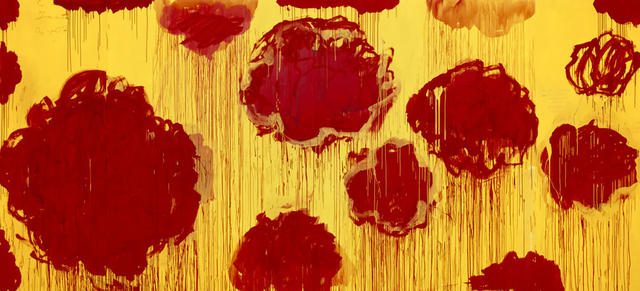
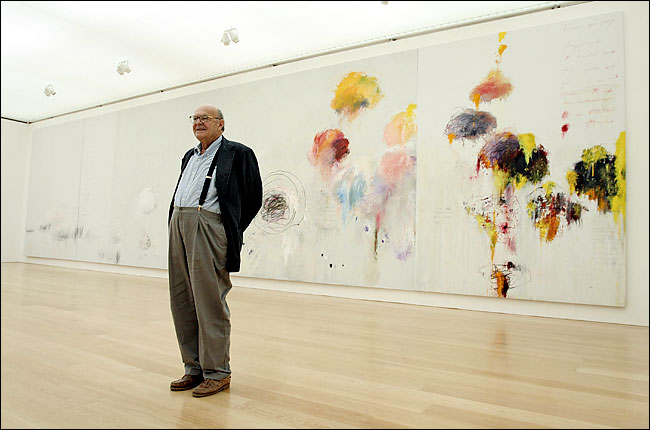
The death of Cy Twombly has an oddly catastrophic feel—oddly because he was eighty-three and a canonical master, but catastrophic because he takes with him a certain epochal, now thoroughly historical, sense of wide-open liberty in very high culture. Such was the cynosure of new art in New York sixty years ago, when Twombly had his first show of startlingly scrawly, somehow furiously languid paintings and drawings. Unlike the heroes of Abstract Expressionism and his comrades Rauschenberg and Johns, he never drove that afflatus. Rather, he took it as a routine state of mind and soul. This could seem dandyishly insolent of him: shrugging off the requirement for logical necessity in big-time avant-garde art. He made clear that he did what he felt like doing. His feeling-like-doing-it was the point, ever just a dramatic whisker short of pointlessness. Who did he think he was?
Today we remember him with a mix of new clips and old favorites.
Gil Scott-Heron, April 1, 1949-May 27, 2011
new clips
“The Bottle,” live, Jamaica (Montego Bay, Reggae Sunsplash), 1983 Cool Runnings: The Reggae Movie (1983)
*****
“We Almost Lost Detroit,” live, Austria (Vienna), 2010
*****
Interview, England (London), 2010
*****
old favorites
Here’s a voice I didn’t know if I’d ever hear again.
Gil Scott-Heron, I’m New Here (out this week)
“Where Did The Night Go” (Gil Scott-Heron)
***
“Me And The Devil” (Robert Johnson)
**********
lagniappe
I’ve had bad times in my life when I’d rather be somewhere else doing something else, for sure. But you get to my age, that shit happens. You get in trouble; you maybe lose some folks—a parent or a friend. Maybe your marriage breaks up, you lose your wife, lose touch with your kid. But what life does not have those things in it?—Gil Scott-Heron (in yesterday’s Guardian)
(Orignially posted 2/8/10.)
**********
I’m the person I see least of over the course of my life, and even what I see is not accurate.
—Gil Scott-Heron (New Yorker, 8/9/2010 [Alec Wilkinson, “New York Is Killing Me”])
Gil Scott-Heron, “I’m New Here” (2010)
(Originally posted 8/24/10.)
**********
It’s a remix world.
Gil Scott-Heron, “New York Is Killing Me” (2010), Chris Cunningham remix
**********
lagniappe
Here’s the original track, followed by a couple more remixes.
Vodpod videos no longer available.
***
With Nas
Vodpod videos no longer available.
***
With Mos Def
Vodpod videos no longer available.
**********
langiappe
musical thoughts
In the dark times, will there also be singing? Yes, there will be singing. About the dark times.
Lloyd Knibb, drummer(Skatalites, etal.)
March 8, 1931-May 12, 2011
Lloyd Knibb’s importance to Jamaican music can’t be overstated. The inventor of the ska beat at Coxson Dodd’s Studio One, Knibb created a sound that spread like wildfire the world over.
—Carter Van Pelt, host, Eastern Standard Time, WKCR-FM
This arrived yesterday, in response to an email letting her know that she was featured here (with Hazel Dickens):
Thanks for letting me know about this. We said goodbye to Hazel yesterday and singing was never more difficult. She was my musical guide and my beloved friend. Smart, funny, complicated, always real. She’ll live in my music, and my life, forever. “Fly away, Little Pretty Bird.”
Yesterday we heard music of “nostalgia” and “homesickness,” of “loneliness” and “separation,” from Mali. Today it comes from West Virginia.
Hazel Dickens, singer, songwriter
June 1, 1925-April 22, 2011
Live, with Ginny Hawker, vocals, and Tracy Schwartz, fiddle
“West Virginia My Home” (H. Dickens), Kentucky (Morehead State University), 2008
Vodpod videos no longer available.
***
“I Love To Sing The Old Songs” (H. Dickens), 2008
Vodpod videos no longer available.
**********
lagniappe
Hazel Dickens, a clarion-voiced advocate for coal miners and working people and a pioneer among women in bluegrass music, died on Friday in Washington. She was 75.
The cause was complications of pneumonia, said Ken Irwin, her longtime friend and the founder of Rounder Records, her label for more than four decades.
Ms. Dickens’s initial impact came as a member of Hazel and Alice, a vocal and instrumental duo with Alice Gerrard, a classically trained singer with a passion for the American vernacular music on which Ms. Dickens was raised. Featuring Ms. Dickens on upright bass and Ms. Gerrard on acoustic guitar, Hazel and Alice toured widely on the folk and bluegrass circuits during the 1960s and ’70s, captivating audiences with their bold, forceful harmonies and their empathetic approach to songs of struggle and heartbreak.
***
The influence of the staunchly traditional duo extended beyond bluegrass to commercial country music. Hazel and Alice’s arrangement of the Carter Family’s “Hello Stranger” became the blueprint for Emmylou Harris’s version of the song, and their adaption of “The Sweetest Gift (A Mother’s Smile)” inspired Naomi Judd, then a single mother in rural Kentucky, to start singing with her daughter Wynonna.
***
Hazel Jane Dickens was born June 1, 1935, in Mercer County, W.Va. One of 11 children, she grew up in a family whose survival depended on the coal industry. Her father, a Primitive Baptist preacher and a forceful singer, hauled timber to feed the household. Her brothers were miners and one of her sisters cleaned house for a supervisor at the mines. The music they sang in church and heard on the radio, particularly the music of the Grand Ole Opry in Nashville, offered one of their few diversions.
She moved to Baltimore in the early 1950s and worked in factories there. City living was hardly more prosperous than the life she’d known in the coal fields of Mercer County, but it did afford her exposure to the larger social and political world. She met and started playing music with the singer and folklorist Mike Seeger, who eventually introduced her to Ms. Gerrard.
***
A reluctant feminist role model, Ms. Dickens said she was originally scared to write about issues like sexism and the oppression of women.
“I can remember the first time I sang ‘Don’t Put Her Down, You Helped Put Here There,’ ” she said in her 1999 No Depression interview. “I was at a party standing in the middle of all these men. It was here in Washington. Bob Siggins was playing banjo, and when I got done, everyone just looked at each other, and Bob said, ‘That’s a nice song, but I won’t be able to sing it.’ And I said, ‘Of course you can.’ ”
“We were writing about our own experience,” she explained. “They were things we needed to say.”

 music clip of the day