Bill Frisell (guitar) with Tony Scherr (bass) & Kenny Wollesen (drums)
Live, Rochester (NY), 2007
***
The Delfonics, 1968
(First clip originally posted 5/28/10.)
**********
lagniappe
reading table
And this disease which was Swann’s love had so proliferated, was so closely entangled with all his habits, with all his actions, with his thoughts, his health, his sleep, his life, even with what he wanted after his death, it was now so much a part of him, that it could not have been torn from him without destroying him almost entirely: as they say in surgery, his love was no longer operable.
—Marcel Proust, Swann’s Way (translated from French by Lydia Davis)
Weasel Walter (drums), Peter Evans (trumpet), Mary Halvorson (guitar), live, Toronto (Placebo Space), 2011
**********
lagniappe
reading table
We call it a grain of sand,
but it calls itself neither grain nor sand.
It does just fine without a name,
whether general, particular,
permanent, passing,
incorrect, or apt.
Our glance, our touch mean nothing to it.
It doesn’t feel itself seen and touched.
And that it fell on the windowsill
is only our experience, not its.
For it, it is no different from falling on anything else
with no assurance that it has finished falling
or that it is falling still.
The window has a wonderful view of a lake,
but the view doesn’t view itself.
It exists in this world
colorless, shapeless,
soundless, odorless, and painless.
The lake’s floor exists floorlessly,
and its shore exists shorelessly.
Its water feels itself neither wet nor dry
and its waves to themselves are neither singular nor plural.
They splash deaf to their own noise
on pebbles neither large nor small.
And all this beneath a sky by nature skyless
in which the sun sets without setting at all
and hides without hiding behind an unminding cloud.
The wind ruffles it, its only reason being
that it blows.
A second passes.
A second second.
A third.
But they’re three seconds only for us.
Time has passed like a courier with urgent news.
But that’s just our simile.
The character is invented, his haste is make-believe,
his news inhuman.
—Wislawa Szymborska (1923-2012), “View with a Grain of Sand” (translated from Polish by Stanislaw Baranczak and Clare Cavanagh)
A lot of trumpet players try to bowl you over. This guy, whose last album appeared on many year-end top-10 lists (When the Heart Emerges Glistening, Blue Note), does something different. He gets under your skin.
Ambrose Akinmusire (ah-kin-MOO-sir-ee) Quintet (AA, trumpet; Walter Smith III, tenor saxophone; Fabian Almazan, piano; Harish Ragavan, bass; Justin Brown, drums); live, New York (Jazz Standard), 2011
Part 1
***
Part 2
***
Part 3
***
Part 4
**********
lagniappe
musical thoughts
Everything you don’t love, make sure that’s not in your playing.
Wislawa Szymborska (vees-WAH-vah shim-BOR-ska), poet
July 2, 1923-February 1, 2012
The world—whatever we might think when terrified by its vastness and our own impotence, or embittered by its indifference to individual suffering, of people, animals, and perhaps even plants, for why are we so sure that plants feel no pain; whatever we might think of its expanses pierced by the rays of stars surrounded by planets we’ve just begun to discover, planets already dead? still dead? we just don’t know; whatever we might think of this measureless theater to which we’ve got reserved tickets, but tickets whose lifespan is laughably short, bounded as it is by two arbitrary dates; whatever else we might think of this world—it is astonishing.
But “astonishing” is an epithet concealing a logical trap. We’re astonished, after all, by things that deviate from some well-known and universally acknowledged norm, from an obviousness we’ve grown accustomed to. Now the point is, there is no such obvious world. Our astonishment exists per se and isn’t based on comparison with something else.
Granted, in daily speech, where we don’t stop to consider every word, we all use phrases like “the ordinary world,” “ordinary life,” “the ordinary course of events” . . . But in the language of poetry, where every word is weighed, nothing is usual or normal. Not a single stone and not a single cloud above it. Not a single day and not a single night after it. And above all, not a single existence, not anyone’s existence in this world.
—Wislawa Szymborska, Nobel Lecture (excerpt, translated from Polish by Stanislaw Baranczak and Clare Cavanagh), 12/7/96
Until 1996, when she was awarded the Nobel Prize in Literature, I’d never heard of her. Since then I’ve read virtually everything of hers that’s appeared in translation. How much does she mean to me? Well, she’s one of two charter members (the other’s saxophonist Von Freeman) of the ultra-exclusive MCOTD Hall of Fame.
Compositionally I always wanted to be like Fred Astaire.
***
I never feel that my music is sparse or minimal; the way fat people never really think they’re fat. I certainly don’t consider myself a minimalist at all.
Last week a record store in Dupont Circle announced that it was closing. The immediate cause of its demise—it had outlasted national and regional chains—was Price Check, Amazon’s new idea for exterminating competition. It is an app that allows shoppers to scan the bar code on any item in any store and transmit it to Amazon for purposes of comparison, and if it compares favorably to Amazon’s price, Amazon’s special promotion promises a discount on the same item. In this way shoppers become spies, and stores, merely by letting customers through their doors, become complicit in their own undoing. It will not do to shrug that this is capitalism, because it is a particular kind of capitalism: the kind that entertains fantasies of monopoly. For all its technological newness, Amazon’s “vision” is disgustingly familiar. (“Amazon is coming to eat me,” a small publisher of fine religious books stoically told me a few weeks ago.) Nor will it do to explain that Amazon’s app is convenient, unless one is prepared to acquiesce in a view of American existence according to which its supreme consideration must be convenience. How easy must every little thing be? A record store in your neighborhood is also convenient, and so is a bookstore. There is also a sinister side to the convenience of online shopping: hours once spent in the sensory world, in the diversified satisfaction of material needs and desires, can now be surrendered to work. It appears to be a law of American life that there shall be no respite from screens. And so Amazon’s practices raise the old question of the cultural consequences of market piggishness. For there are businesses that are not only businesses, that also have non-monetary reasons for being, that are public goods. Their devastation in the name of profit may be economically legitimate, but it is culturally calamitous. In a word, wrong.
WHEN MY FRIEND at Melody Records told me about the death of his store, I was bereft. This was in part because he is my friend—after my father died, I received a letter from the Holocaust Museum informing me that he had made a donation in my father’s memory—and now he must fend for himself and his family and his staff in the American wreckage. But my dejection was owed also to the fact that this store was one of the primary scenes of my personal cultivation. For thirty years it stimulated me, and provided a sanctuary from sadness and sterility. “Going to Melody” was a reliable way of improving my mind’s weather. The people who worked there had knowledge and taste: they apprised me of obscure pressings of Frank Martin’s chamber music, and warned me about the sound quality of certain reissues of Lucky Thompson and Don Byas, and turned me on to old salsa and new fado. They even teased me about my insane affection for Rihanna. When they added DVDs to the store, my pleasures multiplied. (Also my amusements. Not long ago Marcel Ophuls’ great film arrived in the shop, and the box declared: “Woody Allen presents The Sorrow and The Pity.” Beat that.) Of course all these discs can be found online. But the motive of my visits to the store was not acquisitiveness, it was inquisitiveness. I went there to engage in the time-honored intellectual and cultural activity known as browsing.
IT IS A MATTER OF some importance that the nature of browsing be properly understood. Browsing is a method of humanistic education. It gathers not information but impressions, and refines them by brief (but longer than 29 seconds!) immersions in sound or language. Browsing is to Amazon what flaneurie is to Google Earth. It is an immediate encounter with the actual object of curiosity. The browser (no, not that one) is the flaneur in a room. Browsing is not idleness; or rather, it is active idleness—an exploring capacity, a kind of questing non-instrumental behavior. Browsing is the opposite of “search.” Search is precise, browsing is imprecise. When you search, you find what you were looking for; when you browse, you find what you were not looking for. Search corrects your knowledge, browsing corrects your ignorance. Search narrows, browsing enlarges. It does so by means of accidents, of unexpected adjacencies and improbable associations. On Amazon, by contrast, there are no accidents. Its adjacencies are expected and its associations are probable, because it is programmed for precedents. It takes you to where you have already been—to what you have already bought or thought of buying, and to similar things. It sells similarities. After all, serendipity is a poor business model. But serendipity is how the spirit is renewed; and a record store, like a bookstore, is nothing less than an institution of spiritual renewal.
The 1960s—a decade of relentless experimentation, bold innovation, of searching, always, for something new, something true.
Freddie and the Dreamers, “Little Bitty Pretty One,” “A Little You”
Live, London, 1965
**********
lagniappe
reading table
Last night I had a dream. I was in France. Paris was again falling to the Germans, but it had become such a habit that one had to look closely to see that anyone really cared. I arrived in Paris (from the front, I think, but there wasn’t much of one) went to a party, where I was surrounded by acquaintances. They became distant and shadowy when I approached them. Suddenly I saw you and gave you a tremendous hug. You moved to another table. I said: ‘I know where there are a couple of good French restaurants.’ You said: ‘They’re all French here.’
—Robert Lowell, Letter to Elizabeth Bishop, 6/14/1953,
in The Letters of Robert Lowell (Saskia Hamilton ed., 2005)
When that happens, this is one of the things I turn to—it never fails.
Johann Sebastian Bach, Suite No. 3 in C major for Unaccompanied Cello, 4th Mvt. (Sarabande); Pierre Fournier (1906-1986), cello
**********
lagniappe
reading table
[O]ld age is a ceremony of losses, which is on the whole preferable to dying at forty-seven or fifty-two.
***
After a life of loving the old, by natural law I turned old myself. Decades followed each other—thirty was terrifying, forty I never noticed because I was drunk, fifty was best with a total change of life, sixty extended the bliss of fifty—and then came my cancers, Jane’s death, and over the years I travelled to another universe. However alert we are, however much we think we know what will happen, antiquity remains an unknown, unanticipated galaxy. It is alien, and old people are a separate form of life. They have green skin, with two heads that sprout antennae. They can be pleasant, they can be annoying—in the supermarket, these old old ladies won’t get out of my way—but most important they are permanently other. When we turn eighty, we understand that we are extraterrestrial. If we forget for a moment that we are old, we are reminded when we try to stand up, or when we encounter someone young, who appears to observe green skin, extra heads, and protuberances.
***
Whatever the season, I watch the barn. I see it through this snow in January, and in August I will gaze at trailing vines of roses on a trellis against the vertical boards. I watch at the height of summer and when darkness comes early in November. From my chair I look at the west side, a gorgeous amber laved by the setting sun, as rich to the eyes as the darkening sweet of bees’ honey. . . . Out the window, I watch a white landscape that turns pale green, dark green, yellow and red, brown again under bare branches, until snow falls again.
—Donald Hall, “Out the Window,” New Yorker, 1/23/12
If you’re looking for sunshine, you’ll have to go elsewhere.
This is one of the saddest, darkest, most chilling things I know.
Nina Simone, “Black Is The Color Of My True Love’s Hair”
**********
lagniappe
reading table
[L]ife needs a lot of imaginative fixing, since it regularly fails to provide us with wild adventure and comfortable closure. ‘In life,’ Proust wrote in a notebook, ‘novels don’t finish.'”
If you wanted to conjure a world full of mystery, what better instrument to lead the way than one that possesses neither the brightness of the violin nor the darkness of the cello?
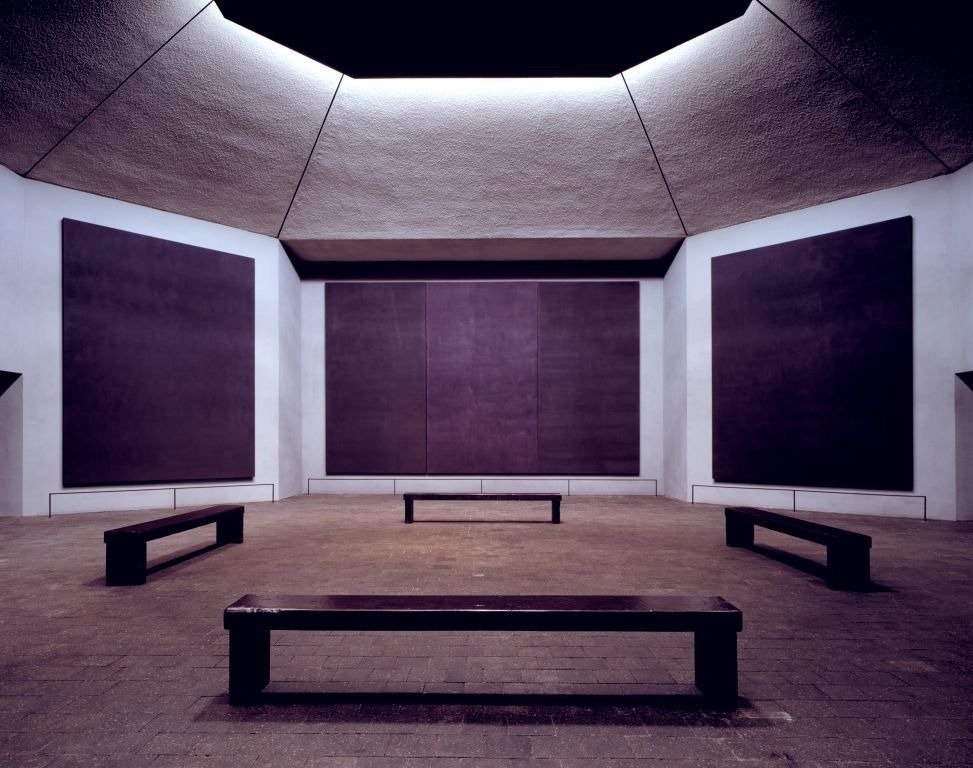
Morton Feldman, Rothko Chapel (1971), live, Houston (Rothko Chapel), 2011; Kim Kashkashian (viola), Brian Del Signore (percussion), Sarah Rothenberg (celeste), Maureen Broy Papovich (soprano), Houston Chamber Choir (Robert Simpson, cond.)
The Rothko Chapel is an interfaith sanctuary, a center for human rights — and a one-man art museum devoted to 14 monumental paintings by abstract expressionist Mark Rothko. The Houston landmark, commissioned by John and Dominique de Menil, opened its doors 40 years ago, in February 1971.
For the past four decades, the chapel has encouraged cooperation between people of all faiths — or of no faith at all. While the chapel itself has become an art landmark and a center for human-rights action, the sanctuary’s creator never lived to see it finished. Rothko committed suicide in 1970.
Approaching the chapel from the south, visitors first see a steel sculpture called Broken Obelisk by Barnett Newman in the middle of a pool — it appears to be floating on the surface of the water. The chapel itself is a windowless, octagonal brick building. Solid black doors open on a tiny glass-walled foyer. (The foyer was walled off from the rest of the interior when the Gulf Coast’s notorious humidity began to affect the paintings.)
The main room is a hushed octagonal space with gray stucco walls, each filled by massive paintings. Some walls feature one canvas, while on others, three canvases hang side by side to form a triptych. A baffled skylight subdues the bright Houston sun, and the surfaces of the paintings change dramatically as unseen clouds pass outside. There are eight austere wooden benches informally arranged, and today, a few meditation mats. A young woman brings the meditation hour to a close by striking a small bowl with a mallet, creating a soft peal of three bells in the intense silence of the room.
Concerts, conferences, lectures, weddings and memorial services all take place in the chapel throughout the year, but on most days you will find visitors — about 55,000 annually come to see, to meditate, to write in the large comment book in the foyer, to read the variety of well-thumbed religious texts available on benches at the entrance.
***
These paintings do not feature the luminous color fields that made Rothko famous. The paintings in the chapel are dark, in purplish or black hues. And there’s a reason for that, says [chapel historian Suna] Umari.
“They’re sort of a window to beyond,” she explains. “He said the bright colors sort of stop your vision at the canvas, where dark colors go beyond. And definitely you’re looking at the beyond. You’re looking at the infinite.”
***
At first glance, the paintings appear to be made up of solid, dark colors. But look closely, and it becomes evident that the paintings are composed of many uneven washes of pigment that create variations in every inch. Stepping back, waves of subtle color difference appear across the broad surfaces — leading to an unmistakable impression of physical depth.
***
Though Mark Rothko didn’t live to see the sanctuary he created, Christopher Rothko says his father knew what it should be.
“It took me a while to realize it, but that’s really my father’s gift, in a sense, to somebody who comes to the chapel. It’s a place that will really not just invite, but also demand a kind of journey.”
 music clip of the day