If you’re looking for sunshine, you’ll have to go elsewhere.
This is one of the saddest, darkest, most chilling things I know.
Nina Simone, “Black Is The Color Of My True Love’s Hair”
**********
lagniappe
reading table
[L]ife needs a lot of imaginative fixing, since it regularly fails to provide us with wild adventure and comfortable closure. ‘In life,’ Proust wrote in a notebook, ‘novels don’t finish.'”
If you wanted to conjure a world full of mystery, what better instrument to lead the way than one that possesses neither the brightness of the violin nor the darkness of the cello?
Morton Feldman, Rothko Chapel (1971), live, Houston (Rothko Chapel), 2011; Kim Kashkashian (viola), Brian Del Signore (percussion), Sarah Rothenberg (celeste), Maureen Broy Papovich (soprano), Houston Chamber Choir (Robert Simpson, cond.)
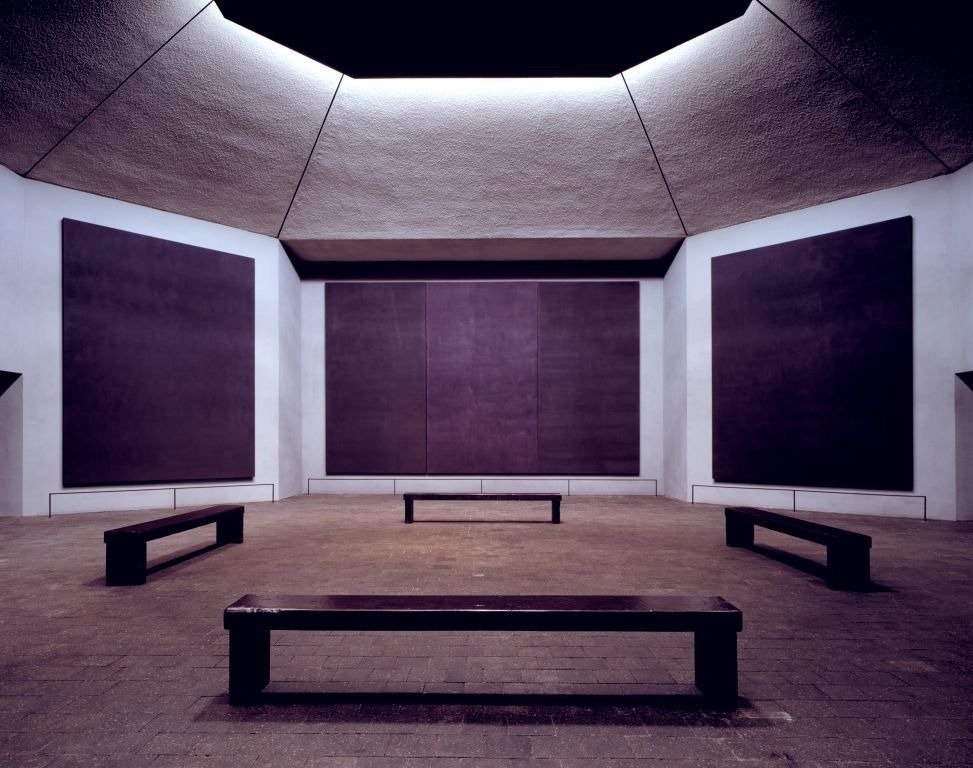
The Rothko Chapel is an interfaith sanctuary, a center for human rights — and a one-man art museum devoted to 14 monumental paintings by abstract expressionist Mark Rothko. The Houston landmark, commissioned by John and Dominique de Menil, opened its doors 40 years ago, in February 1971.
For the past four decades, the chapel has encouraged cooperation between people of all faiths — or of no faith at all. While the chapel itself has become an art landmark and a center for human-rights action, the sanctuary’s creator never lived to see it finished. Rothko committed suicide in 1970.
Approaching the chapel from the south, visitors first see a steel sculpture called Broken Obelisk by Barnett Newman in the middle of a pool — it appears to be floating on the surface of the water. The chapel itself is a windowless, octagonal brick building. Solid black doors open on a tiny glass-walled foyer. (The foyer was walled off from the rest of the interior when the Gulf Coast’s notorious humidity began to affect the paintings.)
The main room is a hushed octagonal space with gray stucco walls, each filled by massive paintings. Some walls feature one canvas, while on others, three canvases hang side by side to form a triptych. A baffled skylight subdues the bright Houston sun, and the surfaces of the paintings change dramatically as unseen clouds pass outside. There are eight austere wooden benches informally arranged, and today, a few meditation mats. A young woman brings the meditation hour to a close by striking a small bowl with a mallet, creating a soft peal of three bells in the intense silence of the room.
Concerts, conferences, lectures, weddings and memorial services all take place in the chapel throughout the year, but on most days you will find visitors — about 55,000 annually come to see, to meditate, to write in the large comment book in the foyer, to read the variety of well-thumbed religious texts available on benches at the entrance.
***
These paintings do not feature the luminous color fields that made Rothko famous. The paintings in the chapel are dark, in purplish or black hues. And there’s a reason for that, says [chapel historian Suna] Umari.
“They’re sort of a window to beyond,” she explains. “He said the bright colors sort of stop your vision at the canvas, where dark colors go beyond. And definitely you’re looking at the beyond. You’re looking at the infinite.”
***
At first glance, the paintings appear to be made up of solid, dark colors. But look closely, and it becomes evident that the paintings are composed of many uneven washes of pigment that create variations in every inch. Stepping back, waves of subtle color difference appear across the broad surfaces — leading to an unmistakable impression of physical depth.
***
Though Mark Rothko didn’t live to see the sanctuary he created, Christopher Rothko says his father knew what it should be.
“It took me a while to realize it, but that’s really my father’s gift, in a sense, to somebody who comes to the chapel. It’s a place that will really not just invite, but also demand a kind of journey.”
I don’t know what these folks call this stuff, but one thing I’m sure of: it ain’t “world music.”
Sobanza Mimanisa (“Orchestra of Light”), “Kiwembo,” live
Democratic Republic of Congo (Kinshasa), c. 2005
**********
lagniappe
reading table
The 100 Most Powerless New Yorkers
Have you noticed that power lists, which have been spreading like the clap lately, from the Time100 to the Forbes 500, tell you things you already know about the rich and famous and give publicity to people who already have more of it than they know what to do with? For the rest of us, here’s a power list to get 2012 going in the right direction. They’re in no particular order. (Like it really matters.)
1. Weed-delivery guys
The reason so many marijuana arrests are of black and Hispanic people is not because they smoke weed more. White New Yorkers, by the NYPD’s own numbers, have a higher per-capita rate of contraband when they’re arrested. However, white people stay safe in their apartments while colored folks deliver drugs to them. Delivering drugs puts you on the bottom of a pyramid scheme where you usually earn less than minimum wage, making you vulnerable to homicide and giving you about as much of a chance of becoming a rich kingpin as being a production assistant or a media intern gives you of becoming a celebrity. . . .
Roy Hargrove Quintet,* “Strasbourg/Saint Denis,” live, Paris, 2008
What better way to begin the new year than with live music, which is what I did last Sunday (with my wife Suzanne and older son Alex), catching these guys at Chicago’s Jazz Showcase, where they played an ebullient set for the overflow crowd.
**********
lagniappe
reading table
In January baseball lives in the imagination.
Now he was stuck at this ramshackle ballpark between a junkyard and an adult bookstore on the interstate outside Peoria.
***
“The shortstop is a source of stillness at the center of the defense. He projects this stillness and his teammates respond.”
***
When your moment came, you had to be ready, because if you fucked up, everyone would know whose fault it was. What other sport not only kept a stat as cruel as the error but posted it on the scoreboard for everyone to see?
When I was little, I would go into Chicago to hear live music—Peter, Paul & Mary, Kingston Trio, Beach Boys—with my father. Then, as a teenager, I’d go into the city with my brother Don to hear the Velvet Underground and the MC5, the Who, Tim Hardin and Tim Buckley, Muddy Waters. Now I make these trips with my sons. The other night, for instance, my older son Alex (now 24 and home for the holidays) and I went to the Hideout, a small club on Chicago’s north side, not far from where I once went with my father (now gone) and my brother (now hundreds of miles away), to hear this guy.
Jason Adasiewicz’s Rolldown (JA, vibraphone; Josh Berman, cornet; Aram Shelton, alto saxophone; Jason Roebke, bass; Frank Rosaly, drums), “Hide,” live, c. 2008
**********
lagniappe
reading table
No, the human heart
Is unknowable.
But in my birthplace
The flowers still smell
The same as always.
—Ki no Tsurayuki (872-945; trans. Kenneth Rexroth)
kaleidoscopic, adj. 1. changing form, pattern, color, etc., in a manner suggesting a kaleidoscope. 2. continually shifting from one set of relations to another. E.g., Azealia Banks’ “212” (2011).
**********
lagniappe
reading table
In an age when other fantastically speedy, widespread media are triumphing, and running the risk of flattening all communication into a single, homogeneous surface, the function of literature is communication between things that are different simply because they are different, not blunting but even sharpening the differences between them, following the true bent of written language.
—Italo Calvino, Six Memos for the Next Millennium (1988 [trans. Patrick Creagh])