Saturday, April 1st
more
Tank and the Bangas, “Quick,” 2017
**********
lagniappe
reading table
It seems unlikely that so much literature
could be made from twenty-six letters.—Brenda Shaughnessy, “Card 12: The Hanged Man,” fragment (Our Andromeda)
more
Tank and the Bangas, “Quick,” 2017
**********
lagniappe
reading table
It seems unlikely that so much literature
could be made from twenty-six letters.—Brenda Shaughnessy, “Card 12: The Hanged Man,” fragment (Our Andromeda)
what’s new
Oumou Sangaré (feat. Tony Allen, drums), “Yere Faga,” 3/30/17
**********
lagniappe
reading table
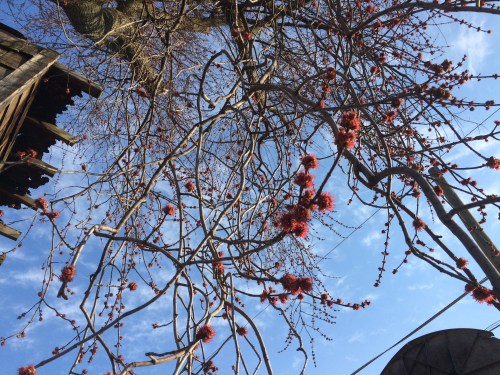
First cherry blossoms
just came out
pretty good day!—Matsuo Basho (1644-1694), translated from Japanese by David Young
timeless
Ann Peebles, I Can’t Stand the Rain,* 1974 (Hi Records)
**********
lagniappe
reading table
The only thing worse than trying to look younger than you are is trying to look wiser than you are.
*****
*Track list (courtesy of YouTube):
“I Can’t Stand The Rain” (Don Bryant, Bernard “Bernie” Miller, Ann Peebles)
“Do I Need You” (Bryant, Peebles)
“Until You Came into My Life” (Bryant, Miller, Peebles)
“(You Keep Me) Hanging On” (Ira Allen, Buddy Mize)
“Run Run Run” (Bryant, Darryl Carter, Peebles)
“If We Can’t Trust Each Other” (Earl Randle)
“A Love Vibration” (Bryant, Miller, Peebles)
“You Got to Feed the Fire” (Bryant, Miller, Peebles)
“I’m Gonna Tear Your Playhouse Down” (Earl Randle)
“One Way Street” (Bryant, Peebles)
more
Yasmine Hamdan, “Beirut,” 2014
**********
lagniappe
reading table
No Romance sold unto
Could so enthrall a Man –
As the perusal of
His Individual One –‘Tis Fiction’s – to dilute to plausibility
Our – Novel. When ’tis small eno’
To credit – ‘Tis’nt true –—Emily Dickinson (1830-1886), 590 (Franklin)
Soundtrack for a man in a box trying to escape.
Ab Baars (tenor saxophone), “Asor,” live, Amsterdam, 2014
**********
lagniappe
reading table
I thought that you were an anchor in the drift of the world;
but no: there isn’t an anchor anywhere.
There isn’t an anchor in the drift of the world. Oh no.
I thought you were. Oh no. The drift of the world.—William Bronk (1918-1999, MCOTD Hall of Fame), “The World”
sounds of Mali
Salif Keita, live, London, c. 2002
**********
lagniappe
reading table
What one seems to want in art, in experiencing it, is the same thing that is necessary for its creation, a self-forgetful, perfectly useless concentration.
—Elizabeth Bishop (1911-1979), letter
more
Wolfgang Amadeus Mozart (1756-1791), Piano Concerto No. 26 in D major (“Coronation”); Munich Philharmonic Orchestra with Friedrich Gulda (conducting, piano), live, 1986
**********
lagniappe
reading table
How I wish I’d been a painter . . . that must really be the best profession—none of this fiddling around with words—there are a couple of Daumiers at the Phillips that make me feel my whole life has been wasted.
—Elizabeth Bishop (1911-1979), letter, 1977
more
William Parker’s In Order To Survive (WP, bass; Hamid Drake, drums, MCOTD Hall of Fame; Cooper-Moore, piano, vocals; Lewis Barnes, trumpet; Rob Brown, alto saxophone), “Hymn,” live, New York, 2013
**********
lagniappe
reading table
He isn’t doing that right—that was a very important one. It was what Astaire claimed he was thinking whenever he watched himself onscreen, and I noted that third-person pronoun. This is what I understood by it: that for Astaire the person in the film was not especially connected with him. And I took this to heart, or rather, it echoed a feeling I already had, mainly that it was important to treat oneself as a kind of stranger, to remain unattached and unprejudiced in your own case. I thought you needed to think like that to achieve anything in this world. Yes, I thought that was a very elegant attitude.
—Zadie Smith, Swing Time
back to church
“Give Me Jesus,” Langrum Branch Baptist Church, York, S.C., 2000
**********
lagniappe
reading table
The authentic and pure values—truth, beauty, and goodness—in the activity of a human being are the result of one and the same act, a certain application of the full attention to the object.
—Simone Weil (1909-1943), Gravity and Grace (translated from French by Emma Crawford)
*****
random sights
this morning, Oak Park, Ill.
tonight in Chicago
These guys, from Australia, are playing at Constellation.
The Necks, live, London, 2016
**********
lagniappe
reading table
The Imaginary Iceberg
by Elizabeth Bishop (1911-1979)We’d rather have the iceberg than the ship,
although it meant the end of travel.
Although it stood stock-still like cloudy rock
and all the sea were moving marble.
We’d rather have the iceberg than the ship;
we’d rather own this breathing plain of snow
though the ship’s sails were laid upon the sea
as the snow lies undissolved upon the water.
O solemn, floating field,
are you aware an iceberg takes repose
with you, and when it wakes may pasture on your snows?This is a scene a sailor’d give his eyes for.
The ship’s ignored. The iceberg rises
and sinks again; its glassy pinnacles
correct elliptics in the sky.
This is a scene where he who treads the boards
is artlessly rhetorical. The curtain
is light enough to rise on finest ropes
that airy twists of snow provide.
The wits of these white peaks
spar with the sun. Its weight the iceberg dares
upon a shifting stage and stands and stares.The iceberg cuts its facets from within.
Like jewelry from a grave
it saves itself perpetually and adorns
only itself, perhaps the snows
which so surprise us lying on the sea.
Good-bye, we say, good-bye, the ship steers off
where waves give in to one another’s waves
and clouds run in a warmer sky.
Icebergs behoove the soul
(both being self-made from elements least visible)
to see them so: fleshed, fair, erected indivisible.
 music clip of the day