Ornette Coleman, saxophonist (trumpeter and violinist, too), composer, bandleader, March 9, 1930-June 11, 2015
Today we remember him by revisiting earlier posts.
*****
3/9/11
His sound—his whole approach (simple melodies, vocal phrasing, off-center intonation)—is drenched in the blues.
Ornette Coleman (alto saxophone) with The Roots
Live, London (Meltdown Festival), 2009
#1
***
#2
The tenor player at the end—that’s David Murray.
*****
3/9/12
Ornette Coleman Quartet with guests Joshua Redman (tenor saxophone), James Blood Ulmer (guitar), Charlie Haden (bass), live, Netherlands (North Sea Jazz Festival, Rotterdam), 2010
#1
***
#2
***
#3
***
#4
***
#5
*****
6/16/14
Ornette, at 84, still plays some of the most haunting blues I’ve ever heard.
Ornette Coleman (alto saxophone), with Henry Threadgill (alto saxophone; MCOTD Hall of Famer), David Murray (tenor saxophone), Savion Glover (tap dance), et al., live, New York (Prospect Park), 6/12/14
*****
odds & ends (from posts featuring clips no longer available)
On the Ornette Coleman Quartet (OC, Don Cherry, Charlie Haden, Ed Blackwell): The sounds you don’t hear can mean as much as the ones you do. Here, for instance, it’s hard to overstate the importance of what isn’t onstage—a harmony instrument (piano, guitar). Without it, the drums move forward in the mix. The bass has more space to fill. The sound of each instrument becomes clearer, more distinct. The group sound becomes lighter, more open.
***
When we were on relief during the Depression, they’d give us dried-up old cheese and dried milk and we’d get ourselves all filled up and we’d kept this thing going, singing and dancing. I remember that when I play. You have to stick to your roots. Sometimes I play happy. Sometimes I play sad. But the condition of being alive is what I play all the time.
***
You know what I realize? That all sound has a need. Otherwise it wouldn’t have a use. Sound has a use. . . . You use it to establish something—an invisible presence or some belief. . . . But isn’t it amazing that sound causes the idea to sound the way it is, more than the idea?
***
Music has no face. Whatever gives oxygen its power, music is cut from the same cloth.
—Ornette Coleman
(The first and last quotes are from Ornette’s website. The second is from Ben Ratliff, The Jazz Ear: Conversations over Music [2008].)
***
How can I turn emotion into knowledge? That’s what I try to do with my horn.
***
It’s not that I reject categories. It’s that I don’t really know what categories are.
***
You take the alphabet of the English language. A to Z. A symbol attached to a sound. In music you have what are called notes and the key. In life you’ve got an idea and an emotion. We think of them as different concepts. To me, there is no difference.
***
The violin, the saxophone, the trumpet: Each makes a very different sound but the very same notes. That’s pretty heavy, you know? Imagine how many different races make up the human race. I’m called colored, you’re called white, he’s called something else. We still got an asshole and a mouth. Pardon me.
Henry Threadgill’s Zooid,* live, Washington, D.C., 2013
**********
lagniappe
reading table
Nothings’s a Gift
by Wislawa Szymborska (1923-2012; translated from Polish by Clare Cavanagh and Stanislaw Baranczak)
Nothing’s a gift, it’s all on loan.
I’m drowning in debts up to my ears.
I’ll have to pay for myself
with my self,
give up my life for my life.
Here’s how it’s arranged:
The heart can be repossessed,
the liver, too,
and each single finger and toe.
Too late to tear up the terms,
my debts will be repaid,
and I’ll be fleeced,
or, more precisely, flayed.
I move about the planet
in a crush of other debtors.
Some are saddled with the burden
of paying off their wings.
Others must, willy-nilly,
account for every leaf.
Every tissue in us lies
on the debit side.
Not a tentacle or tendril
is for keeps.
The inventory, infinitely detailed,
implies we’ll be left
not just empty-handed
but handless too.
I can’t remember
where, when, and why
I let someone open
this account in my name.
We call the protest against this
the soul.
And it’s the only item
not included on the list.
*****
the beat goes on
Two thousand posts—and counting.
*****
*HT (flute, alto saxophone), Liberty Ellman (guitar), Jose Davila (tuba, trombone), Christopher Hoffman (cello), Elliot Humberto Kavee (drums).
Stephan Crump (bass) & Mary Halvorson (guitar), “Erie” (S. Crump), live, New York, 4/17/15
**********
lagniappe
random thoughts
Life consists of driving a vehicle you didn’t design, one that came without an owner’s manual, until one day it runs off the road and winds up in a ditch.
More of the Instant Composers Pool (ICP) Orchestra.*
Live, Chicago (Elastic Arts), 5/3/15
***
**********
lagniappe
art beat
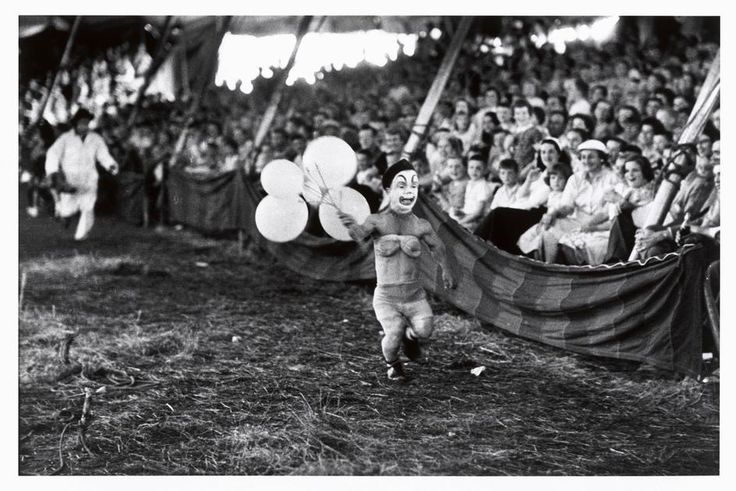
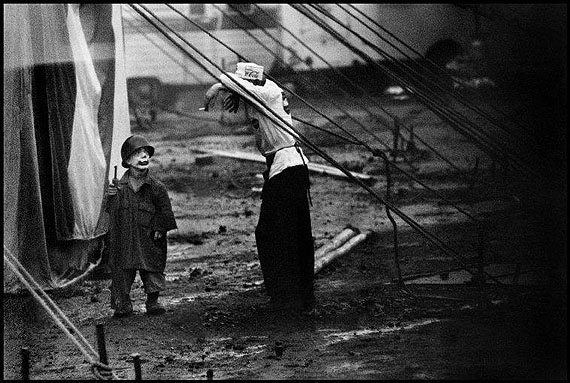
Bruce Davidson (1933-), Palisades, New Jersey, 1958
*****
*Ab Baars, tenor saxophone; Tobias Delius, tenor saxophone; Michael Moore, alto saxophone; Thomas Heberer, trumpet; Walter Wierbos, trombone; Tristan Honsiger, cello; Mary Oliver, violin; Ernst Glerum, bass; Han Bennink, drums; with guest Guus Janssen (piano).
It’s a wonderful life—sometimes, anyway. This weekend, in Chicago, I got to hear these folks twice: Saturday night all together (Constellation), Sunday in a series of (mostly) duos and trios (Elastic Arts).
Instant Composers Pool (ICP) Orchestra*
“Lavoro” (S. Bergin, borrowing from “Moten Swing”), live, Oakland, Ca., 2013
***
“East of the Sun, West of the Moon” (Brooks Bowman), recording (East of the Sun), 2014
*****
*Ab Baars, tenor saxophone; Tobias Delius, tenor saxophone; Michael Moore, alto saxophone; Thomas Heberer, trumpet; Walter Wierbos, trombone; Tristan Honsiger, cello; Mary Oliver, violin; Ernst Glerum, bass; Han Bennink, drums.
These folks—three reed players and a cellist from Chicago, along with a drummer from Norway—will be playing (and recording a live album) at a performing-arts center on the city’s northwest side (Elastic Arts).
Dave Rempis (saxophones), Keefe Jackson (reeds), Jason Stein (bass clarinet), Tomeka Reid (cello), Tollef Østvang (drums), live, Lafayette, Ind., 4/25/15
Charles Mingus, composer, bandleader, bassist
April 22, 1922-January 5, 1979
Better late than never for someone who, like Miles and Monk, Bach and Beethoven, I couldn’t live without.
Charles Mingus (bass) with Eric Dolphy (alto saxophone, bass clarinet, flute), Clifford Jordan (tenor saxophone), Johnny Coles (trumpet), Jaki Byard (piano), Dannie Richmond (drums), live, Belgium, Norway, and Sweden, 1964*
**********
lagniappe
musical thoughts
There’s something about listening to Eric Dolphy that makes you feel glad to be alive.
Belgium
00:00-00:45 Intro
00:46-05:33 So Long Eric
05:35-11:20 Peggy’s Blue Skylight
11:23-32:03 Meditations On Integration
Norway
32:30-54:46 So Long Eric
56:30-1:11:40 Orange Was The Color Of Her Dress, Then Blue Silk
1:13:53-1:16:20 Parkeriana
1:16:22-1:29:05 Take The “A” Train
Sweden
1:30:05-1:33:55 So Long Eric
1:34:02-1:52:35 Meditations On Integration
1:52:40- 1:59:50 So Long Eric
 music clip of the day