Monday, April 15th
Why not begin the week with something beautiful?
Bill Evans (1929-1980, piano), “Like Someone in Love” (J. Burke, J. Van Heusen), recorded 1962
***********
lagniappe
random sights
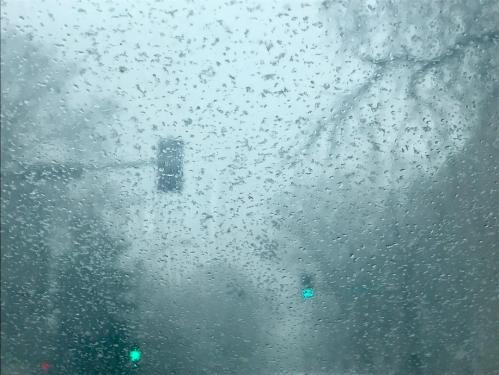
yesterday, Oak Park, Ill.
Why not begin the week with something beautiful?
Bill Evans (1929-1980, piano), “Like Someone in Love” (J. Burke, J. Van Heusen), recorded 1962
***********
lagniappe
random sights
yesterday, Oak Park, Ill.
3 x 2 x X = ?
Tomas Fujiwara (drums, composition) with Gerald Cleaver (drums), Mary Halvorson (guitar), Brandon Seabrook (guitar), Taylor Ho Bynum (cornet), Ralph Alessi (trumpet), “Blueberry Eyes,” live (studio), New Haven, Conn., 2017
**********
lagniappe
random sights
yesterday, Forest Park, Ill.

voices I miss
Leroy Jenkins (1932-2007), violin, live (“Lush Life” [B. Strayhorn], “Keep on Trucking, Brother (A Message to Bruce)” [L. Jenkins], “Nobody Knows the Trouble I’ve Seen” [Trad.]), New York, 1977
**********
lagniappe
musical thoughts
A jazz musician playing alone is like a tightrope walker working without a net. Playing a music of rhythmic verve, he lacks a rhythm section. Playing a music of spirited interplay, he lacks the company of others. And when the musician’s instrument happens to be the violin, he’s working not only without a net but without a tightrope.
The violin lacks all the advantages of the one instrument with a long-standing tradition of solo jazz performance, the piano. Where a pianist can play more than one musical line at a time (accompanying herself with her left hand, for example, while “soloing” with her right), a violinist can’t. Where a pianist can readily play complex chords, a violinist is limited to four strings and beset by innumerable fingering problems. And the range of pitches available to a violinist is only about half that available to a pianist. When a jazz violinist steps onstage by himself, he either falls flat on his face or, defying the conventions of gravity, flies.
Last Friday at HotHouse, jazz violinist Leroy Jenkins not only flew but soared. A dignified man so diminutive that he makes a violin appear large, Jenkins focused the listener’s attention not on what was absent—other musicians, multiple lines, an expansive tonal range—but on what was present. His concert provided a response of sorts to the familiar Zen koan: What is the sound of one hand clapping?
Playing for a small but attentive audience, the longtime associate of the Chicago-based Association for the Advancement of Creative Musicians—who hadn’t performed here for several years—displayed a powerful and original musical vocabulary. Just as a poem forces one to consider language word by word, a solo jazz performance forces one to consider music sound by sound. And that was how Jenkins constructed each of his pieces: sound by sound.
He began most of them with a simple melodic statement that sang. Then he would veer off into gradually accelerating repetitions of two-, three-, and four-note patterns. Unlike a horn player, he never had to stop for breath, so these patterns could go on and on. Out of them would emerge long, winding bursts of melody, like swallows taking flight through a swarm of bees. Then Jenkins would return to repeated patterns, steadily building the intensity until he reached a climax and suddenly stopped.
The narrative structure of many of his pieces was thus not unlike that of a sexual encounter. But the steadily mounting intensity was invariably coupled with precise articulation, lucid organization, and exquisite control. When near the end of his set Jenkins rocked back and forth like a man possessed, his seemingly unshakable control of his instrument only heightened the dramatic impact.
A master colorist, Jenkins called forth a seemingly limitless array of sounds, from singing to fluttering to stinging to rasping to wheezing. But what was ultimately even more impressive than the variety and virtuosity of his playing was its logic and coherence. And unlike some jazz musicians, whose solos can be neatly divided into segments “inside” or “outside” normal harmonic and tonal conventions, Jenkins’s playing was all of a piece.
Jenkins’s HotHouse set readily calls to mind Richard Goode’s magnificent recent performance at Pick-Staiger Concert Hall of five Beethoven piano sonatas. Neither musician spoke a word to the audience, but neither seemed remote. Both played so wholeheartedly that they virtually disappeared in the music. Both are virtuosos who put their virtuosity entirely at the service of the music, never exploiting it simply for effect. Both played music that often pitted a coming-apart-at-the-seams emotional intensity against an ultimately prevailing clarity and order. Perhaps one day, solo jazz concerts of the caliber of Jenkins’s will be met with the same degree of anticipation and excitement that performances of Beethoven piano sonatas by artists such as Goode typically receive today.
—Richard McLeese, “Flying Solo,” Chicago Reader, 10/27/1994
*****
art beat: other day, Art Institute of Chicago
Vincent van Gogh (1853-1890), The Bedroom, 1889

sounds of New York
We Free Strings,* live New York, 1/18/19
*Melanie Dyer, viola; Charles Burnham, violin; Gwen Laster, violin; Alex Waterman, cello; Ken Filiano, bass; Michael Wimberly, percussion.
No one fired up this pianist—one of the most influential in the history of jazz—like this drummer.
Bill Evans Trio (BE [1929-1980], piano; Philly Joe Jones [1923-1985], drums; Marc Johnson [1953-], bass), “Nardis” (M. Davis), live, Italy (Umbria), 1978
**********
lagniappe
reading table
How many poems have gotten so much attention with so few words?
so much depends
upona red wheel
barrowglazed with rain
waterbeside the white
chickens—William Carlos Williams (1883-1963), “The Red Wheelbarrow”
what’s new
More from this new album.
Joe Lovano (tenor saxophone, percussion), “One Time In,” published 2/11/19 (Trio Tapestry with Marilyn Crispell [piano], Carmen Castaldi [drums], 2019)
**********
lagniappe
reading table
Emily Dickinson, writing to her cousins (Louise and Frances Norcross) after the death of their father, closes with this (letter #278, poem #528 [Franklin], 1863):
Let Emily sing for you because she cannot pray.
‘Tis not that Dying hurts us so –
‘Tis Living – hurts us more –
But Dying – is a different way –
A kind behind the Door –The Southern Custom – of the Bird –
That ere the Frosts are due –
Accepts a better Latitude –
We – are the Birds – that stay.The Shiverers round Farmer’s doors –
For whose reluctant Crumb –
We stipulate – till pitying Snows
Persuade our Feathers Home
timeless
Fats Waller (1904-1943, piano, vocals), “I’m Gonna Sit Right Down and Write Myself a Letter” (F. E. Ahlert, J. Young), 1935
**********
lagniappe
random sights
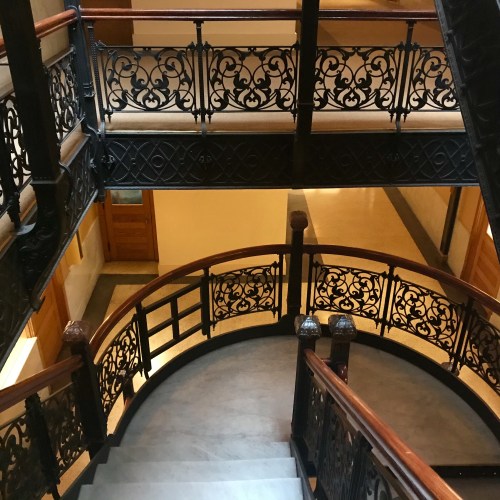
this morning, Chicago (Monadnock Building, 1891-93)
what’s new
Quinsin Nachoff’s Flux (QN, tenor saxophone, composition; David Binney, alto saxophone; Matt Mitchell, piano, keyboards, modular synthesizer; Nat Wood, drums; with guest Jason Barnsely, 1924 Kimball theatre organ), “Bounce,” video by Lee Hutzulak, 1/14/19
**********
lagniappe
random sights
yesterday, Oak Park, Ill.

sounds of New York
Marilyn Crispell (piano), Mark Helias (bass), Tyshawn Sorey (drums, percussion), live, New York, 2014
**********
lagniappe
random sights
this morning, Oak Park, Ill.

 music clip of the day