music clip of the day

jazz/blues/rock/classical/gospel/more

Category: guitar

Saturday, 4/10/10

no wonder they’re called “hooks”

The moment it ends—a great pop song, that is—you want to hear it again.

Prefab Sprout

“Doo Wop In Harlem,” live (TV broadcast), c. 1990

*****

“Sweet Gospel Music”

Sunday, 4/4/10

When it comes to working an audience, no one outshines gospel singers.

Paul Porter, “Two Wings,” live, Cleveland, 2009

**********

lagniappe

Want more gospel?

Stevie Wonder

Al Green

Aretha Franklin

Otis Clay

*****

art beat

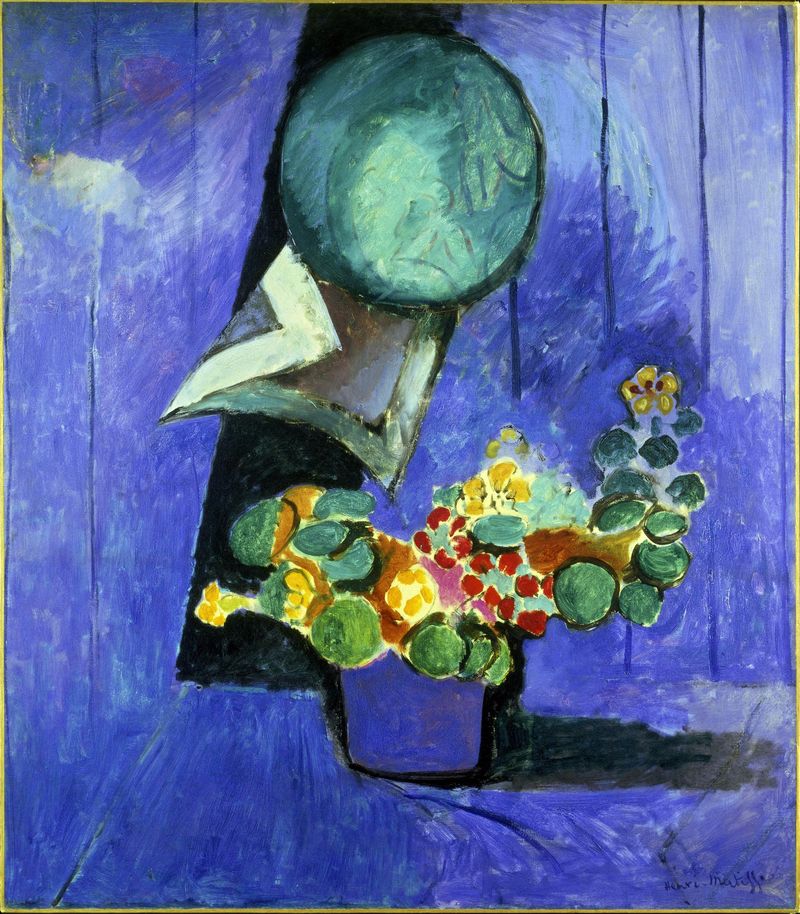
Henri Matisse, Flowers and Ceramic Plate (1913)

This is just one of dozens of reasons to see “Matisse: Radical Invention, 1913-1917,” which will be at the Art Institute through June 20th, then at the Museum of Modern Art beginning July 18th. At the risk of sounding like a PR flack, this exhibit (which I saw opening weekend and will return to soon) has critics scrambling for superlatives: “revelatory” (Artforum), “thrilling” (San Francisco Chronicle), “breathtaking” (Los Angeles Times)—well, you get the idea.

Saturday, 4/3/10

replay: a clip too good for just one day

Here’s another musician who, like Dinu Lipatti (Tuesday’s post), died way too young: the great Chicago blues artist Magic Sam (AKA Samuel Maghett). He suffered a fatal heart attack just months after this performance. He was 32.

Magic Sam, live (TV broadcast), Germany, 1969

**********

lagniappe

Facebook seems to have expanded into new markets. “Sign up,” they say, “to connect with [t]he late, great Magic Sam.”

(Originally posted 11/21/09.)

**********

Want more Chicago blues?

Muddy Waters

Howlin’ Wolf

Robert Nighthawk

Earl Hooker

Junior Wells

Otis Rush

Hound Dog Taylor

Buddy Guy

Fenton Robinson

Jimmy Johnson

Friday, 4/2/10

[T]he greatest rock is birthed from equal parts intelligence and stupidity.—Chris Bohn (The Wire, 2/10)

Jandek

“Real Wild,” live, Glasgow, 2004

*****

Live, Houston, 2009

**********

lagniappe

Much speculation has been made over the true identity of the mysterious singer/songwriter Jandek, and his equally obscure record label, Corwood Industries. For over 25 years, the artist released album after album of twisted, ghostly, and utterly unique songs that crooned a tale of despair.

***

Jandek played his first ever concert on October 17th, 2004 in Glasgow, Scotland as part of the Instal Festival, accompanied by Richard Youngs on bass, and Alexander Neilson on drums. The name Jandek did not appear on any of the promotional material for the festival. Some members of the audience, in disbelief, recognized the man from his album covers and could not mistake the sound for any other. Word quickly spread that Jandek had indeed performed . . . —Raphi Gottesman

*****

art beat

Joseph Cornell, Hotel Eden (c. 1945)


Monday, 3/29/10

This guy, like Captain Beefheart, studied at the Howlin’ Wolf School of Vocal Alchemy.

Tom Waits, “Make It Rain,” live (TV broadcast), 2004

**********

lagniappe

More on William Eggleston and Alex Chilton

Yesterday, while at the Art Institute, I stopped again at the William Eggleston exhibit (previously mentioned here and here), which runs through May 23rd. It includes not only the album cover I posted earlier (Big Star’s Radio City), but also this one. Eggleston, an accomplished piano player, once accompanied Chilton on a track—the Nat King Cole classic  “Nature Boy,” which appears on Big Star’s Third/Sister Lovers (expanded reissue), produced by Jim Dickinson, as well as Keep an Eye on the Sky (2009 boxed set).

Thursday, 3/25/10

street music

Dublin

On Grafton Street

Sunday, 3/21/10

At last Sunday’s (wonderful) 84th birthday celebration for DeLois Barrett Campbell, roses graced the altar—a gift from longtime friend Aretha Franklin.

DeLois Barrett Campbell and the Barrett Sisters, live, “He Has Brought Us” (Say Amen, Somebody), 1982

**********

lagniappe

And then we being blood sisters, I always say that gives our harmony a special edge.—DeLois Barrett Campbell

That girl [DeLois Barrett Campbell] can make a song so sweet you want to eat it.—Marion Williams

—Quoted in Anthony Heilbut, The Gospel Sound: Good News and Bad Times (6th ed. 2002) (Heilbut was at last Sunday’s birthday celebration.)

*****

mail

You supply the most delightful diversions!

*****

Spent a good portion of the afternoon playing back your old clips. Such wonderful variety.

*****

Just wanted to let you know that I’ve really been enjoying that blog of yours. Very cool.

Saturday, 3/20/10

What a nasty one-two punch for Memphis: first Jim Dickinson, then—seven months later—Alex Chilton.

Alex Chilton, December 28, 1950-March 17, 2010

Big Star, “Thirteen” (1972)

*****

Big Star, “September Gurls” (1974)

*****

Alex Chilton, “Bangkok” (1978)

*****

The Replacements, “Alex Chilton” (1987)

*****

Alex Chilton, “There Will Never Be Another You” (1985?)

**********

lagniappe

Alex Chilton, the pop hitmaker, cult icon and Memphis rock iconoclast best known as a member of 1960s pop-soul act the Box Tops and the 1970s power-pop act Big Star, died Wednesday at a hospital in New Orleans.

The singer, songwriter and guitarist was 59.

“I’m crushed. We’re all just crushed,” said John Fry, owner of Memphis’ Ardent Studios and a longtime friend of Chilton’s. “This sudden death experience is never something that you’re prepared for. And yet it occurs.”

***

The Memphis-born Chilton rose to prominence at age 16 when his gruff vocals powered the massive Box Tops hit “The Letter,” as well as “Cry Like a Baby” and “Neon Rainbow.”

After the Box Tops broke up in 1970, Chilton had a brief solo run in New York before returning to Memphis. He soon joined forces with a group of Anglo-pop-obsessed musicians — fellow songwriter/guitarist Chris Bell, bassist Andy Hummel and drummer Jody Stephens — to form Big Star.

The group became the flagship act for Ardent’s Stax-distributed label. Big Star’s 1972 debut album, #1 Record, met with critical acclaim but poor sales.

The group briefly disbanded, but reunited without Bell to record the album Radio City. Released in 1974, the second album suffered a similar fate, plagued by Stax’s distribution woes.

The group made one more album, Third/Sister Lovers, with just Chilton and Stephens — and it, too, was a minor masterpiece. Darker and more complex than the band’s previous pop-oriented material, it remained unreleased for several years.

In 2003, Rolling Stone magazine named all three Big Star albums to its list of the 500 Greatest Albums of All Time.

“It’s a fork in the road that a lot of different bands stemmed from,” said Jeff Powell, a respected local producer who worked on some of Chilton’s records. “If you’re drawing a family tree of American music, they’re definitely a branch.”

***

“When some people pass, you say it was the end of an era. In this case, it’s really true,” said Van Duren, a fellow Memphis musician who knew Chilton for decades. “It puts an end to the Big Star thing, and that’s a very sad thing.”—Jody Callahan, Bob Mehr, Memphis Commericial Appeal (3/17/10)

*****

A day after the death of Memphis music legend Alex Chilton, shock and sadness slowly gave way to fond remembrance by friends, fans and fellow musicians.

Over the course of a remarkably varied 40-plus-year career with the Box Tops, Big Star and as a solo artist, Chilton was a creative chameleon. A teen pop hitmaker, a reluctant cult hero, a champion of Southern roots music, a visionary producer, a punk-rock provocateur and a much underrated guitarist, Chilton had carved his place as one of the most singular figures — both as an artist and as a personality — that Memphis music has ever produced.

***

The news of Chilton’s death sent shockwaves through the annual South by Southwest music conference in Austin, Texas. The massive industry gathering kicked off Wednesday night just as word of his passing began to spread.

Chilton had been scheduled to perform with Big Star on Saturday night, part of a headlining set at Antone’s nightclub, and the group was also set to be the subject of a historical panel earlier in the day.

After consulting with Chilton’s wife and festival organizers, surviving Big Star members Jody Stephens, Jon Auer and Ken Stringfellow confirmed that the panel and performance would go on as scheduled, effectively serving as memorials for Chilton.

“It felt like we had to pay tribute in some form,” said Auer. “In a strange way, it’s amazing that it happened around something like South by Southwest. So many people there are hyper-aware of Chilton and understand what he means musically, so it seems like the perfect place to do something like this.”

The Saturday night Big Star set is shaping up to be an all-star tribute. Though the lineup is still coming together, a variety of artists including X’s John Doe, R.E.M.’s Mike Mills, indie-folk singer M. Ward, the dB’s Chris Stamey, Green on Red veteran Chuck Prophet and Chilton’s longtime New Orleans collaborators Doug Garrison and René Coman are among those expected to appear.

For Coman, the sheer breadth of Chilton’s artistry and the scope of his career remain the true measure of the man. “Alex had such a long career, and all kinds of different stages to it.” said Coman. “The people that stay in it for a really long time and still enjoy it, it seems like they wind up finding different things to keep them interested as the years go by.

“Alex, being the free spirit that he was, always followed his own muse.”—Bob Mehr, Memphis Commercial Appeal (3/18/10)

*****

Congressman Steve Cohen (3/18/10)

Tuesday, 3/16/10

street music

New Orleans

Loose Marbles, in the French Quarter

Part 1

*****

Part 2

**********

lagniappe

The Loose Marbles is a sort of Amalgamated Jazz Corporation that creates subsidiaries around the city, to maximize tips and minimize boredom. The fifteen musicians play clarinet, trumpet, banjo, washboard, accordion, trombone, guitars, sousaphone, standup bass, and guitars, but you’re likely to see only seven or eight performers at any given gig. And since you rarely see the same configuration of instruments twice in a row, you rarely hear the same kind of jazz. If Patrick McPeck is there with the accordion, you’ll hear the Marbles’ repertoire of spooky, minor-keyed, Gypsy-influenced songs. If Alynda Segarra is there, with her banjo or washboard, and Jason Jurzek is on string bass instead of tuba, they’ll be playing songs that sound as if they were first performed in a hobo jungle during the Hoover Administration. In Washington Square, in New York, they split into two groups, one anchored by the tuba and the other anchored by the bass, and they play on opposite sides of the park. Halfway through the day, they’ll mix up the configurations to give both the musicians and the crowd a change of pace. At the end of the day, they pool all the tips and divide them equally. I’ve seen days here in New Orleans where they have a stack of bills that’s so thick it can’t be held in one hand, and that contains a lot of portraits of Hamilton and Jackson.

***

The Loose Marbles look like street urchins, and at least a few of them are. The goat-bearded guitar and tuba player, Barnabus Jones; Ruth’s boy, Kiowa Wells; and the banjo and washboard player Alynda all come from a subculture of rail-riding, outdoor-living hobos that was beautifully documented a couple of years ago by the photographer James Heil in Time. . . . But the trumpeter Ben Polcer is a University of Michigan music-school graduate, and the clarinetist Mike Magro, from suburban Philadelphia, is a virtuoso who can hold forth at length about the rare and antiquated Albert fingering of his clarinet.

In addition to their song selection and their remarkably tight and vibrant musicianship, two things particularly excite me about the Loose Marbles. One is how carefully thought out their act is; their inter-war, Mitteleuropean flavor is somehow more than accidental and less than shtick. The other is how much, and how obviously, they all love each other.

***

I asked Ben why he and his friends aren’t playing rock and roll like proper twenty-somethings. What is the attraction, I wanted to know, of music his grandparents listened to?

“I’ve played in a lot of rock bands,” he said. “I like rock and roll. We all like rock and roll. But jazz is special. To play it well, you really have to listen to each other.”—Dan Baum

Friday, 3/12/10

Both Chicago blues artists. Both guitar players. Both influenced by other kinds of music.

Musical personalities? They could hardly be more different.

Buddy Guy, “Let Me Love You Baby,” live

*****

Fenton Robinson, “Somebody Loan Me A Dime,” live, 1977

***

Back in the 1970s, when I was at Alligator Records, I had the pleasure of working with Fenton, co-producing his album I Hear Some Blues Downstairs (a Grammy nominee). He didn’t fit the stereotype of a bluesman. Gentle, soft-spoken, serious, introspective: he was all these things. He died in 1997.