The funkiest, countriest quartet. As a church once rocked to guitarist William ‘Pee Wee’ Crawford’s vamps, the late Reuben Willingham quipped, ‘This may not be a Fish Fry, but it sure got soul.’ The Augusta-based Swanees maintained the same background—Charlie Barnwell, Rufus Washington and the good-humored falsetto James ‘Big Red’ Anderson—for over thirty years. Some of James Brown’s grooves were first set down by his friends the Swanees. Veteran leads included Willingham, Johnny Jones (the finest singer in the post Sam Cooke tradition, with a range from baritone to high falsetto, and a more vivid, sanctified persona than his idol Cooke) and Percy Griffin.
—Anthony Heilbut, The Gospel Sound: Good News and Bad Times (6th ed. 2002)
*****
Swanee Quintet, live
“What Are They Doing In Heaven” (featuring Johnny Jones), TV broadcast
*****
“Little Talk With Jesus” (featuring Johnny Jones), TV broadcast
*****
“New Walk” (featuring Reuben Willingham and Johnny Jones), TV broadcast
*****
“Doctor Jesus” (featuring Percy Griffin and Johnny Jones)
This is another track from The Widow’s Might, the wonderful DVD—nearly 700 (!) gospel songs in mp3 format (everything played on Sinner’s Crossroads[one of my all-time favorite radio shows] in 2009)—that’s available as a $75 premium from WFMU-FM.
**********
lagniappe
What I want to do is sing so good that the people who don’t believe in God will have an idea that there is a God . . .
This track comes from The Widow’s Might, a wonderful DVD with nearly 700 gospel songs in mp3 format (everything played on Sinner’s Crossroads in 2009) that’s available as a $75 premium from WFMU-FM.
**********
lagniappe
The Caravans’ star then was Inez, whom they called the High Priestess. She looks the part. A coffee-colored woman with high Indian cheekbones and an intense, almost drugged stare, she can sing higher natural notes than anyone on the road. Tina [Albertina Walker] said, ‘The rest of us sang awhile, but the folks really wanted to hear Inez whistle.’
—Anthony Heilbut, The Gospel Sound: Good News and Bad Times (6th ed. 2002)
*****
Determination is important. You’ve got to be determined to live what you sing as well as sing what you sing. God understands the . . . difficulty that we go through for the truth. The Bible says your determination will be rewarded because God sees it when no one else does.
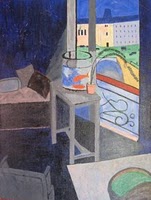
The Matisse exhibit at Chicago’s Art Institute (which I returned to yesterday) closes on June 20th, then opens at New York’s Museum of Modern Art on July 18th. I have only one word of advice: Go!
You’re sitting, in 1926, in the back of a little church in Dallas. It’s hot and the windows are open. This woman, who’s been at the piano since you walked in, begins to play.
You don’t have to go to Chicago’s south or west sides to hear music that comes from the gospel tradition. The other day, at a Catholic church in a far northwest suburb (Barrington), a funeral service (for my uncle) closed with this.
Thomas A. Dorsey (1899-1993), “Precious Lord,” live, c. 1981 (Say Amen, Somebody [1982])
**********
lagniappe
More from Mr. Dorsey (and Say Amen, Somebody):
*****
Since it’s the best-known gospel song [‘Precious Lord’], it was perfectly natural for Dr. Martin Luther King to request its performance the night of his death.
—Anthony Heilbut, The Gospel Sound: Good News and Bad Times (6th ed. 2002)
*****
Want more gospel?
Here’s the theme song for one of my favorite radio shows, Kevin Nutt’s Sinner’s Crossroads (WFMU-FM), which can be heard liveon Thursday night from 7-8 p.m. (EST) or at the archives anytime.
(This comes from The Widow’s Might, a DVD containing [in mp3 format] every song played on Sinner’s Crossroads in 2009, which is available as a premium for a $75 pledge to WFMU.)
These guys sounded awfully good the other day—let’s hear some more.
Trombone Shorty and Orleans Avenue, “Orleans & Claiborne,” live, New Orleans, 2010
There are a lot of things to like about this performance. One is the way Shorty, following two hot solos (tenor, baritone), doesn’t try to out-blow those guys. Instead, he changes directions (3:20). Sometimes nothing packs more punch than restraint. (Yeah, I don’t know why this clip cuts off when it does, either.)
Soon I’ll be leaving for a funeral—my uncle, Hugh Frebault. Nine days ago we sat and talked and laughed for over an hour; now he’s silent. Does life get any more understandable as you get older? I don’t think so—if anything, it seems to become only more mysterious, more unfathomable.
Blind Willie Johnson, “Dark Was The Night – Cold Was The Ground” (1927, Dallas)

 music clip of the day