Henry “Red” Allen (trumpet), with Coleman Hawkins (tenor saxophone), Vic Dickenson (trombone), Pee Wee Russell (clarinet), Rex Stewart (cornet), Danny Barker (guitar), Nat Pierce (piano), Milt Hinton (bass), Papa Jo Jones (drums), “Wild Man Blues,” live (TV Broadcast, The Sound of Jazz), 1957
All-star jam sessions often fizzle. Not this one. What makes this so good? A lot of it, I think, has to do with saxophonist Coleman Hawkins, who takes the first solo after trumpeter Red Allen states the melody. Right from the beginning (1:27-) it’s apparent that Hawkins isn’t just going through the motions. He plays, throughout, with great concentration and conviction, not wasting a moment. This inspires everyone; you can see it in their faces (1:44-47, 1:55-58, 2:03-08, 2:39-44). He gives the others a lot to live up to—and they do.
The 1960s—a decade of relentless experimentation, bold innovation, of searching, always, for something new, something true.
Freddie and the Dreamers, “Little Bitty Pretty One,” “A Little You”
Live, London, 1965
**********
lagniappe
reading table
Last night I had a dream. I was in France. Paris was again falling to the Germans, but it had become such a habit that one had to look closely to see that anyone really cared. I arrived in Paris (from the front, I think, but there wasn’t much of one) went to a party, where I was surrounded by acquaintances. They became distant and shadowy when I approached them. Suddenly I saw you and gave you a tremendous hug. You moved to another table. I said: ‘I know where there are a couple of good French restaurants.’ You said: ‘They’re all French here.’
—Robert Lowell, Letter to Elizabeth Bishop, 6/14/1953,
in The Letters of Robert Lowell (Saskia Hamilton ed., 2005)
Yesterday we left off in 1977; let’s fast-forward 33 years.
Von Freeman (tenor saxophone), with Mike Allemana (guitar), Matt Ferguson (bass), Michael Raynor (drums); “Lester Leaps In,” live, Chicago (New Apartment Lounge, 75th St.), 2010
Johnny Otis, December 28, 1921-January 17, 2012, singer, songwriter, piano player, bandleader, disc jockey, TV host, etc.
“Willie and the Hand Jive” (The Johnny Otis Show), c. late 1950s
**********
lagniappe
Genetically, I’m pure Greek. Psychologically, environmentally, culturally, by choice, I’m a member of the black community.
***
Society wants to categorize everything, but to me it’s all African-American music. The music isn’t just the notes, it’s the culture—the way Grandma cooked, the way Grandpa told stories, the way the kids walked and talked.
The other night my son Alex took me—this was my Christmas present—to see this guy at a small concert hall on the north side of Chicago (Old Town School of Folk Music). We’d last seen him together 20 years ago, in 1992, at a little club not far from where we live (FitzGerald’s). Alex wasn’t even five years old. It was an early evening set, part of a big Fourth of July festival. The night was stormy. The power went out. He played by candlelight.
If you wanted to conjure a world full of mystery, what better instrument to lead the way than one that possesses neither the brightness of the violin nor the darkness of the cello?
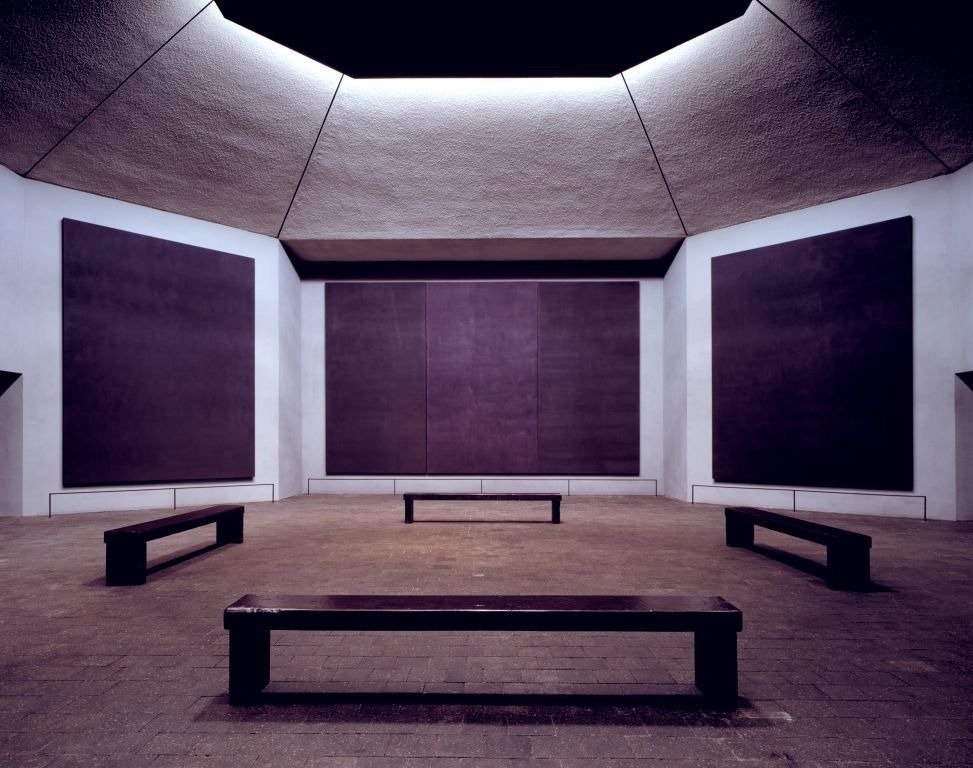
Morton Feldman, Rothko Chapel (1971), live, Houston (Rothko Chapel), 2011; Kim Kashkashian (viola), Brian Del Signore (percussion), Sarah Rothenberg (celeste), Maureen Broy Papovich (soprano), Houston Chamber Choir (Robert Simpson, cond.)
The Rothko Chapel is an interfaith sanctuary, a center for human rights — and a one-man art museum devoted to 14 monumental paintings by abstract expressionist Mark Rothko. The Houston landmark, commissioned by John and Dominique de Menil, opened its doors 40 years ago, in February 1971.
For the past four decades, the chapel has encouraged cooperation between people of all faiths — or of no faith at all. While the chapel itself has become an art landmark and a center for human-rights action, the sanctuary’s creator never lived to see it finished. Rothko committed suicide in 1970.
Approaching the chapel from the south, visitors first see a steel sculpture called Broken Obelisk by Barnett Newman in the middle of a pool — it appears to be floating on the surface of the water. The chapel itself is a windowless, octagonal brick building. Solid black doors open on a tiny glass-walled foyer. (The foyer was walled off from the rest of the interior when the Gulf Coast’s notorious humidity began to affect the paintings.)
The main room is a hushed octagonal space with gray stucco walls, each filled by massive paintings. Some walls feature one canvas, while on others, three canvases hang side by side to form a triptych. A baffled skylight subdues the bright Houston sun, and the surfaces of the paintings change dramatically as unseen clouds pass outside. There are eight austere wooden benches informally arranged, and today, a few meditation mats. A young woman brings the meditation hour to a close by striking a small bowl with a mallet, creating a soft peal of three bells in the intense silence of the room.
Concerts, conferences, lectures, weddings and memorial services all take place in the chapel throughout the year, but on most days you will find visitors — about 55,000 annually come to see, to meditate, to write in the large comment book in the foyer, to read the variety of well-thumbed religious texts available on benches at the entrance.
***
These paintings do not feature the luminous color fields that made Rothko famous. The paintings in the chapel are dark, in purplish or black hues. And there’s a reason for that, says [chapel historian Suna] Umari.
“They’re sort of a window to beyond,” she explains. “He said the bright colors sort of stop your vision at the canvas, where dark colors go beyond. And definitely you’re looking at the beyond. You’re looking at the infinite.”
***
At first glance, the paintings appear to be made up of solid, dark colors. But look closely, and it becomes evident that the paintings are composed of many uneven washes of pigment that create variations in every inch. Stepping back, waves of subtle color difference appear across the broad surfaces — leading to an unmistakable impression of physical depth.
***
Though Mark Rothko didn’t live to see the sanctuary he created, Christopher Rothko says his father knew what it should be.
“It took me a while to realize it, but that’s really my father’s gift, in a sense, to somebody who comes to the chapel. It’s a place that will really not just invite, but also demand a kind of journey.”
What do you get when you combine a pianist who plays with the percussive intensity of a drummer and a drummer who plays with the melodic buoyancy of a pianist?
Cecil Taylor (piano), Max Roach (drums), live
New York (Columbia University), 2000
**********
lagniappe
art beat: more from Thursday’s stop at the Art Institute of Chicago (after a hearing at the nearby federal court building)
Roy Hargrove Quintet,* “Strasbourg/Saint Denis,” live, Paris, 2008
What better way to begin the new year than with live music, which is what I did last Sunday (with my wife Suzanne and older son Alex), catching these guys at Chicago’s Jazz Showcase, where they played an ebullient set for the overflow crowd.
**********
lagniappe
reading table
In January baseball lives in the imagination.
Now he was stuck at this ramshackle ballpark between a junkyard and an adult bookstore on the interstate outside Peoria.
***
“The shortstop is a source of stillness at the center of the defense. He projects this stillness and his teammates respond.”
***
When your moment came, you had to be ready, because if you fucked up, everyone would know whose fault it was. What other sport not only kept a stat as cruel as the error but posted it on the scoreboard for everyone to see?