Friday, 2/10/12
only rock ’n roll
Terry Malts (Phil Benson, vocals, bass; Corey Cunningham, guitar; Nathan Sweatt, drums), “Nauseous,” “Something About You,” 2012
Vodpod videos no longer available.
only rock ’n roll
Terry Malts (Phil Benson, vocals, bass; Corey Cunningham, guitar; Nathan Sweatt, drums), “Nauseous,” “Something About You,” 2012
Vodpod videos no longer available.
how to cast a spell
Tip #1: Be under one yourself.
Gretchen Parlato (with Taylor Eigsti, piano; Alan Hampton, bass; Mark Guiliana, drums), “Better Than,” live, Germany (Stuttgart), 2010
**********
lagniappe
reading table
thin wall—
with the moonlight
comes the cold—Kobayashi Issa, 1824 (translated from Japanese by David G. Lanoue)
not for the faint of heart
Weasel Walter (drums), Peter Evans (trumpet), Mary Halvorson (guitar), live, Toronto (Placebo Space), 2011
**********
lagniappe
reading table
We call it a grain of sand,
but it calls itself neither grain nor sand.
It does just fine without a name,
whether general, particular,
permanent, passing,
incorrect, or apt.Our glance, our touch mean nothing to it.
It doesn’t feel itself seen and touched.
And that it fell on the windowsill
is only our experience, not its.
For it, it is no different from falling on anything else
with no assurance that it has finished falling
or that it is falling still.The window has a wonderful view of a lake,
but the view doesn’t view itself.
It exists in this world
colorless, shapeless,
soundless, odorless, and painless.The lake’s floor exists floorlessly,
and its shore exists shorelessly.
Its water feels itself neither wet nor dry
and its waves to themselves are neither singular nor plural.
They splash deaf to their own noise
on pebbles neither large nor small.And all this beneath a sky by nature skyless
in which the sun sets without setting at all
and hides without hiding behind an unminding cloud.
The wind ruffles it, its only reason being
that it blows.A second passes.
A second second.
A third.
But they’re three seconds only for us.Time has passed like a courier with urgent news.
But that’s just our simile.
The character is invented, his haste is make-believe,
his news inhuman.—Wislawa Szymborska (1923-2012), “View with a Grain of Sand” (translated from Polish by Stanislaw Baranczak and Clare Cavanagh)
Some tracks, the first time you hear them (as I did this a couple weeks ago), you wonder how you ever got along without them.
Joe McPhee (tenor saxophone) with Otis Greene (alto saxophone), Mike Kull (electric piano), Herbie Lehman (organ), Dave Jones (guitar), Tyrone Crabb (bass), Bruce Thompson & Ernest Bostic (percussion), “Shakey Jake” (Nation Time, 1970; reissued 2009)
**********
lagniappe
random thoughts
Remember when there was a whole season—not just a storm or two—called “winter”?
A lot of trumpet players try to bowl you over. This guy, whose last album appeared on many year-end top-10 lists (When the Heart Emerges Glistening, Blue Note), does something different. He gets under your skin.
Ambrose Akinmusire (ah-kin-MOO-sir-ee) Quintet (AA, trumpet; Walter Smith III, tenor saxophone; Fabian Almazan, piano; Harish Ragavan, bass; Justin Brown, drums); live, New York (Jazz Standard), 2011
Part 1
***
Part 2
***
Part 3
***
Part 4
**********
lagniappe
musical thoughts
Everything you don’t love, make sure that’s not in your playing.
—Steve Coleman (saxophonist, composer, bandleader) to Ambrose Akinmusire
*****
passings
Wislawa Szymborska (vees-WAH-vah shim-BOR-ska), poet
July 2, 1923-February 1, 2012
The world—whatever we might think when terrified by its vastness and our own impotence, or embittered by its indifference to individual suffering, of people, animals, and perhaps even plants, for why are we so sure that plants feel no pain; whatever we might think of its expanses pierced by the rays of stars surrounded by planets we’ve just begun to discover, planets already dead? still dead? we just don’t know; whatever we might think of this measureless theater to which we’ve got reserved tickets, but tickets whose lifespan is laughably short, bounded as it is by two arbitrary dates; whatever else we might think of this world—it is astonishing.
But “astonishing” is an epithet concealing a logical trap. We’re astonished, after all, by things that deviate from some well-known and universally acknowledged norm, from an obviousness we’ve grown accustomed to. Now the point is, there is no such obvious world. Our astonishment exists per se and isn’t based on comparison with something else.
Granted, in daily speech, where we don’t stop to consider every word, we all use phrases like “the ordinary world,” “ordinary life,” “the ordinary course of events” . . . But in the language of poetry, where every word is weighed, nothing is usual or normal. Not a single stone and not a single cloud above it. Not a single day and not a single night after it. And above all, not a single existence, not anyone’s existence in this world.
—Wislawa Szymborska, Nobel Lecture (excerpt, translated from Polish by Stanislaw Baranczak and Clare Cavanagh), 12/7/96
More Szymborska? Here. And here. And here. And here.
Until 1996, when she was awarded the Nobel Prize in Literature, I’d never heard of her. Since then I’ve read virtually everything of hers that’s appeared in translation. How much does she mean to me? Well, she’s one of two charter members (the other’s saxophonist Von Freeman) of the ultra-exclusive MCOTD Hall of Fame.
one of my desert-island singers
Dorothy Love Coates (1928-2002) & the Gospel Harmonettes
“I Won’t Let Go” (AKA “I’m Just Holding On”), live
More?
And here.
**********
lagniappe
Here’s the original recording (Specialty, 1950s).
*****
Were gospel to be more publicly acclaimed, she [Dorothy Love Coates] might have the stature of a Billie Holiday or a Judy Garland. Instead, for thousands of black people, she is the message carrier.
—Anthony Heilbut, The Gospel Sound: Good News and Bad Times (6th ed. 2002)
***
[I]t was obvious that Keith [Richards] and Gram [Parsons] enjoyed spending time together. . . . [W]e just all cared deeply about the same things. We just loved, for instance, to sit and listen to Dorothy Love Coates, the gospel singer.
(Quotes originally posted 3/28/10.)
lighter than air, funkier than dirt
Otha Turner (1907-2003) and the Rising Star Fife and Drum Band (with guest Luther Dickinson, guitar), “My Babe,” live, Memphis, 1990s
**********
lagniappe
art beat: more from Wednesday’s stop at the Art Institute of Chicago
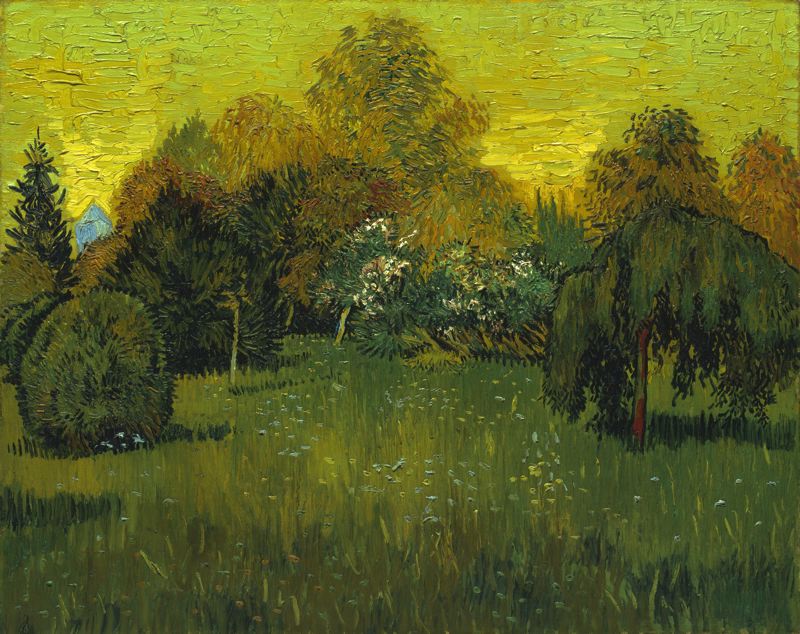
Vincent van Gogh, The Poet’s Garden (1888)
*****
musical thoughts
Last night, at the University of Chicago’s Mandel Hall, I heard what may be the finest encore I’ve ever heard. After devoting the second half of his concert to Beethoven’s mammoth Diabelli Variations, pianist Peter Serkin, following several trips offstage to rapturous applause, sat down and played, slowly, meditatively, the Aria from Bach’s Goldberg Variations. As the last note was fading, if someone had turned to me and said, with the kind of confidence one often encounters in Hyde Park, that the greatest achievements in the history of humanity can be heard at the piano, I couldn’t have done anything other than agree.
When the groove’s this strong, I don’t ever want it to end.
Give me another take.
And another.
Another.
Black Dub (Brian Blade, drums; Trixie Whitley, drums, vocals; Daniel Lanois, guitar, vocals; Jim Wilson, bass, vocals), “Last Time”
1: Santa Monica, 2/16/11
***
2: Philadelphia, 11/18/10
***
3: Vancouver, 2/2/11
***
4: Hamburg, 7/21/11
most useless label?
world music
indie rock
free jazz
The competition’s fierce.
Mostly Other People Do the Killing (Moppa Elliott, bass; Peter Evans, trumpet; Jon Irabagon, alto saxophone; Kevin Shea, drums), live, London (The Vortex), 7/14/11
**********
lagniappe
art beat: yesterday at the Art Institute of Chicago (after a hearing at the nearby federal court building)
Vincent van Gogh
The Bedroom (1889)

*******
Self-Portrait (1887)
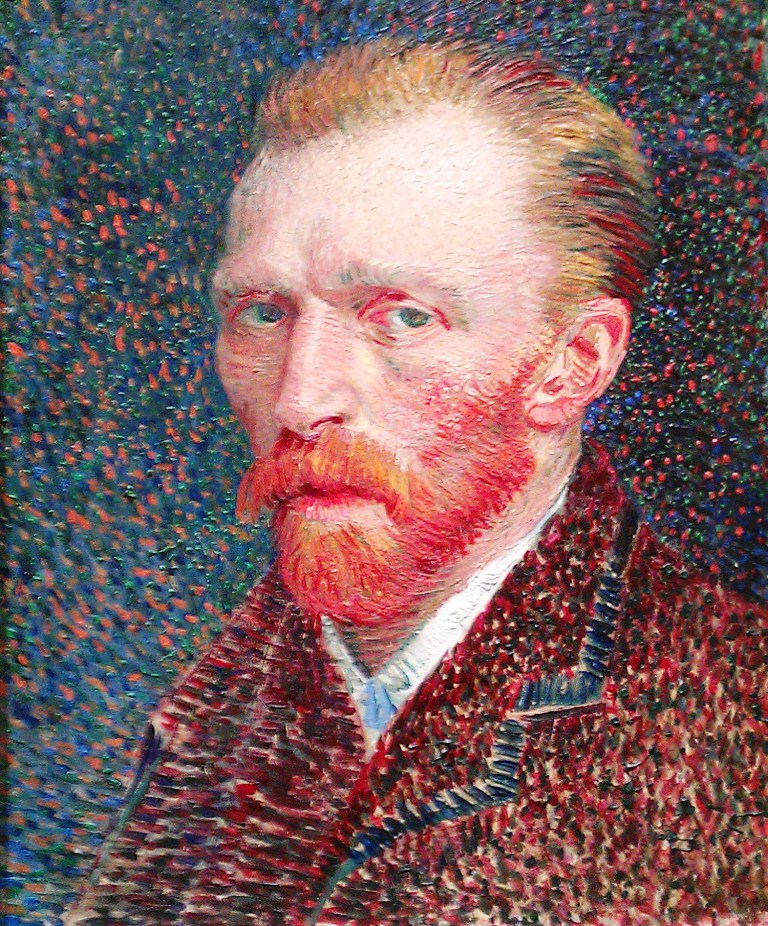
With van Gogh, the life continually threatens to overtake the art; the challenge is to look with fresh eyes.
on & on & . . .
Lyn Horton, Goldmine Brook: The Day After Christmas (2011)
Glenn Branca, Lesson No. 1 for Electric Guitar (1980, reissued 2004)
Vodpod videos no longer available.

