music clip of the day

jazz/blues/rock/classical/gospel/more

Category: classical

Wednesday, May 26, 2010

Funeral last week.

Ill this week.

What to listen to?

Beethoven, Piano Sonata No. 32 in C minor, Op. 111/Claudio Arrau, piano (1970)

1st Movement

*****

2nd Movement

#1

#2

lagniappe

A fascinating lecture-recital on this sonata, by pianist Andras Schiff, can be heard here.

*****

Speaking of the second movement, pianist Alfred Brendel said:

. . . perhaps nowhere else in piano literature does mystical experience feel so immediately close at hand.

Saturday, May 22, 2010

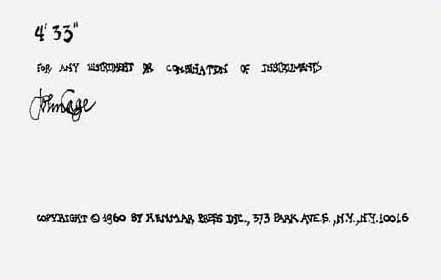
Here’s a piece that sounds different every time you hear it.

John Cage, 4’ 33” (1952)/David Tudor, piano

lagniappe

***

*****

I didn’t wish it [4′ 33″] to appear, even to me, as something easy to do or as a joke. I wanted to mean it utterly and be able to live with it.

***

Until I die there will be sounds. And they will continue following my death. One need not fear about the future of music.

—John Cage

*****

mail

Thank you so much for this.

—Robert Ambrose (in response to an email letting him know that he and Bent Frequency were featured here)

*****

art beat

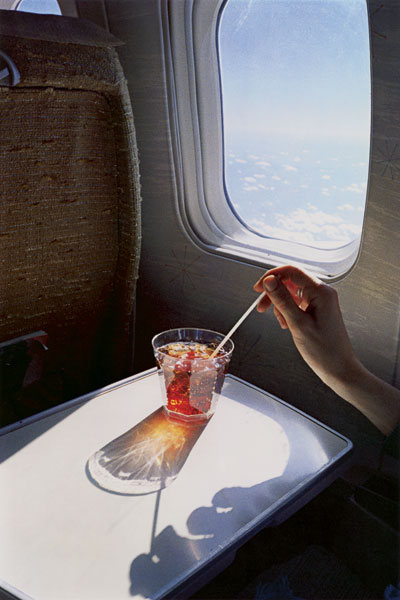
Tomorrow’s the last day to see the William Eggleston exhibit at Chicago’s Art Institute.

Want more? Here. Here.


Wednesday, May 19, 2010

1. Things you’ve heard before.

2. Things you’ve never heard.

Suppose you could listen to only one for the rest of your life.

Which would you choose?

Tristan Murail (1947-), “L’Espirit de Dunes” (1993-94)/Bent Frequency, Robert Ambrose conducting; live, Georgia (Morrow), 2006

Part 1

*****

Part 2

**********

lagniappe

Our conception of music is held prisoner by our education. All has been cut into slices, put into categories, classified, limited. There is a conceptual error from the very beginning: the composer does not work with 12 notes, x rhythmic figures, x dynamic markings, all infinitely permutable–he works with sound and timbre. Sound has been confused with its representations . . .

—Tristan Murail, “Spectra and Pixies” (1984)

Want more? Here.

Monday, 5/10/10

YouTube giveth, and YouTube taketh away.

I’ve posted other clips that were subsequently removed by YouTube. But this is the first time where I’ve posted something that was removed the very same day.

Oh, well—more tomorrow.

**********

When the tempo is perfect, the music unfolds in what seems to be the only way it could. “Fast” and “slow” lose their meaning. Time disappears.

Frederic Chopin, 24 Preludes for Solo Piano, Op. 28/Friedrich Gulda, piano

Nos. 15, 10, 9, 3, 4

*****

Nos. 7, 13, 21, 24

Want more? Here.


Thursday, 5/6/10

I was about 16 when I had an experience that I recollect in nearly Proustian detail, listening for the first time to the String Quartet in C-sharp Minor, op. 131. I was sitting in a friend’s living room when her father put a recording of it on the hi-fi. I remember everything about those three-quarters of an hour back in 1961 or ’62: the room in which I was sitting and the direction in which I was facing; the single, exposed Bozak speaker vibrating like an exotic organism in the unfinished wooden box that Mr. L. had built to contain it; the quickly dawning realization that the first movement was the most overwhelming piece of music I had ever heard—a feeling that comes back to me whenever I listen to it, in real sound or mentally, as at this moment; and I remember (but this memory comes also from countless later listenings) the mysterious, throbbing sound of the first violin’s statement of the opening subject in that recording, made by the Budapest Quartet in the early 1950s.

***

I am now several years older than Beethoven lived to be. I still think of him as my alpha and omega, but in a different sense: as the author of music that transformed my existence at the onset of adulthood and that continues to enrich it more than any other music as I approach what are often referred to as life’s declining years. His music still gives me as much sensual and emotional pleasure as it gave me 50 years ago, and far more intellectual stimulation than it did then. It adds to the fullness when life feels good, and it lengthens and deepens the perspective when life seems barely tolerable. It is with me and in me. A thousand or 5,000 or 10,000 years from now, Beethoven and our civilization’s other outstanding mouthpieces may still have much to communicate to human beings—if any of our descendants are still around—or they may seem remote, cold, obscure. But what matters most in Beethoven’s case is his belief that we are all part of an endless continuum, whatever our individual level of awareness may be. In the Ninth Symphony, he used Schiller’s words to tell us explicitly what many of his other works, especially his late works, tell us implicitly: that the “divine spark” of joy and the “kiss for the whole world,” which originate “above the canopy of stars,” must touch and unite us all. The spark is there, he said, and so is the kiss; we need only feel and accept their presence.—Harvey Sachs

*****

Beethoven, String Quartet No. 14 in C-sharp minor, op. 131/1st Movement

Budapest Quartet, 1943

*****

Busch Quartet, 1936

Want more? Here. Here. Here.

Saturday, 4/17/10

When it comes to saying a lot with a little, Chopin’s 24 Preludes for solo piano—most of which last no more than a minute or two—have few equals. This one was played at his funeral.

Frederic Chopin, Prelude No. 4 in E Minor, Op. 28

Sviatoslav Richter (1915-1997)

*****

Alfred Cortot (1877-1962)

*****

Martha Argerich (1941-)

**********

lagniappe

Today isn’t just any old day; it’s Record Store Day 2010.

Chris Brown, Bull Moose (New England record stores)

*****

reading table

an old man’s ways—

my backside warmed

by the wood fire

—Kobayashi Issa (1763-1828; Trans. David G. Lanoue)

Saturday, 3/27/10

Here’s more from my favorite 101-year-old composer.

Elliott Carter, Two Diversions for Piano (2) (1999)/Pierre-Laurent Aimard, piano

Want more Elliott Carter? Here. Here.

More Pierre-Laurent Aimard? Here.

**********

lagniappe

I used to write these gigantic pieces that were very complex and took a long time to compose, if not to play. I am now much more impatient and couldn’t stand working for so long on the same thing. But also those pieces were me working out certain ideas about music. Those ideas are now part of my life, so I don’t have to think about them in quite the same way. But some things never change, in that you are still glad to finish a piece and still wonder whether it is as good as you hoped it might be when you started out.

***

The Two Diversions were an idea of Ursula Oppens. Oppens decided that Carnegie Hall should commission composers to write what they considered easy pieces, and to make an album for piano students, and so I wrote two pieces for this album. I don’t think they’re as easy as they’d hoped, but there are some people with even harder ones.

—Elliott Carter (first quote’s from here, second here)
Tuesday, 3/23/10

looking back

Today, celebrating our 200th post, we revisit a few favorites.

**********

9/14/09

If I didn’t have kids, would my ears be stuck, forever, on “repeat”?

Here’s something my younger son Luke, who just started college, played for me recently, after first pronouncing it, with quiet but absolute authority, the best thing this guy has done (already Luke’s learned that what’s important isn’t to be right; it’s to seem right).

Lupe Fiasco, “Hip Hop Saved My Life,” live, Los Angeles, 2008

*****

And here’s a track my older son Alex played for me a couple weeks ago, before heading back to school.

Dirty Projectors, “Stillness Is The Move”

*****

Koan for aging parents: What is the sound of a childless house?

**********

10/15/09

How to be both solid and fluid, both fat and delicate. How to make the beat breathe. These are things that, as a child, Philly Joe Jones began to learn while dancing—tap-dancing. Just watch the way Thelonious Monk, listening to this solo, rocks back and forth (1:25-1:50), as if he’s about to break into a little dance himself.

Philly Joe Jones, live (with Thelonious Monk), 1959

**********

lagniappe

He breathed our history as/his walking beat . . . The Man/So Hip/A City/Took/His/Name.—Amiri Baraka (formerly LeRoi Jones, in Eulogies [1996])

**********

10/30/09

The first time I stood before a judge at Chicago’s Criminal Courts Building at 26th and California—this was back in the ’70s (when I was working at Alligator Records)—it was to speak on behalf of this man, Hound Dog Taylor. The day before, during a drunken argument at his apartment, he’d shot his longtime guitarist Brewer Phillips (who survived). In his own way, Hound Dog was a pretty canny guy. When he told me about this incident over the phone, shortly after it happened, he put it this way: “Richard, they say I shot Phillip.”

(No, don’t touch that dial; these stills are way out of focus—which, for Hound Dog, seems just right.)

*****

Hound Dog Taylor and the Houserockers, live, Ann Arbor Blues Festival, 1973

“Wild About You Baby”

***

“Taylor’s Rock”

***

“I Held My Baby”

**********

11/23/09

Here’s Arthur Russell, the “seminal avant-garde composer, singer-songer-writer, cellist, and disco producer who died in 1992 at the age of 40 (of AIDS-related complications) and is the subject of both a recent documentary, Wild Combination, and a new book, Hold On To Your Dreams: Arthur Russell and the Downtown Music Scene, 1973-1992.

Arthur Russell

“Get Around To It”

*****

“You And Me Both”

*****

“This Is How We Walk on the Moon”

*****

“That’s Us/Wild Combination”

(Yeah, the fact that I’m posting four tracks by this guy shows how much his music, which I just encountered recently, has been getting under my skin.)

**********

12/5/09

Here one of the greatest American artists of the 20th century (composer Morton Feldman [1926-1980]) pays homage to another (painter Mark Rothko [1903-1970]).

Morton Feldman, “Rothko Chapel” (composed in 1971; first performed, at Houston’s Rothko Chapel, in 1972)

Part 1

Part 2

Part 3

Part 4

Part 5

**********

12/6/09

I first heard this guy back in the mid-1970s, after reading a review in the New York Times, by the late Robert Palmer, of his first album, The Gospel Saxophone of Vernard Johnson—and I’ve been listening to him ever since.

Vernard Johnson, saxophone

Live, Texas (Roanoke)

**********

lagniappe

reading table

Music . . . helped me to go deeper inside myself, to find new things there: the variety which I had vainly sought in life and in travel, yet the longing for which was stirred in me by the surge of sound whose sunlit wavelets came to break at my feet.

—Marcel Proust, The Prisoner (Trans. Carol Clark)

Wednesday, 3/17/10

Some music—like, say, Emil Gilels performing Beethoven’s Waldstein sonata or Ben Webster playing “Old Folks” or Al Green singing “Jesus Will Fix It”—transports you to another place. Other music, like this, transforms the space around you.

Steve Reich, “Music for 18 Musicians” (1974-76)

Part 1

Excerpt (beginning), live, Cincinnati, 2008

*****

Part 2

Excerpt, recording (Grand Valley State University New Music Ensemble)

*****

Part 3

Excerpt (ending), live, Tokyo, 2008

*****

I first encountered Steve Reich’s music in 1971, while in college and living for a few months in New York. At a concert at New York University, I heard Reich and his ensemble perform his then-new piece “Drumming.” Stunning, mesmerizing, it was unlike anything my 19-year-old ears had ever heard.

**********

lagniappe

The other day, I watched as Steve Reich walked away from Carnegie Hall, where celebrations of his seventieth birthday were under way, and out into his native city. Trim and brisk, he darted into West Fifty-seventh Street, fell back before oncoming traffic, bopped impatiently in place, then darted forth again. He soon disappeared into the mass of people, his signature black cap floating above the crowd. Perhaps I should have lamented the fact that one of the greatest living composers was moving around New York unnoticed, but lamentation is not a Reichian state of mind, and I thought instead about how his work has blended into the cultural landscape, its repeating patterns and chiming timbres detectable all over modern music. Brian Eno, David Bowie, David Byrne, and a thousand d.j.s have paid him heed. On Fifty-seventh Street, Reich-inflected sounds may have been coursing through the headphones of a few oblivious passersby.

Three decades ago, New York’s leading institutions would have nothing to do with Reich. A riot broke out when Michael Tilson Thomas presented “Four Organs” at Carnegie in 1973: one woman tried to stop the concert by banging on the edge of the stage with her shoe. Now uptown is lionizing the longtime renegade.

***

Reich changed music, and he also changed how music relates to society. In the face of early incomprehension, he took a do-it-yourself approach to getting his work before the public. Nonclassical musicians were among his models: he saw John Coltrane some fifty times, and marvelled at how the great man would unleash mind-bending sounds, pack up his sax, and disappear into the night. With his namesake ensemble, Reich performed in galleries, clubs, and wherever else he felt welcome. The effects of this paradigm shift can be seen on any day of the week in New York, as composer-led ensembles proliferate.

***

The Reich ensemble retains most of its original members, and they remain an awesome force, even as shaggy hairdos have given way to dignified shocks of white. At Zankel Hall, they played Part I of “Drumming,” a phase-shifting tour de force in which bongos are struck with sticks. I was curious to see how they would compare with two sharp young ensembles who had performed the same stretch of music in recent weeks—So Percussion, at Symphony Space, and four Juilliard percussionists, at Carnegie. The youngsters drummed with effortless grace, as if the score were written into their genetic code. But the veterans more than held their own, bringing to bear a kind of disciplined wildness, in the spirit of the Ghanaian drummers with whom Reich studied before he wrote the piece. The energy that blazed up at climactic moments could have powered the hall in a blackout.

Alex Ross (The New Yorker, 11/13/06)

Thursday, 2/25/10

Composed almost a century ago, these tiny pieces—haiku-like in their compression—still astonish.

Anton Webern (1883-1945), Six Bagatelles for String Quartet, Op. 9 (1911-13)/LaSalle Quartet

**********

lagniappe

The 15th of September 1945, the day of Anton Webern’s death, should be a day of mourning for any receptive musician. We must hail not only this great composer but also a real hero. Doomed to a total failure in a world of ignorance and indifference he inexorably kept on cutting out his diamonds, his dazzling diamonds, the mines of which he had such a perfect knowledge.—Igor Stravinsky