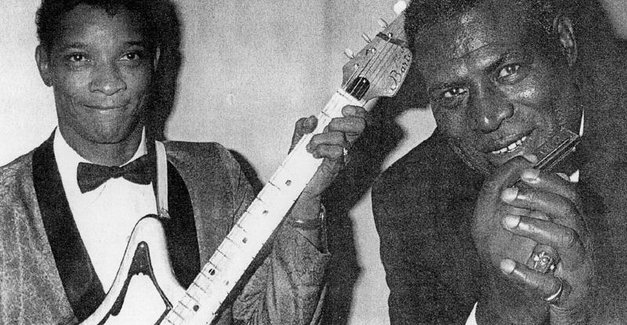
Johnny Shines (1915-1992), vocals, guitar; David “Honeyboy” Edwards (1915-2011), guitar; Big Walter Horton (1917-1981), harmonica; “For The Love of Mike,” live, 1978
A belated Happy Birthday to MCOTD Hall of Famer Von Freeman, who turned 88 yesterday. Want to send birthday wishes? You can email them to info@jazzinchicago.org (subject line: Birthday Wishes for Von Freeman). Or you can do it the old-fashioned way: Birthday Wishes for Von Freeman, c/o The Jazz Institute of Chicago, 410 S. Michigan Ave., Chicago, IL 60605.
One of many remarkable things about the world we live in is the variety of ways you can die. It’s easy to imagine a world in which there was just one cause of death—say, heart attack. But here we have strokes, too. And there is colon cancer, and liver cancer, and breast cancer, and brain cancer. Don’t forget infectious diseases: pneumonia, tuberculosis, AIDS. Daily folks depart in car crashes. You could also drown. If death were a product sold in stores, imagine how many aisles it would occupy.
Life thickens as you get older, becoming more layered. The other night, for instance, listening to Mad Professor dub Bob Marley at a club on Chicago’s south side (Reggie’s, State near Cermak), I found it hard not to think of another night over thirty years ago, of another club on the other side of town (Quiet Knight, Belmont near Clark, now gone), of hearing Bob Marley not dubbed but live.
Bob Marley and the Wailers, “Trenchtown Rock”
Live, Chicago (Quiet Knight), 1975
Today, in celebration of our second birthday, we revisit a few favorites from our first month.
*******
If I didn’t have kids, would my ears be stuck, forever, on “repeat”?
Here’s something my younger son Luke, who just started college, played for me recently, after first pronouncing it, with quiet but absolute authority, the best thing this guy has done (already Luke’s learned that what’s important isn’t to be right; it’s to seem right).
Lupe Fiasco, “Hip Hop Saved My Life,” live, Los Angeles, 2008
*****
And here’s a track my older son Alex played for me a couple weeks ago, before heading back to school.
Dirty Projectors, “Stillness Is The Move”
*****
Koan for aging parents: What is the sound of a childless house?
(Originally posted 9/14/09.)
*******
May, 2012
Nobel-Prize-winning economist devises a way to turn faces—images of them, that is—into marketable commodities: the more expressive the face, the greater the value.
March, 2013
Haiti is named one of the world’s wealthiest countries.
Arcade Fire, “Haiti” (Funeral, 2004)
(Originally posted 9/23/09.)
*******
Performances like this usually fall somewhere between disappointing and disastrous. So many things can—and usually do—go wrong when you take a bunch of folks who’re used to leading their own bands and throw them together onstage. People trip all over each another; flash trumps feeling. But this performance, with Albert King, Stevie Ray Vaughan, Paul Butterfield, and (at the end) B.B. King, has plenty of strong moments—some funny ones, too. Listen to Albert bark at Paul:“Turn around!” (0:39) And watch Albert outfox B.B. First he invites him back onstage (4:40) and then, just when B.B.’s about to take flight (5:55), he cuts him off—faster than you can say “wham”—with his own (wonderful) solo. So much for Emily Post.
Stevie Ray Vaughan, Albert King, Paul Butterfield, B.B. King, live, 1987
(Originally posted 9/18/09.)
*******
If spirit could be sold, New Orleans would be rich.
Rebirth Brass Band, live, New Orleans, 2009
**********
lagniappe
Brass band musicians are a wild bunch. They’re hard to control. The street funk that the Rebirth [Brass Band]plays definitely isn’t traditional—it might be in thirty years time.
—Lajoie “Butch” Gomez (in Mick Burns, Keeping the Beat on the Street: The New Orleans Brass Band Renaissance[2006])
(Originally posted 9/11/09.)
*******
Muddy Waters, Saul Bellow, Steppenwolf Theater Company (John Malkovich, John Mahoney, Gary Sinise, Laurie Metcalf, et al.), Curtis Mayfield: a lot of great artists, musical and otherwise, have come out of Chicago in the last 50 years. Among the greatest is this group: the Art Ensemble of Chicago. While the horn players (Roscoe Mitchell, Joseph Jarman, Lester Bowie) got the lion’s share of the attention, what gave their music its juice—what made it dance—was (as you’ll hear) one of the finest rhythm sections ever: Malachi Favors, bass; Don Moye, drums.
Art Ensemble of Chicago, live, Poland (Warsaw), 1982 (in four parts)
Part 1 of 4
Part 2 of 4
Part 3 of 4
Part 4 of 4
(I talk about the AEC in the past tense because, while recordings are still released under this name from time to time, with two key members [they were all “key members”] now dead—trumpeter Lester Bowie [1999] and bassist Malachi Favors [2004]—it just isn’t [nor could it be] the same.)
(Originally posted 9/8/09.)
*******
Here—with a shout-out to my brother Don, with whom (at the age of 15) I saw the MC5 in Chicago’s Lincoln Park during the 1968 Democratic Convention (when nobody outside the Detroit/Ann Arbor area [including us] knew who they were)—is an awfully good cover, from what might seem an unlikely source, of one of their “greatest hits.”
Jeff Buckley, “Kick Out The Jams,” live, Chicago, 1995
And here, courtesy, apparently, of the Department of Defense, is (silent) footage of the scene in Lincoln Park on August 25, 1968—the day the MC5 (who appear here fleetingly) played.
(Originally posted 9/7/09.)
*******
If influence were compensable, Claude Jeter of the Swan Silvertones—a huge influence on Sam Cooke, Curtis Mayfield, Eddie Kendricks (Temptations), Al Green, even Paul Simon (who took inspiration from a line in the Swans’ “hit” “Mary, Don’t You Weep” [“I’ll be a bridge over deep water if you trust in my name”] when he wrote “Bridge Over Troubled Water”)—would have, when he passed earlier this year at the age of 94, died a wealthy man.
When he leaves the house [in NYC], he whistles his favorite tune, ‘What A Friend We Have In Jesus,’ while greeting the assorted neighborhood junkies and prostitutes who knew him mainly as sometime manager of the [Hotel] Cecil. ‘What’s new, Jeter,’ they ask. ‘Nothing new, nothing good, just thank God for life up here with these heathens and muggers.’
—Anthony Heilbut, The Gospel Sound: Good New and Bad Times(1971)
take 2: original recording (Soul Heaven Records 2006)
Vodpod videos no longer available.
***
take 3: Phil Asher Remix (2006)
Vodpod videos no longer available.
***
take 4: Groove Assassin Remix (2007)
Vodpod videos no longer available.
**********
lagniappe
Did you come up in the house music community of Chicago?
My brother was in that community before he passed away. Every night he was going out. That was a way of me basically paying homage to him, and finding the fruit, if you will, in that community that had yet to been picked. There’s so much that has to be said about music, and dance music altogether. People have been dancing since the beginning of time, so I don’t know what this whole “dance music” [label] is about.
Delois Barrett Campbell, whose subtle phrasing and silvery soprano helped define the sound of the Barrett Sisters, a prominent Chicago gospel trio featured in the 1982 documentary “Say Amen, Somebody,” died on Tuesday in Chicago. She was 85.
The cause was a pulmonary embolism, her daughter Mary Campbell said.
Ms. Campbell, the eldest of the Barrett Sisters, initially caught the attention of the gospel world in the 1940s when she became the first soprano to join the Roberta Martin Singers and sang lead on their 1947 recording of “Yield Not to Temptation.”
She and her sisters, Rodessa and Billie, formed a group in the early 1960s that recorded on the Savoy label. They enjoyed modest hits with “Jesus Loves Me” and “I’ll Fly Away,” but real fame came with “Say Amen, Somebody,” which exposed them to a new generation of listeners and an enthusiastic European audience.
“That film put them on the map, and, in a way, Lois became the symbol of Chicago gospel,” said Anthony Heilbut, author of “The Gospel Sound: Good News and Bad Times.”
Delores Barrett was born on March 12, 1926, in Chicago, where she grew up on the South Side. She and her sisters sang at the Morning Star Baptist Church, where their father was a deacon and their mother sang in the choir, directed by their aunt, Mattie Dacus.
The sisters developed a high-pitched, close-harmony style influenced by the Andrews Sisters, with Delores’s light, ringing soprano, which had a semi-operatic quality, anchoring the group’s sound.
***
While a senior at Englewood High School, Delores was recruited by the Roberta Martin Singers, a seminal group from the Pilgrim Baptist Church that was known for its stellar roster of lead male voices, notably Robert Anderson and Norsalus McKissick. She continued to perform with her sisters as well.
In 1950 she married the Rev. Frank Campbell, who changed the spelling of her first name to conform to her nickname, Lois. In addition to their daughter Mary, of Chicago, she is survived by another daughter, Sue Ladd, also of Chicago; her sisters, Rodessa Barrett Porter and Billie Barrett GreenBey, both of Chicago; four grandchildren; and six great-grandchildren.
In 1962, when the Roberta Martin Singers were on the verge of breaking up, Ms. Campbell re-formed the trio with her sisters, who had gone on to rear children and pursue their own careers.
The group became a fixture on the Chicago gospel scene, appearing often on “Jubilee Showcase,” a local television show that featured the nation’s top gospel groups in the 1960s and ’70s.
The trio often recorded pop ballads like “You’ll Never Walk Alone,” and Dinah Washington once urged Ms. Campbell to follow in her footsteps and make a career as a crossover artist.
***
The group’s stirring performances of “The Storm Is Passing Over,” “(I Don’t Feel) No Ways Tired” and “He Has Brought Us” in “Say Amen, Somebody” gave the sisters a second career. They appeared on “The Tonight Show” and began touring internationally to great acclaim.
The well of Chicago gospel runs so deep it sometimes seems bottomless.
DeLois Barrett Campbell and The Barrett Sisters, “The Storm Is Passing Over,” live, 1982 (Say Amen, Somebody)
**********
lagniappe
[DeLois Barrett Campbell and the Barrett Sisters’] harmony is special, probably the best in female gospel.
—Anthony Heilbut, The Gospel Sound: Good News and Bad Times (1975 ed.)
*****
DeLois Barrett Campbell & The Barrett Sisters
The O’Neal Twins
The Clark Sisters
The Louvin Brothers
The Delmore Brothers
The Stanley Brothers
The Everly Brothers
The Beach Boys
The Bee Gees
Kate & Anna McGarrigle
The Jackson Five
The Isley Brothers
The Neville Brothers
The list goes on, and on, and . . .
(Originally posted 1/3/10.)
*****
Today at 3 p.m., at a church on Chicago’s south side (First Church of Deliverance, 4301 S. Wabash), hundreds of gospel music lovers (including me) will gather to celebrate the birthday of this group’s lead singer—it’s her 84th.
DeLois Barrett Campbell and the Barrett Sisters
“No Ways Tired,” live, 1982 (Say Amen, Somebody)
*****
“Fly Away,” live
**********
lagniappe
Chicago, gospel’s Mecca and Vatican, remains the one city where traditional singers comprise a community, and retain a small but steady audience.
—Anthony Heilbut, The Gospel Sound: Good News and Bad Times (6th ed. 2002)
(Originally posted 3/4/10.)
*****
At last Sunday’s (wonderful) 84th birthday celebration for DeLois Barrett Campbell, roses graced the altar—a gift from longtime friend Aretha Franklin.
DeLois Barrett Campbell and the Barrett Sisters, live, “He Has Brought Us,” 1982 (Say Amen, Somebody)
**********
lagniappe
And then we being blood sisters, I always say that gives our harmony a special edge.—DeLois Barrett Campbell
That girl [DeLois Barrett Campbell] can make a song so sweet you want to eat it.—Marion Williams
—Quoted in Anthony Heilbut, The Gospel Sound: Good News and Bad Times (6th ed. 2002) (Heilbut was at last Sunday’s birthday celebration.)
(Originally posted 3/21/10.)
*****
This afternoon, at 3 p.m., hundreds of gospel fans—from all over—will gather, once again, at a church on Chicago’s south side (First Church of Deliverance, 4315 S. Wabash) to celebrate her (85th!) birthday.
DeLois Barrett Campbell & the Barrett Sisters, “Precious Lord, Take My Hand,” live, 1983
The other night, as we headed home after having dinner at a Mexican restaurant I first went to when I was about his age (Nuevo Leon, 1515 W. 18th St., Chicago), my (23-year-old son) Alex slid these guys into the dashboard CD player.
TV on the Radio, Nine Types of Light (2011)
Vodpod videos no longer available.
**********
lagniappe
mail
What an unexpected delight it was to receive, in yesterday’s mail, a note from New Orleans trumpeter Lionel Ferbos, the world’s oldest performing jazz musician (previously mentioned here and here), thanking me for the card I sent him for his 100th birthday.
A charter member of the just-announced (to excitement so deafening it’s inaudible) MCOTD Hall of Fame, he’s being celebrated tonight at a concert, in Chicago’s Millenium Park, featuring musicians who came up under him, including saxophonists Steve Coleman and Eric Alexander.
*****
No tenor player moves me more.
Von Freeman
“I Can’t Get Started” (excerpt), live, Belgium, 1992
*****
“Blues for Sunnyland,” live, Germany (Berlin), 2002
*****
Live, Chicago, 2009
**********
lagniappe
Being a local legend can be a mixed bag. Consider Von Freeman, the 72-year-old tenor saxophonist who reigns as Chicago’s preeminent local jazz legend. In the 40s, he performed with bop genius Charlie Parker. In the 60s, Miles Davis tried to hire him as a replacement for John Coltrane. In the 80s, he and his son Chico, a formidable saxophonist himself, shared an album with the first family of jazz: trumpeter Wynton Marsalis, his saxophonist brother Branford, and his pianist father Ellis (Fathers and Sons, Columbia). And in the 90s, he’s performed at New York’s most prestigious concert halls–Lincoln Center and Carnegie Hall.
But legendary status can have drawbacks. It’s opened a lot of doors for Freeman, making him a familiar figure at a variety of local clubs (including the Bop Shop, the Green Mill, Pops for Champagne, and Andy’s). But appearing so often at so many places can make a performer seem as unremarkable as a crooked alderman. And the tag “legendary,” which smacks of the sort of hushed reverence usually reserved for the dead, can make a performer seem less a vital artist–one who continues to take chances–than a bloodless icon.
But Freeman is neither unremarkable nor bloodless. Hearing him live is like taking a tour of a fun house: you never know what you’ll find behind the next door.
Upon entering, the first thing you notice is that the floor seems tilted–the result of Freeman’s distinctively oblique intonation. His sour off-center tone–which occasionally prompts charges that he plays out of tune–invests the best of his performances with a hard-edged emotional intensity. When he played Charlie Parker’s “Confirmation” on a recent weekend at the Jazz Showcase, where he led a fine quintet (Brad Goode on trumpet; Joan Hickey on piano; Mendai on bass; Robert Shy on drums one night and Michael Raynor on drums the other), he bristled with energy but also sounded wounded. And when he played the ballad “Lover Man,” he conjured up a world that was unremittingly bleak.
Freeman’s improvisations take you quickly from one room to the next. Some of them, like the meowing slurs during an unaccompanied solo on the ballad “Body and Soul,” are breathtakingly strange. Others, like the wild chorus at the top of his range on Duke Ellington’s “Caravan,” offer hair-raising adventure.
Not all of his ideas are equally striking. But jazz improvisation on the order of Freeman’s is necessarily a hit-or-miss affair. As Somerset Maugham put it, only the mediocre are always at their best.
Throughout the recent performance Freeman played the role of genial host. One moment he was encouraging the bassist: “Hit it, Mendai!” The next he was indulging in Von-speak, adding the ending “-ski” to proper nouns, turning himself into “Vonski” and the Duke Ellington piece into “Caravanski.” And in another he was explaining, in a tone half mocking and half serious, the unpredictable nature of jazz: “Sometimes this horn plays and sometimes it doesn’t. I have no control over it.”
At their best, Freeman’s performances dazzle in ways all too rarely encountered in jazz these days. While the well-mannered music of many of today’s most acclaimed performers (Wynton Marsalis, Marcus Roberts) may have its appeal, it generally lacks those undomesticated virtues that Freeman’s music celebrates: daring, originality, and unpredictability. Like the man himself, Freeman’s musical values are a product of this city. He began developing them while attending DuSable High School, where–like many other Chicago-bred jazz giants, including fellow tenor saxophonists Gene Ammons, Johnny Griffin, and John Gilmore–he studied under the fabled music teacher Captain Walter Dyett. As Freeman once explained in a New York Times interview, Dyett stressed originality, preaching a message both simple and elusive: “Try and find yourself.” Even when performing classic material (Ellington, Parker, Monk), Freeman’s music sounds brand-new. The difference between him and many younger musicians who have achieved greater renown is like that between a fun house and a museum.
—“Jazz Tilt-A-Whirl,” (review of Von Freeman, Jazz Showcase, 1/13-14/1995), Chicago Reader, 1/26/1995 (yeah, I’m cannibalizing myself here)
*****
. . . one of the most original and creative tenormen of the 1950s and, in light of other work I’ve heard by him, a great tenor player by any standards.
***
An exceptional artist, he belongs in jazz’s pantheon.
A while back, I said that if I had to name my favorite alto player, there would be days where I’d say Art Pepper.
Tenor players?
Some days this’d be the guy.
Like Pepper, he has a sound that’s immediately identifiable. It’s a sound that, like Pepper’s, holds both joy and heartbreak. And like Pepper, he’s hard—no, impossible—to pigeonhole. Swing, bebop, free: the label that’s capacious enough to contain him hasn’t been invented.
Von Freeman, “Lester Leaps In,” live, Chicago (New Apartment Lounge), 2010
Vodpod videos no longer available.
(Originally posted 2/12/11.)
*****
Our music is a Secret Order.
—Louis Armstrong, 1954 (John F. Zwed, Space Is The Place: The Lives And Times Of Sun Ra [1997], epigraph)
Von Freeman (tenor saxophone, with Ed Petersen, tenor saxophone; Willie Pickens, piano; Brian Sandstrom, bass; Robert Shy, drums), live, Chicago (Green Mill Lounge), 12/31/10
Vodpod videos no longer available.
(Originally posted 2/25/11.)
*****
More Von
The other night, during a performance and interview at the University of Chicago, he seemed, at times, a bit frail. He’s nearing 90 and was recently in the hospital. But what I said a while back still holds true: no tenor player moves me more.
Von Freeman (tenor saxophone, with Mike Allemena, guitar; Matt Ferguson, bass; Michael Raynor, drums), “Bewitched, Bothered and Bewildered,” live, Chicago (Mandel Hall, University of Chicago), 2/24/11
It takes years to explain those vibrational things in verbal language. And it still might not work. One time I asked Von Freeman about his voice-leading in harmony, he’s the master of that shit. I asked him, “How did you learn that shit? You’re so fluent at it.” And he said, “Well, you know, I sat down one day and I said, let me look at this thing.” He said, “I began with one tone. I studied one tone. And I studied all that I could study about one tone.” When these old guys talk, you don’t ask too many questions. You pretty much just listen to what they say. And so, I didn’t know what he meant, but I just listened. And he said, “I worked on that for a long time, you know, for months. Just seeing what could be done with one tone. When I felt pretty good about that, I moved on to two tones. That was a bit harder. I worked a lot longer, but I worked and saw all that I could do with two tones. Then I moved to three tones, and so on. After I went on for a while I realized that you can pretty much do everything that you need to do with two tones.” That’s what he told me. I spent years thinking about this shit. Years. I’m still thinking about it, you know. I feel like I have a better handle on knowing what he meant now than then, although it is not a simple thing to explain. And when I tell the story to somebody playing in my group or something, and they ask me, “What did he mean?” it takes me literally years to explain what I think he means. And I’m sure I only have part of what he means. What it means to me. Some things, you have to explain them with a million examples over a period of time. The meaning dawns on a person and when they have to explain it it’s funny. We live in this McDonald’s type society where everybody thinks everything is just quick. It’s not like that. You have to actually build the understanding, slowly over time. So this thing that Von Freeman explained to me, it sounds like a very simple thing, but it really doesn’t make any sense at all without the experience. It’s maybe fifteen years ago that he told me, and I found it to be absolutely true. I could never explain it in one day, or in a lecture over an hour.
No other musician, in any genre, has meant so much to me in so many ways for so many years. I first heard Von in the mid-70s, when I was in my twenties (and working for Alligator Records) and he was in his fifties. The setting, coincidentally, was the University of Chicago; he opened for Cecil Taylor. I got to know him and booked a few shows for him. In 1977, when I got married, he and pianist John Young played at our wedding ceremony. Later, when I was reviewing live jazz, I wrote a piece about him for the Chicago Reader. Over the last three decades, I’ve listened, avidly, to his growing catalog of albums and seen him live more times than I could count. He is now an old man. And I am getting there.