music clip of the day

jazz/blues/rock/classical/gospel/more

Category: bass

Monday, 7/12/10

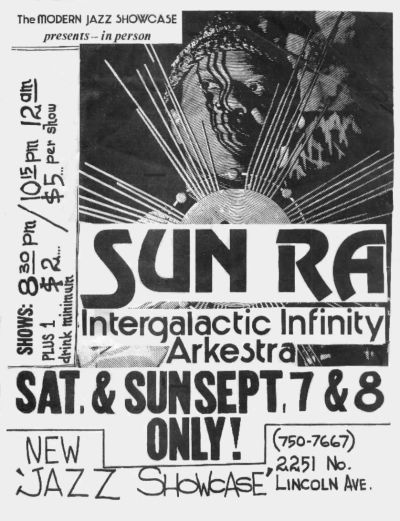
Here’s a big birthday shout-out to my wife Suzanne, who’s not nearly as crazy as I am about music—not nearly as crazy, period—but is crazy enough that she kept going out with me after I took her on our first date, in the summer of 1974, to Chicago’s Jazz Showcase (then on Lincoln Avenue) to see this guy, whose multimedia performance that night featured some of this footage—the stuff with the pyramids.

Sun Ra & His Arkestra in Egypt and Italy, 1971

**********

lagniappe

Even in the excesses of this era there were few audiences prepared for an ominous, ragtag group of musicians in Egyptian robes, Mongolian caps (Mongolian, as from the planet Mongo of Flash Gordon), and B-movie spacesuits who played on a variety of newly invented or strangely modified electronic instruments (the sun harp, the space organ, the cosmic side drum) and proclaimed the greatness of the most ancient of races (this, the Sun Ra of the Solar-Myth Arkestra); or, on yet another night, a merry band in jester’s motley, jerkins, and pointed caps (a la Robin Hood or perhaps the Archers of Arboria) who marched or crawled through the audience, chanting cheerful songs about travel to Venus. It was intensely dramatic music, moving from stasis to chaos and back, horn players leaping about, or rolling on the bandstand, sometimes with fire eaters, gilded muscle men, and midgets, an all-out assault on the senses. At the end of the evening the musicians and dancers moved among the audience, touching them, surrounding them, inviting them to join the Arkestra in marching off to Jupiter.

—John F. Szwed, Space Is The Place: The Lives And Times Of Sun Ra (1997)

*****

Sun Ra’s consistent statement, musically and spoken, is that this is a primitive world. Its practices, beliefs, religions, are uneducated, unenlightened, savage, destructive, already in the past. . . . That’s why Sun Ra returned only to say he left. Into the future. Into Space.

—Amiri Baraka (formerly known as LeRoi Jones)

*****

Silence is music. There are different kinds of silence, each silence is a world all of its own . . . silence is an integral part of all music . . .

***

When you meet a man

You meet a scheme of words

Patterns of concept

A concepted being

Whose very birth conception is called.

***

The earth cannot move without music. The earth moves in a certain rhythm, a certain sound, a certain note. When the music stops the earth will stop and everything upon it will die.

—Sun Ra

*****
Friday, 7/9/10

Alternate career plan for the next life (if the tap-dance thing doesn’t work out): rubboard player.

C.J. Chenier & the Red Hot Louisiana Band, “Jolie Blonde” & “Jambalaya,” New York City, 2008

Like the Blasters and Brave Combo, these guys played last weekend (Sunday the 4th) at FitzGerald’s American Music Festival.

**********

lagniappe

reading table

. . . I received five hundred thousand discrete bits of information today, of which maybe twenty-five are important. And how am I going to sort that out, you know?

—David Foster Wallace (in David Lipsky, Although of Course You End Up Becoming Yourself: A Road Trip with David Foster Wallace [2010])

*****

great minds at work

When you see your starting pitcher win a game, that means you’ve played a good baseball game.

—Lou Piniella, talking with Ron Santo on WGN Radio before last night’s Cubs game

Thursday, 7/8/10

You can learn how to play the harmonica. You can learn how to sing. What you can’t learn is the most important thing—presence.

Junior Wells (vocal and harmonica), Buddy Guy (guitar), “Cryin’ Shame” (AKA “Country Girl”), live, Chicago, 1970 (Chicago Blues)

Want more? Here.

Wednesday, 7/7/10

Fluid, supple, springy: with him on drums, the beat just floats.

Fred Below, September 16, 1926-August 14, 1988

Otis Rush, guitar; Little Brother Montgomery, piano; Jack Myers, bass; Fred Below, drums; Europe, 1966

Want more? Here. Here.

Tuesday, 7/6/10

What the world needs now?

Nah, not love.

What the world needs now—what it cries out for, daily—is inspired silliness.

Brave Combo, live

“The Denton Polka,” Texas (Denton), 2007

*****

“Louie, Louie,” Illinois (Berwyn [FitzGerald’s]), 2008

Brave Combo played a wild set Sunday night (the 4th) at FitzGerald’s American Music Festival—everything from “Beer Barrel Polka” to a hard-rockin’ “Hokey Pokey” to a polka-inflected “Ode to Joy” (“Any Beethoven fans in the house?”) to a Tejano-style “America the Beautiful.” By the end of the 90-minute set, everybody’s IQ, it seemed, had gone up 15 points. Or was it down?

Monday, 7/5/10

How many songs are so 4th-of-July perfect?

The Blasters, “American Music”

Take 1

Live, Illinois (Champaign), 1985

*****

Take 2

Live, Los Angeles, 2010

On Saturday night these guys played this, in overdrive, at FitzGerald’s American Music Festival, a wonderful 4-day event that just celebrated its 30th anniversary.

Thursday, 7/1/10

looking back

Today, celebrating our 300th post, we revisit a few favorites.

**********

3/12/10

Both Chicago blues artists. Both guitar players. Both influenced by other kinds of music.

Musical personalities? They could hardly be more different.

Buddy Guy, “Let Me Love You Baby,” live

*****

Fenton Robinson, “Somebody Loan Me A Dime,” live, 1977

***

Back in the 1970s, when I was at Alligator Records, I had the pleasure of working with Fenton, co-producing his album I Hear Some Blues Downstairs (a Grammy nominee). He didn’t fit the stereotype of a bluesman. Gentle, soft-spoken, serious, introspective: he was all these things. He died in 1997.

**********

3/3/10

What other pop star has made such stunning contributions as a guest artist?

Sinead O’Connor

With Willie Nelson, “Don’t Give Up”

*****

With the Chieftains, “The Foggy Dew”

*****

With Shane MacGowan, “Haunted”

**********

5/28/2010

two takes

“La-La Means I Love You”

The Delfonics, live, 2008 (originally recorded 1968)

*****

Bill Frisell, live, New York (Rochester), 2007

**********

lagniappe

musical thoughts

Music . . . carr[ies] us smoothly across the tumult of experience, like water over rocks.

—Vijay Iyer, liner notes, Historicity (2009)

Wednesday, 6/30/10

The other night, after falling asleep, my older son Alex (now 22) had an unexpected visitor—this guy showed up and began to play.

Vijay Iyer Trio (VI, piano; Marcus Gilmore, drums; Stephan Crump, bass)

“Galang,” recording session (Historicity), New York (Systems Two Studios), 2009

*****

“Questions of Agency,” live, New York (The Stone), 2007

*****

Playing and Talking about Historicity, 2009

**********

lagniappe

Presto! Here is the great new jazz piano trio.

—Ben Ratliff, New York Times (9/9/09)

Monday, 6/28/10

Muscular, unadorned, direct: his playing conjures the old Chicago, when there was no Millennium Park, no flowers blooming in the middle of the street, no dining al fresco (unless you had nowhere else to eat).

Fred Anderson, tenor saxophonist, co-founder of the Association for the Advancement of Creative Musicians (AACM), club owner (Velvet Lounge), March 22, 1929-June 24, 2010

Live, with DKV (Ken Vandermark, tenor saxophone; Kent Kessler, bass; Hamid Drake, drums), Chicago (Hideout), 2008

(Hamid Drake is among my favorite drummers; he’s the perfect foil, in his buoyancy and drive, for Anderson’s dark, searching, sometimes brooding lines.)

*****

“Spirits Came In,” live (with Kidd Jordan, tenor saxophone; William Parker, bass; Hamid Drake, drums), live, New York (Vision Festival), 2002

*****

Live (with Jaribu Shahid, bass; Hamid Drake, drums), France (Le Mans), 2005

Part 1

***

Part 2

***

Part 3

***

Part 4

***

Part 5

***

Part 6

Friday, 6/25/10

The other day, as I waited for a train at an underground station in downtown Chicago, an older black guy started singing this song, accompanying himself on acoustic guitar, and at that moment everything—this song, this singer, this place—seemed all of a piece and I was no longer waiting.

Curtis Mayfield (with David Sanborn, alto saxophone; Hiram Bullock, guitar; David Lindley, steel guitar; George Duke, piano; Phillipe Saisse, keyboard; Tom Barney, bass; Omar Hakim, drums), “It’s All Right,” live (TV broadcast [Sunday Night]), 1989

Want more? Here. Here.