music clip of the day

jazz/blues/rock/classical/gospel/more

Category: art beat

Sunday, 5/22/11

scenes from New Orleans
(an occasional series)

By and By: New Orleans Gospel at the Crossroads (in production)

Trailer

Vodpod videos no longer available.

***

The Electrifying Crown Seekers, “That’s Heaven To Me” (rehearsal)

Vodpod videos no longer available.

***

Sunday Night at Ebenezer Baptist Church

Vodpod videos no longer available.

***

The Voices of Distinction, “A Change Is Gonna Come”

Vodpod videos no longer available.

***

Title Sequence

Vodpod videos no longer available.

**********

lagniappe

art beat

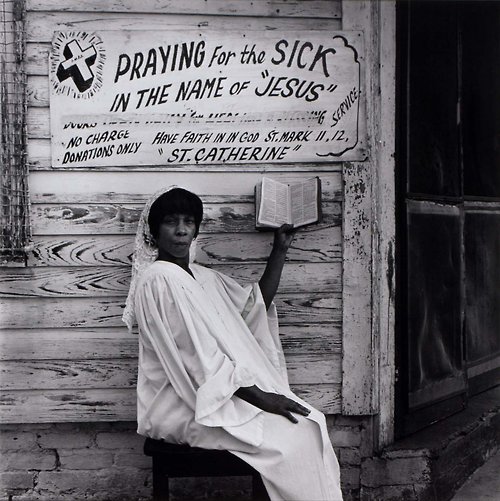
Michael P. Smith, New Orleans photographer

Monday, 5/2/11

 flicks
an occasional series

Joan Blondell & Etta Moten, “Remember My Forgotten Man”
Gold Diggers of 1933 (1933)

Vodpod videos no longer available.

**********

lagniappe

art beat: yesterday at the Art Institute of Chicago

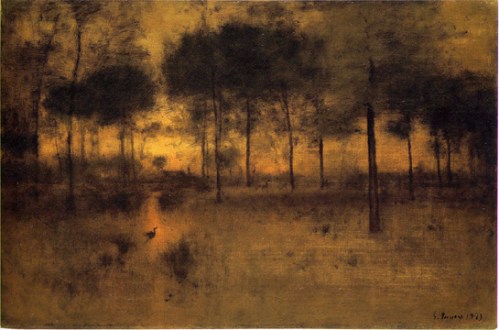
George Inness (American, 1825-1894), The Home of the Heron, 1893

This image, alas, conceals as much as it reveals. It barely hints at the spell this painting casts when you’re standing in front of it. Great paintings defy reproduction. Go. Look.

Sunday, 5/1/11

Won’t somebody tell me . . . ?

Blind Willie Johnson, lead vocals and guitar
Willie B. Harris (BWJ’s wife), vocals
“Soul Of A Man,” Atlanta, 1930

Vodpod videos no longer available.

(The guy in the photo is Chris Thomas King, who portrayed Blind Willie Johnson in Wim Wenders’ The Soul of a Man, which aired on PBS as part of Martin Scorsese’s The Blues.)

More? Here. And here.

**********

lagniappe

Blind Willie Johnson, a gospel singer, preacher, and pioneer of the blues, understood the power of the honest question, and he perceived its flame in the Bible.

Johnson was born in poverty in 1897 and blinded at age 7, when his stepmother, in a fight with his father, threw lye in his face. He died in poverty in 1945, sleeping on a wet bed in the ruins of his house, which had burned down two weeks before. Thankfully, between 1927 and 1930, he recorded a number of his biblically based blues songs with Columbia Records. These have inspired countless rockers, from Led Zeppelin to Beck. In 1977 his “Dark Was the Night, Cold Was the Ground,” a hauntingly inarticulate meditation on the Crucifixion, was sent into deep space on the Voyager 1 as part of the Voyager Golden Record, a collection of music representing the sounds of Earth to any potentially interested extraterrestrials. The time capsule is scheduled to be within 1.6 light-years of two nearby suns in about 40,000 years. The closest thing to timeless any musical artist could possibly achieve. Mercy, how we do so often love to immortalize those despised and forgotten in life.

Johnson’s uniquely spiritual blues music is driven by the deepest questions, often finding voice through an encounter between biblical tradition and his own life experience, which was well acquainted with sorrow. The Bible peopled his imagination. It was his wellspring of imagery. It empowered him to call this world into question and to envision another. On at least one occasion, the powers that be recognized how potentially explosive such an inspired combination of biblical language and lived oppression could be. He was arrested in front of a New Orleans city building for inciting a riot simply by singing “If I Had My Way I’d Tear the Building Down,” a song about the biblical hero Samson, who tore down the house of the Phil­istine lords after they had gouged out his eyes. To the officer who arrested him, the ancient story suddenly sounded dangerously contemporary.

In his well-known songSoul of a Man,” Johnson growls out the question he has pursued his whole life, knowing that no one can really help him find the answer: Just what is the “soul of a man”? Indeed, what is soul? It’s a question filled to overflowing with other questions. Am I more than my mind? More than my body? More than the sum of my parts? Do I have a soul? Does it live beyond this mortal coil? What am I? Who am I? Why am I here? Such profound questions are often asked, but too often are followed by erudite answers from someone who claims to know. Rarely by someone who honestly does not know. As none of us do.

Johnson recalls his lifelong soul search. He’s traveled far and wide, through cities and wildernesses. He’s heard answers from lawyers, doctors, and theologians. None have satisfied. In response to each of the answers he’s been given, he repeats his question with more forceful, gravelly urgency.

In his quest, he turns to the Bible:

“I read the Bible often, I tries to read it right

And far as I could understand, nothing but a burning light”

 Called to preach since age 5, steeped in the African-American Baptist tradition, this blind sage of spiritual blues knew the Bible inside and out from memory. Yet it gave him no answer, only a more profound mystery: nothing but a burning light.

Timothy Beal, “The Bible Is Dead; Long Live The Bible,” The Chronicle of Higher Education, 4/17/11

*****

listening room: what’s playing

Tinariwen, The Radio Tisdas Sessions (World Village)

Tinariwen, Imidiwan: Companions (World Village)

Mos Def & Talib Kweli Are Black Star (Rawkus)

Various Artists, Life Is A Problem (Mississippi Records)

Various Artists, Oh Graveyard, You Can’t Hold Me Always (Mississippi Records)

Various Artists, Powerhouse Gospel on Independent Labels, 1946-1959 (JSP)

Arvo Part, Miserere (ECM)

WFMU-FM
Give the Drummer Some (Doug Schulkind), 9 a.m.-noon (EST) (web stream only)

WKCR-FM (broadcasting from Columbia University)
Eastern Standard Time (reggae), Saturday, 7:30 a.m.-noon (EST)
Traditions in Swing (Phil Schaap), Saturday, 6-9 p.m. (EST)
—Duke Ellington birthday broadcast, 4/29/11

*****

art beat

What brings folks here? It’s not what you might think (if, that is, you were to give this any thought). When it comes to searches, what brings the most people here isn’t music; it’s paintings. “Captain Beefheart paintings,” “de Kooning excavation”: hundreds come here looking for them.

Tuesday, 4/26/11

 favorites
(an occasional series)

Here one of the greatest American artists of the 20th century (composer Morton Feldman [1926-1980]) pays homage to another (painter Mark Rothko [1903-1970]).

Morton Feldman, Rothko Chapel (composed in 1971; first performed, at Houston’s Rothko Chapel, in 1972)

Part 1

***

Part 2

***

Part 3

***

Part 4

***

Part 5

More? Here. And here. And here. And here.

**********

lagniappe

. . . The example of the painters was crucial. Feldman’s scores were close in spirit to Rauschenberg’s all-white and all-black canvases, Barnett Newman’s gleaming lines, and, especially, Rothko’s glowing fog banks of color. His habit of presenting the same figure many times in succession invites you to hear music as a gallery visitor sees paintings; you can study the sound from various angles, stand back or move up close, go away and come back for a second look. Feldman said that New York painting led him to attempt a music ‘more direct, more immediate, more physical than anything that had existed heretofore.’ Just as the Abstract Expressionists wanted viewers to focus on paint itself, on its texture and pigment, Feldman wanted listeners to absorb the basic facts of resonant sound. At a time when composers were frantically trying out new systems and languages, Feldman chose to follow his intuition. He had an amazing ear for harmony, for ambiguous collections of notes that tease the brain with never-to-be-fulfilled expectations. Wilfrid Mellers, in his book ‘Music in a New Found Land,’ eloquently summed up Feldman’s early style: ‘Music seems to have vanished almost to the point of extinction; yet the little that is left is, like all of Feldman’s work, of exquisite musicality; and it certainly presents the American obsession with emptiness completely absolved from fear.’ In other words, we are in the region of Wallace Stevens’s ‘American Sublime,’ of the ’empty spirit / In vacant space.’

***

If there is a Holocaust memorial in Feldman’s work, it is ‘Rothko Chapel,’ which was written in 1971, for Rothko’s octagonal array of paintings in Houston. Rothko had committed suicide the previous year, and Feldman, who had become his close friend, responded with his most personal, affecting work. It is scored for viola, solo soprano, chorus, percussion, and celesta. There are voices, but no words. As is so often the case in Feldman’s music, chords and melodic fragments hover like shrouded forms, surrounded by thick silence. The viola offers wide-ranging, rising-and-falling phrases. The drums roll and tap at the edge of audibility. Celesta and vibraphone chime gentle clusters. There are fleeting echoes of past music, as when the chorus sings distant, dissonant chords reminiscent of the voice of God in Schoenberg’s ‘Moses und Aron,’ or when the soprano sings a thin, quasi-tonal melody that echoes the vocal lines of Stravinsky’s final masterpiece, the ‘Requiem Canticles.’ That passage was written on the day of Stravinsky’s funeral, in April, 1971—another thread of lament in the pattern. But the emotional sphere of ‘Rothko Chapel’ is too vast to be considered a memorial for an individual, whether it is Rothko or Stravinsky.

Shortly before the end, something astonishing happens. The viola begins to play a keening, minor-key, modal song, redolent of the synagogue. Feldman had written this music decades earlier, during the Second World War, when he was attending the High School of Music and Art, in New York. Underneath it, celesta and vibraphone play a murmuring four-note pattern, which calls to mind a figure in Stravinsky’s ‘Symphony of Psalms.’ The song unfurls twice, and the chorus answers with the chords of God. The allusions suggest that Feldman is creating a divine music, appropriate to the sombre spirituality of Rothko’s chapel. In a sense, he is fusing two different divinities, representative of two major strains in twentieth-century music: the remote, Hebraic God of Schoenberg’s opera, and the luminous, iconic presence of Stravinsky’s symphony. Finally, there is the possibility that the melody itself, that sweet, sad, Jewish-sounding tune, speaks for those whom Feldman heard beneath the cobblestones of German towns. It might be the chant of millions in a single voice.

But I can almost hear Feldman speaking out against this too specific reading. At a seminar in Germany in 1972, he was asked whether his music had any relationship to the Holocaust, and he said no. He was a hard-core modernist to the end, despite his sensualist tendencies, and he did not conceive of art a medium for sending messages. It was probably in reaction to the communicative power of ‘Rothko Chapel’ that he later dismissed it, unbelievably, as a minor work. But in that German seminar he did say, in sentences punctuated by long pauses, ‘There’s an aspect of my attitude about being a composer that is like mourning. Say, for example, the death of art . . . something that has to do with, say, Schubert leaving me.’ He also admitted, ‘I must say, you did bring up something that I particularly don’t want to talk about publicly, but I do talk privately.’

Only this one time, in the last minutes of ‘Rothko Chapel,’ did Feldman allow himself the consolation of an ordinary melody. Otherwise, he held the outside world at bay. Yet he always showed an awareness of other possibilities, a sympathy for all that he chose to reject. Listening to his music is like being in a room with the curtains drawn. You sense that with one quick gesture sunlight could fill the room, that life in all its richness could come flooding in. But the curtains stay closed. A shadow moves across the wall. And Feldman sits in his comfortable chair.—Alex Ross (New Yorker, 6/19/06)

(Originally posted 12/5/09.)

Monday, 4/25/11

 joy, n. a source of keen pleasure or delight. E.g., the singing of Eddie Jefferson.

Eddie Jefferson, jazz singer, August 3, 1918-May 9, 1979

Live (with Richie Cole, alto saxophone; John Campbell, piano; Kelly Sill, bass; Joel Spencer, drums), Chicago (Jazz Showcase), 5/6/79 (days later, outside a jazz club in Detroit, he was shot to death)

Vodpod videos no longer available.

**********

lagniappe

art beat: yesterday at the Art Institute of Chicago

Mark Rothko, Untitled (Purple, White, and Red), 1953

No painting has held my gaze more often, or meant more to me, than this. It’s different every time I see it.

*****

reading table

ROTHKO: Look at the tension between the blocks of color: the dark and the light, the red and the black and the brown. They exist in a state of flux—of movement. They abut each other on the actual canvas, so too do they abut each other in your eye. They ebb and flow and shift, gently pulsating. The more you look at them the more they move . . . They float in space, they breathe . . . Movement, communication, gesture, flux, interaction; letting them work . . . They’re not dead because they’re not static. They move through space if you let them, this movement takes time, so they’re temporal. They require time.

—John Logan, Red (2009)

Saturday, 4/23/11

The Heart asks Pleasure – first –

—Emily Dickinson (588, excerpt)

Steve Reich, Bang on a Can All-Stars (Robert Black, bass; David Cossin, drums; Evan Ziporyn, piano; Bryce Dessner & Derek Johnson, guitars)
Rehearsal, 2×5 (S. Reich), 2009

Vodpod videos no longer available.

More? Here. And here.

**********

lagniappe

art beat: Art Institute of Chicago

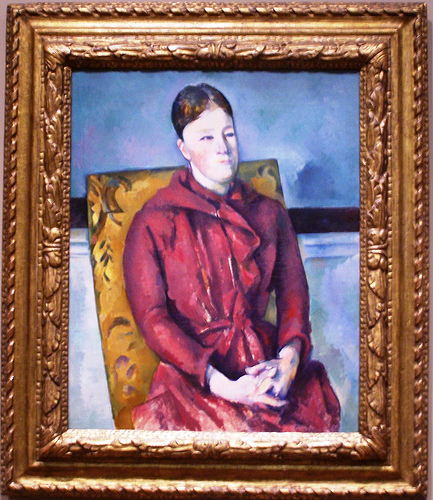
A sea of Cezanne’s blues surrounds The Bay of Marselleilles, Seen From L’Estaque (4/18/11).

Here’s what’s on its left.

Paul Cezanne, Madame Cezanne in a Yellow Chair, 1888-90

***

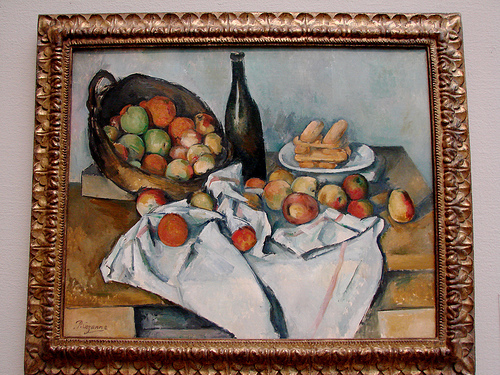
Here’s what’s on its right.

Paul Cezanne, The Basket of Apples, c. 1893

***

And here’s what’s on the adjacent wall.

Paul Cezanne, Harlequin, 1888-90
(on loan from the National Gallery of Art, Washington, D.C.)

***

I still work with difficulty, but I seem to get along. That is the important thing to me. Sensations form the foundation of my work, and they are imperishable, I think. Moreover, I am getting rid of that devil who, as you know, used to stand behind me and forced me at will to “imitate”; he’s not even dangerous any more.

—Paul Cezanne (last letter to his son Paul, dated October 15, 1906, a week before his death; quoted in Ambroise Vollard, Cezanne)

*****

Art ______ of Chicago

In the department of duh, after decades of going there and decades of listening to them, I’ve just noticed the verbal similarity between the Art Institute of Chicago and the Art Ensemble of Chicago.

Monday, 4/18/11

can’t wait
(an occasional series)

Group Doueh, Chicago (Old Town School of Folk Music), 6/26/11

Live, Europe, 2009

Vodpod videos no longer available.

***

Doueh (guitar), Tony Allen (drums)
Live, rehearsal, Western Sahara (Dakhla), 2010

Vodpod videos no longer available.

More Group Doueh? Here. More Tony Allen? Here.

**********

lagniappe

I live in Dakhla [in Western Sahara]. There are other groups in the area, but Group Doueh is the main group for this area. We are the most in demand group for weddings and parties.

***

The power of Jimi Hendrix’s guitar is something that is inspirational on so many levels.

***

The main group is myself on guitar and tinidit. My wife Halima and friend Bashiri are the vocalists. My son Jamal is the keyboardist. There are also many percussionists that play with us from time to time. Also other singers will perform with us depending on who is available for certain weddings or parties.

***

For many years, most of our material was recorded on cassette. I have had many cassette recorders, some two-track, four-track and eight-track models. Now I am able to record digitally to a 16-track model. I am always experimenting to get the best situation. We always record at home and we record all of our performances.

***

[T]here really is no [music] industry [in Western Sahara]. I am an industry unto myself. I record music and have two shops that sell music to the community. Most of the recordings are done at home in makeshift studios, and cassettes or CDs are sold throughout the region.

Doueh (AKA Baamar Salmou)

*****

art beat: yesterday at the Art Institute of Chicago

Paul Cezanne, The Bay of Marselleilles, Seen From L’Estaque, c. 1885

The greatest jazz musicians—Miles Davis, Ornette Coleman, Von Freeman, et al.—can be identified by just one note. Cezanne’s that way, too. His blues are all his own.

Monday, 4/11/11

energy + delicacy = kinetic beauty

Rashied Ali, drums
Don Cherry, pocket trumpet
James Blood Ulmer, guitar

Live (TV broadcast, Sweden), 1978

Vodpod videos no longer available.

More Don Cherry? Here.

I interviewed Rashied in 2008 just before he died, and he showed me this clip on his Mac. He was psyched that it was up on YouTube.

—YouTube comment

**********

lagniappe

art beat

Paul Cezanne, Study of Trees (c. 1904)
Arthur M. Sackler Museum, Harvard University, Cambridge, Massachusetts


Saturday, 4/9/11

If you’re away from home, how good it is to find a musical sanctuary, as I have the last two Fridays at Harvard’s Paine Concert Hall; last night I heard this string quartet play, wonderfully, music by Brahms and two contemporary composers (Adam Roberts, James Yannatos).

Chiara Quartet, Jefferson Friedman: String Quartet No. 2 (excerpt)
Live, New York (Le Poisson Rouge), 2010

Vodpod videos no longer available.

Are we ever better—more focused, more receptive, more supple—than when we’re listening to live music?

**********

lagniappe

art beat

Edward Hopper, Room in Brooklyn (1932), Museum of Fine Arts, Boston

Thursday, 4/7/11

Happy (96th) Birthday, Billie!

Tune in to WKCR-FM (broadcasting from Columbia University) and you’ll swear you must’ve died and gone to heaven—it’s all Billie, all day.

Billie Holiday, “The Blues Are Brewin'” (with Louis Armstrong, trumpet), New Orleans (1947)

Vodpod videos no longer available.

More? Here. And here. And here.

**********

lagniappe

art beat

Joan Mitchell, Chamonix (c. 1962), Museum of Fine Arts, Boston