music clip of the day

jazz/blues/rock/classical/gospel/more

Tag: WKCR-FM

Friday, 9/23/11

Happy (85th) Birthday, Trane!

John Coltrane, September 23, 1926-July 17, 1967

John Coltrane Quartet (JC, tenor saxophone; McCoy Tyner, piano; Jimmy Garrison, bass; Elvin Jones, drums), “I Want To Talk About You,” live, Sweden (Stockholm), 1962

Vodpod videos no longer available.

More? Here. And here. And here. And here.

**********

lagniappe

radio

All Trane, all day: WKCR-FM (broadcasting from Columbia University).

Sunday, 9/4/11

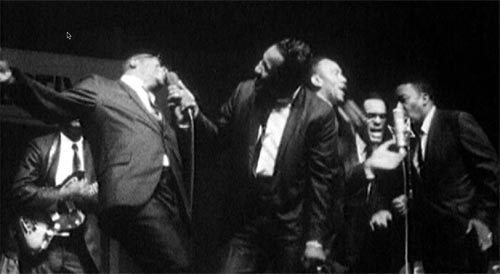
The Dixie Hummingbirds (with Ira Tucker, lead vocals), “If You See My Savior” (T. Dorsey), live (TV broadcast), early 1960s

With a voice like this, who needs words?

(Listen, for instance, at :55 and 1:50.)

More? Here.

**********

lagniappe

listening room: (some of) what’s playing

Theo Parrish, Sound Sculptures Vol. 1 (Sound Signature)

• Various artists, Goodbye Babylon (Dust-to-Digital)

Sun Ra, Jazz in Silhouette (Evidence)

Anthony Braxton, For Alto (Delmark)

Fred Anderson, Timeless (Delmark)

• Bach, Suites for Unaccompanied Cello/Steven Isserlis (Hyperion UK [import])

• Alfred Schnittke, Piano Quintet, String Trio, etc. (Naxos)

• Morton Feldman, For Bunita Marcus, Stephane Ginsburgh, piano (Sub Rosa) (available as a download from Amazon for 89¢)

• WKCR-FM (broadcasting from Columbia University)
—Lester Young/Charlie Parker birthday marathon
Bird Flight (Phil Schaap, jazz [Charlie Parker])
Eastern Standard Time (Carter Van Pelt, Jamaican music)

• WFMU-FM
Mudd Up! (DJ/Rupture“new bass and beats”)
Sinner’s Crossroads 
(Kevin Nutt, gospel)


Thursday, 9/1/11

serendipity

There are a lot of listening experiences I value, such as, for instance, a recent chance encounter with this guy, even if, in describing them, it wouldn’t occur to me to use the word “like.” Limiting yourself to stuff you like just makes your world smaller, doesn’t it?

John Mannion, live, 5/24/11, Austin, Texas
8/7/11, Live Constructions, WKCR-FM, broadcasting from Columbia University (Sunday, 10-11 p.m. [EST])

Vodpod videos no longer available.

Sunday, 8/28/11

As Hurricane Irene hits New York, let’s head to Harlem.

Harold Robinson, Earl Washington, Paul Williams, “Two Wings,” live, Harlem Church of Christ (338 Lenox Ave.), 27th Northeastern Lectureship, 2008

Vodpod videos no longer available.

**********

lagniappe

radio

Speaking of New York, WKCR-FM (broadcasting from Columbia University) continues its Lester Young/Charlie Parker birthday marathon today and tomorrow.

Saturday, 8/27/11

Happy Birthday, Lester!

Lester Young, tenor saxophonist, August 27, 1909-March 15, 1959

Lester Young (ts) with Carl “Tatti” Smith (trumpet), Count Basie (piano), Walter Page (bass), Jo Jones (drums) (10/9/36, Chicago)

“Oh, Lady Be Good”

Vodpod videos no longer available.

***

“Shoe Shine Boy”

Vodpod videos no longer available.

More? Here. And here.

**********

lagniappe

radio: 72 glorious hours

Assuming Irene doesn’t crash the party, the folks at WKCR-FM (broadcasting from Columbia University)* will be playing Lester Young all day today and into tomorrow, when, at some point, they’ll make the transition to Charlie Parker, whose birthday is Monday. As I wrote last year: “Something happens—something delicious—when you surrender your ears and yourself to someone’s music for such a sustained period of time. Little by little, that musician moves in, taking up residence in your brain. Their distinctive voice becomes, for a time, inseparable from everything else you’re hearing and seeing and thinking and feeling.”

*Later note (2:45 p.m. [CST]): When I just checked, their website seemed to be down; you can also get them via iTunes (radio/college).

Sunday, 8/21/11

Ever feel like, each day, you understand less and less?

Davis Sisters (with Jackie Verdell), “We’ll Understand It Better By and By,” live (TV broadcast), early 1960s

Vodpod videos no longer available.

**********

lagniappe

reading table

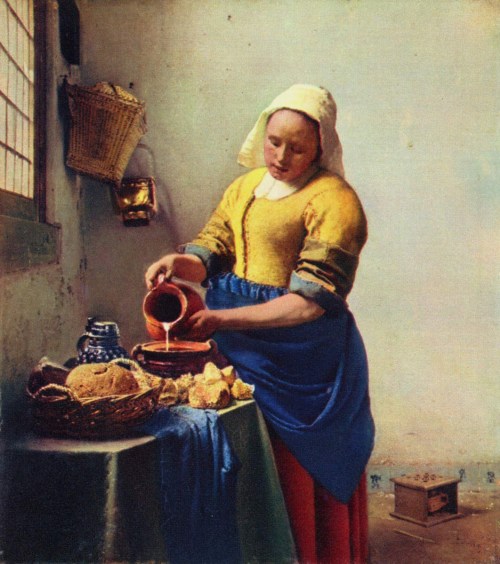
So long as that woman from the Rijksmuseum
in painted quiet and concentration
keeps pouring milk day after day
from the pitcher to the bowl
the World hasn’t earned
the world’s end.

—Wislawa Szymborska, “Vermeer”  (trans. Clare Cavanagh & Stanislaw Baranczak, Here [2010])

***

Johannes Vermeer, The Milkmaid (c. 1658)
*****

Speaking of Szymborska, a charter member, like Von Freeman, of the recently announced MCOTD Hall of Fame (coincidentally, they were both born in 1923), here’s something I just came across:

I am a big admirer of her [Szymborska’s] work. I have read everything she has written, and I keep coming back to it. She is a very witty poet and she has greatly helped me to enjoy life. She exactly fits my definition of an artist. Who shouldn’t only have profound insight and a sharp mind but also remember that his obligation is to entertain the reader. And this is exactly what she does.

—Woody Allen, in the documentary Sometimes Life Is Bearable (2010)

*****

listening room: (some of) what’s playing

Paul Simon, So Beautiful or So What (Hear Music)

Shane MacGowan and the Popes, The Snake (ZTT [import])

Captain Beefheart & His Magic BandTrout Mask Replica (Reprise/Ada)

• The Best of Charlie Patton (Yazoo)

Charley PattonThe Voice of the Delta (Indigo)

• The Detroiters/The Golden Echoes, Old Time Religion (Specialty)

• The Spiritualaires of Hurtsboro, Alabama, Singing Songs of Praise (CaseQuarter)

Archie Shepp/Kahil El’Zabar’s Ritual Trio, Conversations (Delmark)

• Benny Goodman, The Complete Trios (Capitol)

Charlie Parker, The Complete Royal Roost Live Recordings on Savoy, Vol. 3 (Savoy/Columbia [import])

Charles Gayle, Repent (Knitting Factory)

Steve Lacy-Roswell Rudd Quartet, School Days (hat Art)

• Wadada Leo Smith & Jack DeJohnette, America (Tzadik)

Kenny Werner, No Beginning, No End (Half Note)

Bach, Suites for Unaccompanied Cello/Jean-Guihen Queyras (Harmonia Mundi [import])

Alfred Schnittke, String Quartet No. 3, Piano Quintet, Piano Quartet/
Borodin String Quartet with Ludmilla Berlinsky (Virgin Classics)

Morton Feldman, Piano and String Quartet/Kronos Quartet with Aki Takahashi (Nonesuch)

• Morton Feldman, For Bunita Marcus, Stephane Ginsburgh, piano (Sub Rosa) (available as a download from Amazon for 89¢)

• WKCR-FM (broadcasting from Columbia University)
Bird Flight (Phil Schaap, jazz [Charlie Parker])
Traditions in Swing (Phil Schaap, jazz)
Eastern Standard Time (Carter Van Pelt, Jamaican music)
Raag Aur Taal (Various, Indian music)

• WFMU-FM
Mudd Up! (DJ/Rupture“new bass and beats”)
Sinner’s Crossroads 
(Kevin Nutt, gospel)
Thursday, August 4, 2011

Happy Birthday (Again), Pops!

During his life, Louis Armstrong’s birthday was believed to be July 4, 1900, but, as it turned out, that was a year and a month off—the actual date was August 4, 1901. Given the circumstances, WKCR-FM (broadcasting from Columbia University) does the only sensible thing: they celebrate both days, playing nothing but Pops 24 hours straight.

 favorites
(an occasional series)

According to Miles Davis, the history of jazz can be told in four words:
here are the first two.

Louis Armstrong, “Dinah,” live, Copenhagen, 1933

(Originally posted January 15, 2010.)

Sunday, 7/24/11

Last Sunday they sounded so good—let’s hear some more.

The Staple Singers, “On My Way To Heaven,” “Going Away,” “I’m Leaning,”
“I Know I Got Religion”; Uncloudy Day (Vee-Jay), 1959

Vodpod videos no longer available.

**********

lagniappe

listening room: (some of) what’s playing

• Muhal Richard Abrams (with Malachi Favors), Sightsong (Black Saint)

• King Oliver, Off the Record: The Complete 1923 Jazz Band Recordings (Off the Record/Archeophone)

• Beethoven, Symphonies Nos. 1 & 3 (“Eroica”)/ Arturo Toscanini, conductor, NBC Symphony Orchestra (RCA)

• Bach, Cello Suites, Steven Isserlis (Hyperion UK)

Morton Feldman, For Bunita Marcus, Stephane Ginsburgh, piano (Sub Rosa) (available as a download from Amazon for 89¢)

WKCR-FM (broadcasting from Columbia University)
Bird Flight (Phil Schaap, jazz [Charlie Parker])
Traditions in Swing (Phil Schaap, jazz)
Afternoon New Music (Various, classical and hard-to-peg)
Eastern Standard Time (Carter Van Pelt, Jamaican music)
Raag Aur Taal (Various, Indian music)

WFMU-FM
Mudd Up! (DJ/Rupture, “new bass and beats”)
Sinner’s Crossroads
(Kevin Nutt, gospel)

*****

reading table

Here are a couple cheery things (ha, ha) from a favorite poet.

John Berryman, Two Dream Songs

More? Here. And here.

Wednesday, July 13, 2011

Happy (75th) Birthday, Albert!

Albert Ayler, tenor saxophonist, July 13, 1936-November 25, 1970

*****

Albert Ayler Trio (Albert Ayler, ts; Gary Peacock, bass; Sunny Murray, drums), Spiritual Unity (ESP), 1964

“Ghosts: First Variation”

***

“The Wizard”

***

“Spirits”

***

“Ghosts: Second Variation”

More? Here. And here. 

**********

lagniappe

random thoughts

OK, let’s talk physics. One problem with the term “free jazz” is that it suggests a sound world in which there’s no center of gravity—a world where everything pushes outward, where centrifugal force rules. But the reality, with many of the greatest artists, is different. Centripetal, not centrifugal, force is king. The musicians push inward, not outward, toward a center none ever inhabits individually but, collectively, they are always moving toward.

***

The contributions of Gary Peacock and Sunny Murray are hard to overstate. Sidemen? There are none.

***

Like Ornette Coleman, Albert Ayler is at heart a blues musician—one who, like Ornette, expanded the blues vocabulary.

*****

radio

Today, from noon to 9 p.m. (EST), WKCR-FM (broadcasting from Columbia University) is all Albert Ayler.

Tuesday, 7/12/11

John Luther Adams, Inuksuit (excerpt)
New York (Park Avenue Armory), 2/20/11

Vodpod videos no longer available.

More? Here.

**********

lagniappe

Scored for a flexible ensemble of between nine and ninety-nine percussionists, “Inuksuit” is intended for outdoor performance, and it had its première on a mountainside in Banff, Canada, in 2009. Adams at first resisted the idea of taking the piece indoors, because the interaction with nature was integral to his conception. After inspecting the Armory, though, he grasped its possibilities; the space is more a man-made canyon than a concert hall. He settled on a corps of seventy-six musicians, including five piccolo players. Arrays of drums, gongs, cymbals, bells, and numerous smaller instruments were set up on the main floor of the Drill Hall; atop catwalks on all sides; and in the hallways that connect to smaller rooms at the front of the building. In any rendition of “Inuksuit,” the performers are given four or five pages of music—the notation imitates the shapes of the Inuit markers—which they execute at their own pace. Musicians with portable instruments are instructed to move about freely. Prearranged signals prompt a move from one page to the next. The result is a composition that on the microcosmic level seems spontaneous, even chaotic, but that gathers itself into a grand, almost symphonic structure.

At 4 P.M. on a Sunday, thirteen hundred people assembled in the Drill Hall to hear the piece, variously standing, sitting, or lying on the floor. First came an awakening murmur: one group of performers exhaled through horns and cones; others rubbed stones together and made whistling sounds by whirling tubes. Then one member of the ensemble—Schick, perched above the entrance to the Drill Hall—delivered a call on a conch shell. With that commanding, shofar-like tone, the sound started to swell: tom-toms and bass drums thudded, cymbals and tam-tams crashed, sirens wailed, bells clanged. It was an engulfing, complexly layered noise, one that seemed almost to force the listeners into motion, and the crowd fanned out through the arena.

***

It is tricky to write about an event such as this. Because both ensemble and audience were in motion, no two perceptions of the performance were the same, and no definitive record of it can exist. Furthermore, anyone who ventures to declare in a public forum that “Inuksuit” was one of the most rapturous experiences of his listening life—that is how I felt, and I wasn’t the only one—might be suspected of harboring hippie-dippie tendencies. The work is not explicitly political, nor is it the formal expression of an individual sensibility, although John Luther Adams certainly deserved the ecstatic and prolonged ovation that greeted him when he acknowledged the crowd from the center of the Drill Hall. In the end, several young couples seemed to deliver the most incisive commentary when, amid the obliterating tidal wave of sound, they began making out.

—Alex Ross, New Yorker, 3/14/11

*****

Happy Birthday, Suzanne!

As I mentioned on this date last year, the first time my wife Suzanne and I went out together (September 1974, Chicago’s Jazz Showcase), we saw the man who put the sui in sui generis.

Sun Ra, Space Is the Place (1974), excerpt

Vodpod videos no longer available.

More? Here. And here.

*****

speaking of birthdays

How often do you get to say “Happy 100th Birthday”?

Well, here’s your chance.

As I learned the other day from WKCR-FM’s Phil Schaap, who’s been encouraging folks to send this guy a birthday card (I mailed mine yesterday), the oldest performing jazz musician, trumpeter Lionel Ferbos, who plays at New Orleans’ Palm Court Jazz Cafe, turns 100 on July 17th. Birthday greetings can be mailed (remember mail?) to 5543 Press Dr., New Orleans, LA 70126.