The horn players—all eight of them—are sons of Sun RaArkestra trumpeter and AACM (Association for the Advancement of Creative Musicians) cofounder Phil Cohran.
• WKCR-FM (broadcasting from Columbia University)
—Lester Young/Charlie Parker birthday marathon
—John Coltrane birthday broadcast
—Bird Flight (Phil Schaap, jazz [Charlie Parker])
—Traditions in Swing (Phil Schaap, jazz)
—Eastern Standard Time (Carter Van Pelt, Jamaican music)
• WFMU-FM
—Mudd Up! (DJ/Rupture, “new bass and beats”)
—Sinner’s Crossroads(Kevin Nutt, gospel) —Airborne Event (Dan Bodah, “electronic noise to free jazz, drone rock to a capella African song”)
—Give the Drummer Some (Doug Schulkind, sui generis, web only)
—Transpacific Sound Paradise (Rob Weisberg, “popular and unpopular music from around the world”)
• WHPK-FM (broadcasting from University of Chicago)
—The Blues Excursion (Arkansas Red)
What’s surprising here isn’t that there are so many wonderful moments. Given the line-up, you’d expect that. What you wouldn’t expect is for these guys to sound so cohesive, as if they’d been playing together for years.
Sun Ra All Stars (SR, keyboards; Don Cherry, pocket trumpet, vocals; Lester Bowie, trumpet; Archie Shepp, tenor saxophone, vocals; John Gilmore, tenor saxophone; Marshall Allen, alto saxophone, percussion; Philly Joe Jones, drums; Clifford Jarvis, drums; Famadou Don Moye, drums, percussion), live, Germany (Berlin), 1983
• WKCR-FM (broadcasting from Columbia University)
—Lester Young/Charlie Parker birthday marathon
—Bird Flight (Phil Schaap, jazz [Charlie Parker]) —Eastern Standard Time (Carter Van Pelt, Jamaican music)
Scored for a flexible ensemble of between nine and ninety-nine percussionists, “Inuksuit” is intended for outdoor performance, and it had its première on a mountainside in Banff, Canada, in 2009. Adams at first resisted the idea of taking the piece indoors, because the interaction with nature was integral to his conception. After inspecting the Armory, though, he grasped its possibilities; the space is more a man-made canyon than a concert hall. He settled on a corps of seventy-six musicians, including five piccolo players. Arrays of drums, gongs, cymbals, bells, and numerous smaller instruments were set up on the main floor of the Drill Hall; atop catwalks on all sides; and in the hallways that connect to smaller rooms at the front of the building. In any rendition of “Inuksuit,” the performers are given four or five pages of music—the notation imitates the shapes of the Inuit markers—which they execute at their own pace. Musicians with portable instruments are instructed to move about freely. Prearranged signals prompt a move from one page to the next. The result is a composition that on the microcosmic level seems spontaneous, even chaotic, but that gathers itself into a grand, almost symphonic structure.
At 4 P.M. on a Sunday, thirteen hundred people assembled in the Drill Hall to hear the piece, variously standing, sitting, or lying on the floor. First came an awakening murmur: one group of performers exhaled through horns and cones; others rubbed stones together and made whistling sounds by whirling tubes. Then one member of the ensemble—Schick, perched above the entrance to the Drill Hall—delivered a call on a conch shell. With that commanding, shofar-like tone, the sound started to swell: tom-toms and bass drums thudded, cymbals and tam-tams crashed, sirens wailed, bells clanged. It was an engulfing, complexly layered noise, one that seemed almost to force the listeners into motion, and the crowd fanned out through the arena.
***
It is tricky to write about an event such as this. Because both ensemble and audience were in motion, no two perceptions of the performance were the same, and no definitive record of it can exist. Furthermore, anyone who ventures to declare in a public forum that “Inuksuit” was one of the most rapturous experiences of his listening life—that is how I felt, and I wasn’t the only one—might be suspected of harboring hippie-dippie tendencies. The work is not explicitly political, nor is it the formal expression of an individual sensibility, although John Luther Adams certainly deserved the ecstatic and prolonged ovation that greeted him when he acknowledged the crowd from the center of the Drill Hall. In the end, several young couples seemed to deliver the most incisive commentary when, amid the obliterating tidal wave of sound, they began making out.
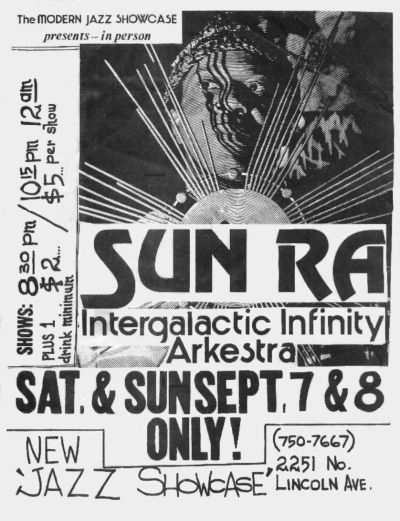
As I mentioned on this date last year, the first time my wife Suzanne and I went out together (September 1974, Chicago’s Jazz Showcase), we saw the man who put the sui in sui generis.
How often do you get to say “Happy 100th Birthday”?
Well, here’s your chance.
As I learned the other day from WKCR-FM’sPhil Schaap, who’s been encouraging folks to send this guy a birthday card (I mailed mine yesterday), the oldest performing jazz musician, trumpeter Lionel Ferbos, who plays at New Orleans’ Palm Court Jazz Cafe, turns 100 on July 17th. Birthday greetings can be mailed (remember mail?) to 5543 Press Dr., New Orleans, LA 70126.
Billy Bang (AKA William Vincent Walker), violinist, 9/20/47-4/11/11
Billy Bang Quintet (BB, violin; Frank Lowe, tenor saxophone; Ahmed Abdullah, trumpet; William Parker, bass; Abbey Rader, drums), live, New York (Knitting Factory), 10/1/00
Vodpod videos no longer available.
*****
Billy Bang Quartet (BB, violin; Ngo Thanh Nahn, dan tranh; Todd Nicholson, bass; Shoji Hano, drums), live, New York (Vision Festival X), 6/18/05
Vodpod videos no longer available.
**********
lagniappe
As I lived in Harlem in the early Fifties as a kid, I heard music all around me from the jazz clubs and from the candy stores. They had speakers outside the candy stores that they would play music, music like Eddie Harris and once in a while, Brubeck’s “Take Five.” So I started hearing jazz very, very early, and when you lived in Harlem in those days, it was in the blood. It was in the people. It was in the clothing. It was prevalent. As a young man, I bought a pair of bongos and two of my friends and I used to play the bongos on the New York City subway system. We would take turns dancing and playing the bongos and earn some money. That was my professional debut in the music.
***
I bought the Delmark records and heard Leroy Jenkins. Then I started hearing all the Joseph Jarman and Roscoe Mitchell. I loved the AACM. I loved Delmark for putting them out, Muhal Richard Abrams. This music really turned me on. It seemed very political, very conscious for me at the time and also very free, but with structure. So when Leroy Jenkins came to New York, I tracked him down and I did a little study with him for about six months. It was enough to reshape my direction. I already had a direction, but it really straightened it. From that point on, I just kept trying to go for it. Nobody would hire me, but that didn’t stop me. I would hire myself and hire a band and we would play at places like lofts in New York. Eventually, loft jazz became very, very big in New York and that catapulted my name and my career. During that period, I did all sorts of things, sitting in with Sam Rivers at The Five Spot. I sat in with Jackie McLean. I just had to be around the music and the cats that I loved and respected. I was disappointed that John Coltrane passed away because I think I would have followed him day after day after day to try and get in his band.
***
[The loft scene] was a very big thing. I think that catapulted my name internationally along with the David Murrays, the Henry Threadgills, the Frank Lowes, the Lester Bowies, the Joe Bowies. A lot of us wrote our own compositions. We weren’t playing standards. The bebop guys had to play standards to be legitimate. We were able to create our own music, direction, and compositions that also helped to lend a more directional input into the music. The loft jazz’s impact of it came when the Newport Jazz Festival came to New York that year and they didn’t hire any of us, so we had our own loft jazz festival. There were meetings and I remember Archie Shepp was talking and Rashied Ali was talking. I was very, very happy to be in New York at that time and to be around such a powerful movement with powerful names in it, Braxton, a lot of cats, all the cats that I love. We started setting up concerts all over, all the places. Sam Rivers had Rivbea and Rashied Ali had Ali Alley, which is where I played most of the time. When I played there with my Survival group, Werner Uehlinger came from hatHUT and he signed me to do a solo record. We were very adamant and strong about what we were doing. We were committed in belief. The World Saxophone Quartet started. The String Trio of New York started. Air was here. There was a lot of power going on simultaneously. There was a movement going on. We actually saw it in the making. I find it extremely important. The only reason why it does not have as much importance as I see it is because a lot of the writers didn’t pick up on it. Francis Davis from Philadelphia, he did and Stanley Crouch to some degree. There were people that picked up on it, but it wasn’t enough of a movement. The next year, George Wein hired some of the loft guys to play at the jazz festival. I was even offered a gig there with the String Trio. I didn’t make it because I like to hold out. I will be very honest, Fred. After I did my tour in Vietnam, I felt above a lot of the everyday activities in this world. I faced death and I think I had died more than once, so after that, I was sort of an untouchable. Me with my music, I didn’t feel the threatening situation that others felt. I didn’t feel obligated to have to compromise or the necessity to have to kiss anybody’s ass. I was determined to be focused in a Billy Bang direction until today, I am the same way. I think that strength is what kept me going, that commitment of strength, that conviction. They didn’t like the things that I did in the beginning. In fact, I didn’t like a lot of it, but I was committed enough to keep trying and not be shot down by critics, writers, peers, whomever.
***
Cats [today] are trying to be technical. You can exercise all your technical prowess and you sound like what’s been out already. I hear more guys sound like Clifford Brown or Freddie Hubbard then I heard them do. That was not the thing. We were always going for individual voices and individual sound. That is the only thing that almost made me stop. I didn’t sound like anybody. I thought I sounded so horrible that one particular day, I was ready to smash up my violin and I remember James Jackson from the Sun Ra band came in and tried to recruit me and he had a long talk with me. He told me that I had my own sound and that I had a Billy Bang sound. I took that to heart and started working from that perspective and saying that I needed to keep working at it and developing my sound.
Here’s a big birthday shout-out to my wife Suzanne, who’s not nearly as crazy as I am about music—not nearly as crazy, period—but is crazy enough that she kept going out with me after I took her on our first date, in the summer of 1974, to Chicago’s Jazz Showcase (then on Lincoln Avenue) to see this guy, whose multimedia performance that night featured some of this footage—the stuff with the pyramids.
Sun Ra & His Arkestra in Egypt and Italy, 1971
**********
lagniappe
Even in the excesses of this era there were few audiences prepared for an ominous, ragtag group of musicians in Egyptian robes, Mongolian caps (Mongolian, as from the planet Mongo of Flash Gordon), and B-movie spacesuits who played on a variety of newly invented or strangely modified electronic instruments (the sun harp, the space organ, the cosmic side drum) and proclaimed the greatness of the most ancient of races (this, the Sun Ra of the Solar-Myth Arkestra); or, on yet another night, a merry band in jester’s motley, jerkins, and pointed caps (a la Robin Hood or perhaps the Archers of Arboria) who marched or crawled through the audience, chanting cheerful songs about travel to Venus. It was intensely dramatic music, moving from stasis to chaos and back, horn players leaping about, or rolling on the bandstand, sometimes with fire eaters, gilded muscle men, and midgets, an all-out assault on the senses. At the end of the evening the musicians and dancers moved among the audience, touching them, surrounding them, inviting them to join the Arkestra in marching off to Jupiter.
—John F. Szwed, Space Is The Place: The Lives And Times Of Sun Ra (1997)
*****
Sun Ra’s consistent statement, musically and spoken, is that this is a primitive world. Its practices, beliefs, religions, are uneducated, unenlightened, savage, destructive, already in the past. . . . That’s why Sun Ra returned only to say he left. Into the future. Into Space.
—Amiri Baraka (formerly known as LeRoi Jones)
*****
Silence is music. There are different kinds of silence, each silence is a world all of its own . . . silence is an integral part of all music . . .
***
When you meet a man
You meet a scheme of words
Patterns of concept
A concepted being
Whose very birth conception is called.
***
The earth cannot move without music. The earth moves in a certain rhythm, a certain sound, a certain note. When the music stops the earth will stop and everything upon it will die.
 music clip of the day