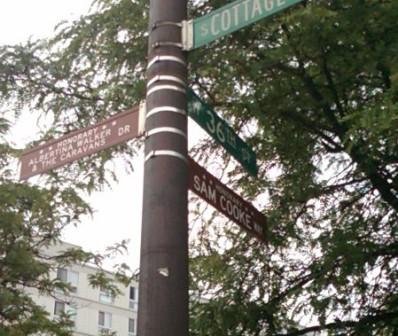
Chicago’s South Side, W. 36th St. (Honorary Sam Cooke Way, as of this month) and S. Cottage Grove Ave. (Honorary Albertina Walker & The Caravans Drive)
On July 29, 1946, Charlie Parker was arrested in Los Angeles, after starting a fire in his hotel room. Earlier that day, unable to score heroin, scratchy, drunk on whiskey, he recorded this track, which, depending on your point of view, is either one of the worst records he ever made (Parker’s view) or, despite (because of?) its raggedyness, among the greatest (Charles Mingus’s opinion). After his arrest he was confined, for six months, at Camarillo State Mental Hospital.
Charlie Parker, “Lover Man” (CP, alto saxophone; Howard McGhee, trumpet; Jimmy Bunn, piano; Bob Kesterson, bass; Roy Porter, drums), rec. 7/29/46
The cafeteria in the hospital’s basement was the saddest place in the world, with its grim neon lights and gray tabletops and the diffuse forboding of those who had stepped away from suffering children to have a grilled cheese sandwich.
***
The next day, I set up an iPod dock and played music, not only in the willfully delusional belief that music would be good for a painful, recovering brain but also to counter the soul-crushing hospital noise: the beeping of monitors, the wheezing of respirators, the indifferent chatter of nurses in the hallway, the alarm that went off whenever a patient’s condition abruptly worsened.
***
One early morning, driving to the hospital, I saw a number of able-bodied, energetic runners progressing along Fullerton Avenue toward the sunny lakefront, and I had a strong physical sensation of being in an aquarium: I could see out, the people outside could see me (if they chose to pay attention), but we were living and breathing in entirely different environments.
Classical music would be better off if folks quit calling it “classical music.”
Arnold Schoenberg (1874-1951), Op. 19, Six Little Piano Pieces
Michel Beroff, piano, live
Vodpod videos no longer available.
**********
lagniappe
musical thoughts
My music must be short.
Lean! In two notes, not built, but “expressed.”
And the result is, I hope, without stylized and sterilized drawn-out sentiment.
That is not how man feels; it is impossible to feel only one emotion.
Man has many feelings, thousands at a time, and these feelings add up no more than apples and pears add up. Each goes its own way.
This multicoloured, polymorphic, unlogical nature of our feelings, and their associations, a rush of blood, reactions in our senses, in our nerves; I must have this in my music.
It should be an expression of feeling, as if really were the feeling, full of unconscious connections, not some perception of “conscious logic.”
Arnett Cobb, tenor saxophonist, August 10, 1918-March 24, 1989
“Texas Blues,” live (with Ellis Marsalis, piano; Chris Severin, bass; Johnny Vidacovich, drums), 1984, New Orleans
Vodpod videos no longer available.
***
“The Nearness of You” (mislabeled “Misty” on YouTube), live (with Wild Bill Davis, piano; Bernard Upsom, bass; Frankie Dunlop, drums), 1982, Germany (Berlin)
Vodpod videos no longer available.
One of my favorite moments comes at 2:48: “I hear ya, I hear ya.”
The other night I happened upon a live set by this guy on WKCR-FM’s Live Constructions—after a few minutes, it felt as though someone had poured a bottle of Drano down my ears (which, actually, I mean as a compliment).
Sonny Rollins, Joe Lovano, et al., talk about Ben Webster
Vodpod videos no longer available.
*****
mail
You are sending out some great stuff at all times. . . . It’s always interesting, and the one you sent out today, Onmutu Mechanicks, was especially cool, since I hadn’t ever crossed their path.
• WKCR-FM (broadcasting from Columbia University)
—Bird Flight (Phil Schaap, jazz [Charlie Parker])
—Traditions in Swing (Phil Schaap, jazz) —Out to Lunch (Various, jazz)
—Jazz Profiles (Various, jazz)
—Jazz Alternatives (Various, jazz)
—Afternoon New Music (Various, classical and hard-to-peg)
—Eastern Standard Time (Carter Van Pelt, Jamaican music)
—Rag Aur Taal (Various, Indian)
—Morning Ragas (Various, Indian)
—Amazing Grace (Various, gospel)
—Live Constructions (Various, hard-to-peg)
• WFMU-FM
—Mudd Up! (DJ/Rupture, “new bass and beats”)
—Sinner’s Crossroads(Kevin Nutt, gospel)
—Give The Drummer Some (Doug Schulkind, sui generis)
—Transpacific Sound Paradise (Rob Weisberg, “popular and unpopular music from around the world”)
—Daniel Blumin (sui generis)
—Airborne Event (Dan Boodah, sui generis)
—The Push Bin with Lou (Lou Z., sui generis)
*****
art beat
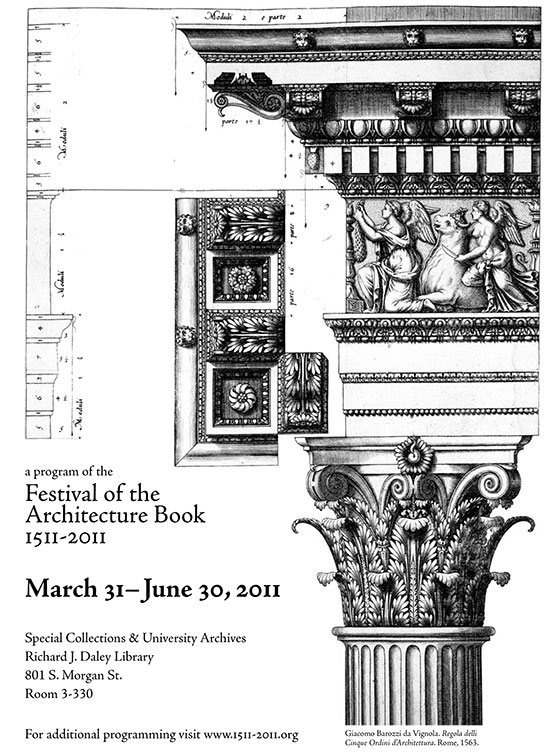
One of the great things about having friends is that they invite you to things you’d never get to, or even know about, otherwise—like, for instance, this wonderful exhibit of illustrated architecture books (dating from 1511), something I wouldn’t have gotten to but for my friend Bob Blythe.
Robert Pete Williams (1914-1980), “Scrap Iron Blues”
Live, Louisiana (Baton Rouge), 1971
Vodpod videos no longer available.
**********
lagniappe
It’s difficult to approve the banalities of most blues singers after listening to Robert Pete Williams. The blues tradition is frequently cited to explain a singer’s conventionality. We see with Robert Pete Williams, however, the possibilities of the blues. He relies upon none of the cliches, either of music or of lyric, which bluesman after bluesman will invoke. He makes each song unmistakably his own and while at times his genius may seem perverse in its oddness, when he succeeds and each odd element comes together, he will convey a tone of almost unbearable sadness.
 music clip of the day