John Luther Adams, “Red Arc/Blue Veil” (excerpt)
Live, University of Kentucky, 2008
Clint Davis, piano
Charlie Olvera, vibraphone, crotales
Jason Corder, Jordan Munson, video
(Originally posted on 2/10/11.)
**********
lagniappe
musical thoughts
One of the functions of music is to remind us how much more beautiful the world is than it needs to be.
The Dirtbombs, live, New York (Southpaw, Brooklyn), 2008
*****
Curtis Mayfield, recording (Sweet Exorcist), 1974
**********
lagniappe
found words
Yesterday, in Cambridge, Massachusetts (where I am for my son Alex’s college graduation), sitting on a brick sidewalk in Harvard Square, a panhandler with a sign:
A high school girl in Reykjavik, an old man in Prague, a grieving widow in Sydney: no matter who you are, no matter where you are, these sounds are just a click away.
Franz Schubert, Piano Sonatas D. 958 (C minor), 959 (A major), 960 (B-flat major); Alfred Brendel, piano*
One of the delights of doing this blog is imagining the lives of the folks who stop by. In the past few days, for instance, there’ve been visitors from Germany, Netherlands, France, Syria, and Italy; Lithuania, Sweden, United Kingdom, and Mexico; Greece, New Zealand, Belgium, Israel, and Ethiopia; Colombia, Hungary, Slovakia, and Spain; Mongolia, Argentina, Indonesia, Turkey, Pakistan, Singapore, and the United States. To all: Welcome!
*****
*Here, courtesy of YouTube, is more detailed information about the program:
Sonata in C minor, D. 958
I Allegro
II Adagio
III Menuetto: Allegro — Trio
IV Allegro
Sonata in A major, D. 959
I Allegro
II Andantino
III Scherzo: Allegro vivace — Trio: Un poco più lento
IV Rondo. Allegretto — Presto
Sonata in B-flat major, D. 960
I Molto moderato
II Andante sostenuto
III Scherzo: Allegro vivace con delicatezza — Trio
IV Allegro, ma non troppo — Presto
Bobby “Blue” Bland, “That’s the Way Love Is” (Duke 1962)
***
O.V. Wright, “That’s How Strong My Love Is” (Goldwax 1964)
***
Jimmy Ruffin, “What Becomes Of The Brokenhearted” (Motown 1966)
**********
lagniappe
found words
You’ve got [Cubs left fielder] Alfonso Soriano out there with Mickey Mantle’s knees. I’m not talking metaphor here. I think he really has Mickey Mantle’s knees.
—Jim Memolo, WGN Radio, Sunday’s post-game call-in show, following the Cubs’ third straight loss to the White Sox
On the morning after the assassination of Dr. Martin Luther King, Jr., city officials in Boston, Massachusetts, were scrambling to prepare for an expected second straight night of violent unrest. Similar preparations were being made in cities across America, including in the nation’s capital, where armed units of the regular Army patrolled outside the White House and U.S. Capitol following President Johnson’s state-of-emergency declaration. But Boston would be nearly alone among America’s major cities in remaining quiet and calm that turbulent Friday night, thanks in large part to one of the least quiet and calm musical performers of all time. On the night of April 5, 1968, James Brown kept the peace in Boston by the sheer force of his music and his personal charisma.
Brown’s appearance that night at the Boston Garden had been scheduled for months, but it nearly didn’t happen. Following a long night of riots and fires in the predominantly black Roxbury and South End sections of the city, Boston’s young mayor, Kevin White, gave serious consideration to canceling an event that some feared would bring the same kind of violence into the city’s center. The racial component of those fears was very much on the surface of a city in which school integration and mandatory busing had played a major role in the recent mayoral election. Mayor White faced a politically impossible choice: anger black Bostonians by canceling Brown’s concert over transparently racial fears, or antagonize the law-and-order crowd by simply ignoring those fears. The idea that resolved the mayor’s dilemma came from a young, African American city councilman name Tom Atkins, who proposed going on with the concert, but finding a way to mount a free, live broadcast of the show in the hopes of keeping most Bostonians at home in front of their TV sets rather than on the streets.
Atkins and White convinced public television station WGBH to carry the concert on short notice, but convincing James Brown took some doing. Due to a non-compete agreement relating to an upcoming televised concert, Brown stood to lose roughly $60,000 if his Boston show were televised. Ever the savvy businessman, James Brown made his financial needs known to Mayor White, who made the very wise decision to meet them.
The broadcast of Brown’s concert had the exact effect it was intended to, as Boston saw less crime that night than would be expected on a perfectly normal Friday in April. There was a moment, however, when it appeared that the plan might backfire. As a handful of young, male fans—most, but not all of them black—began climbing on stage mid-concert, white Boston policemen began forcefully pushing them back. Sensing the volatility of the situation, Brown urged the cops to back away from the stage, then addressed the crowd. “Wait a minute, wait a minute now WAIT!” Brown said. “Step down, now, be a gentleman . . . Now I asked the police to step back, because I think I can get some respect from my own people.”
Brown successfully restored order while keeping the police away from the crowd, and continued the successful peacekeeping concert in honor of the slain Dr. King on this day in 1968.
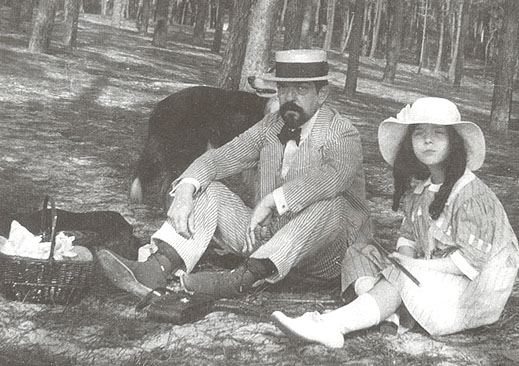
Children’s Corner was written for Debussy’s three-year-old daughter, Claude-Emma (nicknamed ‘Chou-Chou’ [AKA Chouchou]) and bears the following dedication: ‘to my dear Chou-Chou, with the tender apologies of her father for what is to follow.’
—All Music Guide to Classical Music (2005)
*****
Claude & Chouchou
picnicking in a pine forest near Archachon, 1915
 music clip of the day