music clip of the day

jazz/blues/rock/classical/gospel/more

Tag: Morton Feldman

Sunday, 8/5/12

Who wouldn’t want to go to such a heaven?

Soul Stirrers (feat. Jimmy Outler), “Listen to the Angels Sing,” TV show, early 1960s

**********

lagniappe

listening room: (some of) what’s playing

• The Dirtbombs, Ultraglide in Black (In the Red)

• Robert Glasper Experiment, Black Radio (Blue Note)

• Shabazz Palaces, Black Up (Sub Pop)

Terrie Ex, Paal Nilssen-Love, Hurgu! (PNL Records)

• Anthony Braxton Quintet (Basel) 1977 (hatOLOGY)

• Miles Davis, Live in Europe 1967 (Sony Legacy)

• ICP Orchestra Performs Herbie Nichols & Thelonious Monk (ICP)

• George Lewis & The NOW Orchestra, The Shadowgraph Series: Compositions for Creative Orchestra (Spool)

• Misha Mengelberg, Steve Lacy, Goerge Lewis, Harjen Gorter, Han Bennink, Change of Season (Soul Note)

• Pharaoh Sanders, Karma (Impulse!)

• Charles “Bobo” Shaw & Lester Bowie, Bugle Boy Bop (Muse)

• Reverend Claude Jeter, Yesterday and Today (Shanachie)

 This May Be My Last Time Singing: Raw African-American Gospel On 45 RPM (1957-1982) (Tompkins Square)

• J. Berg’s A Cappella Archives (Vol. 3)Royal Rarities (Vol. 3) (Rare Gospel)

Congotronics 2: Buzz ’n’ Rumble in the Urb n’ Jungle (Crammed Discs)

• Pandit Pran Nath, Midnight: Raga Malkauns (Just Dreams)

• Nikhil Banerjee, Afternoon Ragas  (Bhimpalasri, Multani) (Raga Records)

• John Luther Adams, Songbird Songs (Mode Records)

• John Luther Adams, Clouds of Forgetting, Clouds of Unknowing (New World Records)

• John Cage Edition—Vol. 23: The Works for Violin 4 (Irvine Arditti, violin; Stephen Drury, piano) (Mode Records)

• Morton Feldman, Trio  (Aki Takahashi, piano; Marc Sabat, violin; Rohan de Saram, cello) (Mode Records)

• Tristan Murail, Gondwana, Desintegrations, Time and Again (Disques Montaigne)

• Peter Serkin Plays the Music of Toru Takemitsu (RCA/BMG)

• The Incomparable Rudolf Serkin (Beethoven, Piano Sonatas Nos. 30, 31, 32) (Deutsche Grammophon)

• WKCR-FM (broadcasting from Columbia University)

Bird Flight (Phil Schaap, jazz [Charlie Parker])
Eastern Standard Time (Carter Van Pelt, Jamaican music)

• WFMU-FM

Mudd Up! (DJ/Rupture“new bass and beats”)
Sinner’s Crossroads 
(Kevin Nutt, gospel)
Cherry Blossom Clinic (Terre T, rock, etc.)
Fool’s Paradise (Rex; “Vintage rockabilly, R & B, blues, vocal groups, garage, instrumentals, hillbilly, soul and surf”)
Downtown Soulville (Mr. Fine Wine, soul, etc.)
Wednesday, 7/25/12

Suppose that, for the rest of your life, you could listen to only one piece of music.

What would you choose?

Morton Feldman (1926-1987), For Bunita Marcus (1985)
Hildegard Kleeb, piano (1994)

Another take? Here. And here.

**********

lagniappe

musical thoughts

[Morton Feldman and I] were driving back from some place in New England where a concert had been given. He is a large man and falls asleep easily. Out of a sound sleep, he awoke to say, “Now that things are so simple, there’s so much to do.” And then he went back to sleep.

—John Cage, in Silence: Lectures and Writings by John Cage (1961)

Saturday, 6/9/12

Spirits need a lift?

Consider this: how much wonderful music—more than a lifetime’s worth—waits to be heard for the first time.

Morton Feldman, For Philip Guston (1984)*

Part 1

Part 2

Part 3

Part 4

More Feldman?

Here.

Here. 

And here.

Here. 

And here. And here. And here.

Here. 

And here.

**********

lagniappe

musical thoughts

Q. This is a tough question, but what would be your five Desert Island disks?

John Luther Adams: I’d want music I could live inside for a long time; music that’s complex and enigmatic enough that there’s always something new to discover. Off the top of my head, my choices might be . . .

One of Morton Feldman’s major works, probably the Second String Quartet. Or maybe For Philip Guston.

**********

*For piano, celesta, piccolo, flute, alto flute, glockenspiel, vibraphone, marimba, chimes.

Sunday, 2/19/12

the first voice Whitney heard

Emily “Cissy” Houston (born Emily Drinkard), singer, 1933-

The Drinkard Singers (Cissy Houston, lead vocals), “Lift Him Up,” live (TV broadcast), c. early 1960s

**********

lagniappe

Live (TV broadcast), 1970

“Be My Baby” (P. Spector, J. Barry & E. Greenwich)

***

“I Just Don’t Know What To Do With Myself” (B. Bacharach & H. David)

*****

listening room: (some of) what’s playing

• Ambrose Akinmusire, When the Heart Emerges Glistening (Blue Note)

• Johann Sebastian Bach, Suites for Unaccompanied Cello, Pierre Fournier, cello (Archiv Production)

• Johann Sebastian Bach, Well-Tempered Clavier, Glenn Gould, piano (Sony)

• Johann Sebastian Bach, Partitas Nos. 3, 4, 6, Jeremy Denk, piano (Azica)

• Ludwig van Beethoven, Piano Sonatas Nos. 14 (“Moonlight”), 8 (“Pathetique”), 23 (“Appassionata”), Rudolf Serkin, piano (CBS)

• Alfred Cortot, The Master Pianist (EMI)

• Claude Debussy, Pour Le Piano, Etudes Books 1 & 2, Gordon Fergus-Thompson, piano (Musical Heritage Society)

• The Dirtbombs, Ultraglide In Black (In the Red Records)

• Morton Feldman, For Bunita Marcus, John Tilbury, piano (London Hall)

• Morton Feldman, Piano and String Quartet, Aki Takahashi (piano), Kronos Quartet (Nonesuch)

• Mary Halvorson Quintet, Saturn Sings (Firehouse)

• Slim Harpo, The Best of Slim Harpo (Hip-O)

• Paul Hindemith, Benjamin Britten, Krzysztof Penderecki; Kim Kashkashian (viola), Stuttgarter Kammerorchester (Dennis Russell Davies, cond.), Lachrymae (ECM)

• Steve Lehman Octet, Travail, Transformation, and Flow (Pi Recordings)

• Jimmie Lunceford, The Complete Jimmie Lunceford Decca Sessions (Mosaic)

• Guilliaume de Michaut, Motets, The Hilliard Ensemble (ECM)

• Paul Motian Trio (with Joe Lovano, Bill Frisell), Sound of Love (Winter & Winter)

• Mudd Up!, WFMU-FM (DJ/Rupture, “new bass and beats”)

• Pee Wee Russell, Swingin’ with Pee Wee (Prestige)

• Pharoah Sanders, Karma (GRP)

• Pharoah Sanders, Live (Evidence)

• Giacinto Scelsi, Natura Renovatur (ECM)

• Arnold Schoenberg, Piano Works, Peter Serkin, piano (Arcana)

• Sinner’s Crossroads, WFMU-FM (Kevin Nutt, gospel)

• Craig Taborn, Avenging Angel (ECM)

• Toru Takemitsu, Peter Serkin Plays the Music of Toru Takemitsu, Peter Serkin, piano (RCA/BMG)

• Anton Webern, Complete Music for String Quartet, Quartetto Italiano (Philips)

• Anton Webern, Works for String Quartet, Emerson Quartet (Deutsche Grammaphon)

• Wild Flag, Wild Flag (Merge)

Wednesday, 2/1/12

Morton Feldman, For Bunita Marcus (1985)
John Tilbury, piano

According to iTunes, I’ve listened to this piece, which I often put on “repeat” before going to sleep, over a thousand times.

***

More Feldman?

Here.

And here.

Here. 

And here. And here. And here.

Here. 

And here.

**********

lagniappe

musical thoughts

Compositionally I always wanted to be like Fred Astaire.

***

 I never feel that my music is sparse or minimal; the way fat people never really think they’re fat. I certainly don’t consider myself a minimalist at all.

***

No one has the Houdini school of composition.

Morton Feldman (1926-87)

*****

reading table

Last week a record store in Dupont Circle announced that it was closing. The immediate cause of its demise—it had outlasted national and regional chains—was Price Check, Amazon’s new idea for exterminating competition. It is an app that allows shoppers to scan the bar code on any item in any store and transmit it to Amazon for purposes of comparison, and if it compares favorably to Amazon’s price, Amazon’s special promotion promises a discount on the same item. In this way shoppers become spies, and stores, merely by letting customers through their doors, become complicit in their own undoing. It will not do to shrug that this is capitalism, because it is a particular kind of capitalism: the kind that entertains fantasies of monopoly. For all its technological newness, Amazon’s “vision” is disgustingly familiar. (“Amazon is coming to eat me,” a small publisher of fine religious books stoically told me a few weeks ago.) Nor will it do to explain that Amazon’s app is convenient, unless one is prepared to acquiesce in a view of American existence according to which its supreme consideration must be convenience. How easy must every little thing be? A record store in your neighborhood is also convenient, and so is a bookstore. There is also a sinister side to the convenience of online shopping: hours once spent in the sensory world, in the diversified satisfaction of material needs and desires, can now be surrendered to work. It appears to be a law of American life that there shall be no respite from screens. And so Amazon’s practices raise the old question of the cultural consequences of market piggishness. For there are businesses that are not only businesses, that also have non-monetary reasons for being, that are public goods. Their devastation in the name of profit may be economically legitimate, but it is culturally calamitous. In a word, wrong.

WHEN MY FRIEND at Melody Records told me about the death of his store, I was bereft. This was in part because he is my friend—after my father died, I received a letter from the Holocaust Museum informing me that he had made a donation in my father’s memory—and now he must fend for himself and his family and his staff in the American wreckage. But my dejection was owed also to the fact that this store was one of the primary scenes of my personal cultivation. For thirty years it stimulated me, and provided a sanctuary from sadness and sterility. “Going to Melody” was a reliable way of improving my mind’s weather. The people who worked there had knowledge and taste: they apprised me of obscure pressings of Frank Martin’s chamber music, and warned me about the sound quality of certain reissues of Lucky Thompson and Don Byas, and turned me on to old salsa and new fado. They even teased me about my insane affection for Rihanna. When they added DVDs to the store, my pleasures multiplied. (Also my amusements. Not long ago Marcel Ophuls’ great film arrived in the shop, and the box declared: “Woody Allen presents The Sorrow and The Pity.” Beat that.) Of course all these discs can be found online. But the motive of my visits to the store was not acquisitiveness, it was inquisitiveness. I went there to engage in the time-honored intellectual and cultural activity known as browsing.

IT IS A MATTER OF some importance that the nature of browsing be properly understood. Browsing is a method of humanistic education. It gathers not information but impressions, and refines them by brief (but longer than 29 seconds!) immersions in sound or language. Browsing is to Amazon what flaneurie is to Google Earth. It is an immediate encounter with the actual object of curiosity. The browser (no, not that one) is the flaneur in a room. Browsing is not idleness; or rather, it is active idleness—an exploring capacity, a kind of questing non-instrumental behavior. Browsing is the opposite of “search.” Search is precise, browsing is imprecise. When you search, you find what you were looking for; when you browse, you find what you were not looking for. Search corrects your knowledge, browsing corrects your ignorance. Search narrows, browsing enlarges. It does so by means of accidents, of unexpected adjacencies and improbable associations. On Amazon, by contrast, there are no accidents. Its adjacencies are expected and its associations are probable, because it is programmed for precedents. It takes you to where you have already been—to what you have already bought or thought of buying, and to similar things. It sells similarities. After all, serendipity is a poor business model. But serendipity is how the spirit is renewed; and a record store, like a bookstore, is nothing less than an institution of spiritual renewal.

—Leon Wieseltier, “Going To Melody,” The New Republic, 2/2/12

Sunday, 1/29/12

 joy, n. exultation of spirit; gladness, delight. E.g., Calvary Baptist Church in West Philadelphia, with John Legend singing “How I Got Over” (2011).

**********

lagniappe

listening room: (some of) what’s playing

• Theo Parrish, Sound Sculptures, Vol. 1 (Sound Signature)

• Coldcut, 70 Minutes of Madness (Journeys by DJ)

• O.V. Wright, Wright Stuff (Hi UK)

• Bertha “Chippie” Hill, 1925-1929 (Document)

• Animal Collective, Merriweather Post Pavilion (Domino)

• The Fisk Jubilee Quartet, There Breathes A Hope (Archeophone)

•  This May Be The Last Time Singing: Raw African-American Gospel on 45 RPM 1957-1982 (Tompkins Square)

• Lester Bowie’s Brass Fantasy, I Only Have Eyes For You (ECM)

• Chicago Underground Trio, Slon (Thrill Jockey)

• Charlie Christian, The Genius of the Electric Guitar (Sony)

• The Best of the Nat King Cole Trio: Vocal Classics, 1942-46 (Blue Note)

• Chicago Underground Trio, Slon (Thrill Jockey)

• Miles Davis, Legendary Prestige Quintet Sessions (Prestige)

• Bill Dixon with Exploding Star Orchestra (Thrill Jockey)

• Mahmoud Ahmed, Ethiopiques 19 (Buda Musique)

• Ludwig van Beethoven/Julliard String Quartet, String Quartets Nos. 13 & 16 (Sony)

• Ludwig van Beethoven/Solomon, Piano Concertos Nos. 3 & 5 (EMI)

• Ludwig van Beethoven/Berlin Philharmonic Orchestra, Herbert von Karajan cond., Symphony No. 7 (Deutsche Grammaphon)

• Bela Bartok/Hungarian String Quartet, String Quartets Nos. 1-6 (Deutsche Grammaphon)

• Bela Bartok/Takacs Quartet, String Quartets Nos. 5-6 (Hungaroton)

• Boulez Conducts Boulez (Deutsche Grammaphon)

• Cleveland Orchestra, Pierre Boulez cond./Mitsuko Uchida, Arnold Schoenberg, Anton Webern, Alban Berg (Philips)

• Morton Feldman, For Bunita Marcus, Markus Hinterhauser, piano (Col Legno)

• Morton Feldman, Piano and String Quartet, Aki Takahashi, Kronos Quartet (Nonesuch)

• Hawthorne String Quartet, Pavel Haas (String Quartets Nos. 2 and 3), Hans Krasa (String Quartet) (London)

• Pavel Haas Quartet, Leo Janacek (String Quartet No. 1), Pavel Haas (String Quartets Nos. 1 and 3) (Supraphon)

• Arvo Part, Litany (ECM)

• Arnold Schoenberg/LaSalle Quartet, String Quartets Nos. 3 and 4 (Brilliant Classics)

• Robert Schumann/Zehetmair Quartett, String Quartets Nos. 1 & 3 (ECM)

• Zehetmair Quartet, Bela Bartok (String Quartet No. 5), Paul Hindemith (String Quartet No. 4) (ECM)

• WKCR-FM (broadcasting from Columbia University)

—Bach Festival
Bird Flight (Phil Schaap, jazz [Charlie Parker])
Eastern Standard Time (Carter Van Pelt, Jamaican music)

• WFMU-FM

Mudd Up! (DJ/Rupture“new bass and beats”)
Sinner’s Crossroads 
(Kevin Nutt, gospel)
Give the Drummer Some (Doug Schulkind, sui generis, Web only)
Lamin’s Show (sui generis)

Saturday, 1/14/12

If you wanted to conjure a world full of mystery, what better instrument to lead the way than one that possesses neither the brightness of the violin nor the darkness of the cello?

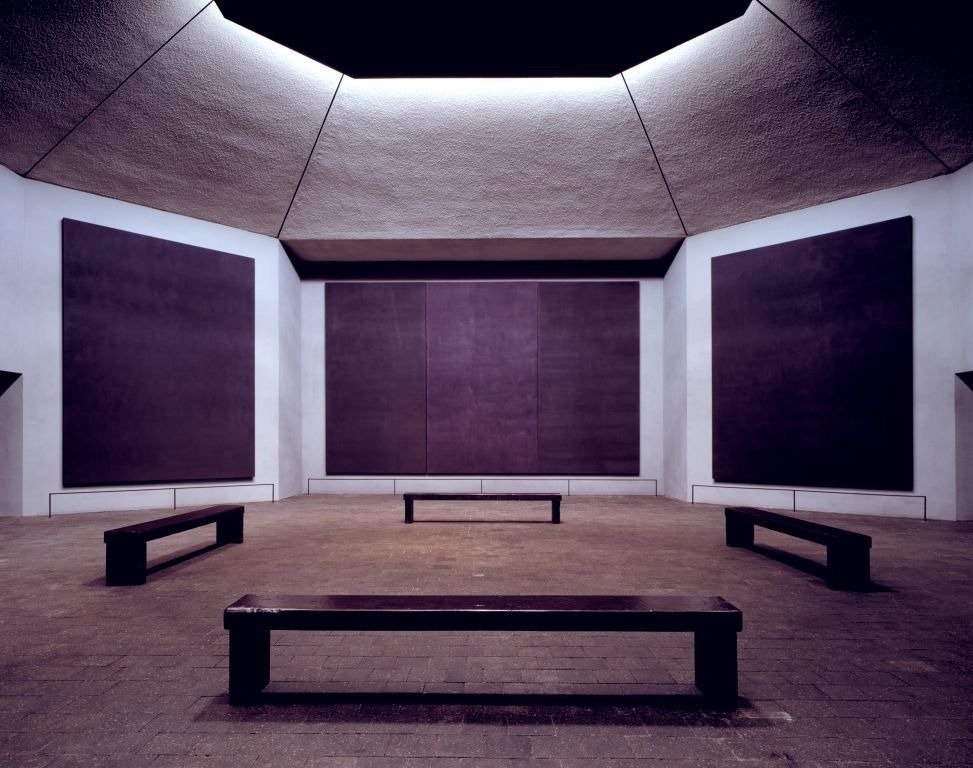
Morton Feldman, Rothko Chapel (1971), live, Houston (Rothko Chapel), 2011; Kim Kashkashian (viola), Brian Del Signore (percussion), Sarah Rothenberg (celeste), Maureen Broy Papovich (soprano), Houston Chamber Choir (Robert Simpson, cond.)

Part 1

***

Part 2

***

Part 3

Another take? Here.

**********

lagniappe

Rothko Chapel, Houston, Texas

***

The Rothko Chapel is an interfaith sanctuary, a center for human rights — and a one-man art museum devoted to 14 monumental paintings by abstract expressionist Mark Rothko. The Houston landmark, commissioned by John and Dominique de Menil, opened its doors 40 years ago, in February 1971.

For the past four decades, the chapel has encouraged cooperation between people of all faiths — or of no faith at all. While the chapel itself has become an art landmark and a center for human-rights action, the sanctuary’s creator never lived to see it finished. Rothko committed suicide in 1970.

Approaching the chapel from the south, visitors first see a steel sculpture called Broken Obelisk by Barnett Newman in the middle of a pool — it appears to be floating on the surface of the water. The chapel itself is a windowless, octagonal brick building. Solid black doors open on a tiny glass-walled foyer. (The foyer was walled off from the rest of the interior when the Gulf Coast’s notorious humidity began to affect the paintings.)

The main room is a hushed octagonal space with gray stucco walls, each filled by massive paintings. Some walls feature one canvas, while on others, three canvases hang side by side to form a triptych. A baffled skylight subdues the bright Houston sun, and the surfaces of the paintings change dramatically as unseen clouds pass outside. There are eight austere wooden benches informally arranged, and today, a few meditation mats. A young woman brings the meditation hour to a close by striking a small bowl with a mallet, creating a soft peal of three bells in the intense silence of the room.

Concerts, conferences, lectures, weddings and memorial services all take place in the chapel throughout the year, but on most days you will find visitors — about 55,000 annually come to see, to meditate, to write in the large comment book in the foyer, to read the variety of well-thumbed religious texts available on benches at the entrance.

***

These paintings do not feature the luminous color fields that made Rothko famous. The paintings in the chapel are dark, in purplish or black hues. And there’s a reason for that, says [chapel historian Suna] Umari.

“They’re sort of a window to beyond,” she explains. “He said the bright colors sort of stop your vision at the canvas, where dark colors go beyond. And definitely you’re looking at the beyond. You’re looking at the infinite.”

***

At first glance, the paintings appear to be made up of solid, dark colors. But look closely, and it becomes evident that the paintings are composed of many uneven washes of pigment that create variations in every inch. Stepping back, waves of subtle color difference appear across the broad surfaces — leading to an unmistakable impression of physical depth.

***

Though Mark Rothko didn’t live to see the sanctuary he created, Christopher Rothko says his father knew what it should be.

“It took me a while to realize it, but that’s really my father’s gift, in a sense, to somebody who comes to the chapel. It’s a place that will really not just invite, but also demand a kind of journey.”

—Pat Dowell, “Meditation and Modern Art Meet In Rothko Chapel,” NPR, 3/1/11

*****

reading table

Our lives are Swiss –
So still – so Cool –
Till some odd afternoon
The Alps neglect their Curtains
And we look farther on!

Italy stands the other side!
While like a guard between –
The solemn Alps –
The siren Alps
Forever intervene!

—Emily Dickinson

Sunday, 11/6/11

two takes

“Don’t sit around in a dead church and die!”

Take 1: Brother Anthony Wynn (Oasis Ministries, Riceville, Tennessee)

*****

Take 2: Sensimo

**********

lagniappe

listening room: (some of) what’s playing

• Theo Parrish, Sound Sculptures, Vol. 1 (Sound Signature)

• Jimmie Dale Gilmore, Come On Back (Rounder)

• Rare & Collectible Fine Wine: 27 Soulful Ultra-Obscurities From the Cellars (WMFU-FM 2011 Premium; Mr. Fine Wine, Downtown Soulville)

• Cooking Cherries (WMFU-FM 2011 Premium; Terre T, The Cherry Blossom Clinic)

• Miles Davis, The Legendary Prestige Quintet Sessions (Prestige)

• Don Pullen Plays Monk (Why Not)

• Lucky 7s, Farragut (Lakefront Digital)

• Julius Hemphill, One Atmosphere (Tzadik)

• Wadada Leo Smith’s Golden Quartet, with WLS, trumpet; Anthony Davis, piano; Malachi Favors, bass; Jack DeJohnette, drums (Tzakik)

• Goodbye, Babylon (Dust-to-Digital)

• Nikhil Banerjee, Raga Purabi Kaylan (Raga)

• Bela Bartok, String Quartets, Keller Quartet (Erato), Hungarian String Quartet (Deutsche Grammaphon), Takacs Quartet (Decca)

• Anton Bruckner, Symphony No. 6, North German Radio Orchestra (Gunter Wand, conductor) (RCA Victor)

• Morton Feldman, For Bunita Marcus, Markus Hinterhauser, piano (Col Legno [import])

• Morton Feldman, Three Voices, Joan La Barbara (New Albion)

• Morton Feldman, Piano and String Quartet, Aki Takahashi, Kronos Quartet (Nonesuch)

• WKCR-FM (broadcasting from Columbia University)

—Jo Jones Centennial Festival
—Thelonious Monk birthday broadcast
Bird Flight (Phil Schaap, jazz [Charlie Parker])
Traditions in Swing (Phil Schaap, jazz)
Eastern Standard Time (Carter Van Pelt, Jamaican music)
Amazing Grace (various, gospel)
Rag Aur Taal (various, Indian)
Jazz Profiles (various, jazz)
Out to Lunch (various, jazz)

• WFMU-FM

Mudd Up! (DJ/Rupture“new bass and beats”)
Sinner’s Crossroads 
(Kevin Nutt, gospel)
Give the Drummer Some (Doug Schulkind, sui generis, Web only)
Daniel Blumin
Cherry Blossom Clinic (Terre T, rock, etc.)
Antique Phonograph Music Program (MAC, “78s and cylinders . . . played on actual period reproducing devices”)
HotRod (“Shamanic vibrational love frequencies for the infinite mind,” Web only)

• WHPK-FM (broadcasting from University of Chicago)

The Blues Excursion (Arkansas Red)

Sunday, 10/2/11

Here, at Luther Vandross’s funeral, Stevie testifies.

Stevie Wonder, “I Won’t Complain”
Live, New York (The Riverside Church), 2005

**********

lagniappe

For as long as you’ve got a harp in your heart, God’s got a hymn for your hurt. And as long as you’ve got a hymn, then you’ve got hope.

—Maurice O. Wallace (funeral sermon, quoted in Karla FC Holloway, Passed On: African American Mourning Stories [2002])

(Originally posted 10/11/09.)

*****

listening room: (some of) what’s playing

• Coldcut, 70 Minutes of Madness (Journeys by DJ)

• Mahmoud Ahmed, Ethiopiques, Vol. 6: Almaz (Buda Musique [import])

• Staff Benda Bilili, Tres Tres Fort (Crammed Discs)

• Louis Armstrong, Hot Fives & Sevens (JSP [import])

• Jaki Byard, Solo/Strings (Prestige)

• John Carter & Bobby Bradford’s New Art Jazz Ensemble, Seeking (hat Art)

• Eric Dolphy, Out to Lunch (Blue Note)

• Bill Evans Trio, Sunday at the Village Vanguard (Riverside)

• The Great Concert of Charles Mingus (Verve)

• The Complete Dean Benedetti Recordings Of Charlie Parker (Mosaic)

• Sun Ra, Sleeping Beauty (Phantom Sound & Vision [import])

• The Complete Novus & Columbia Recordings of Henry Threadgill & Air (Mosaic)

• Wadada Leo Smith’s Golden Quartet (Tzadik)

• Bela Bartok, String Quartets Nos. 5 & 6, Takacs Quartet (Hungaroton [import])

• David Behrman, On the Other Ocean (Lovely Music)

• Morton Feldman, Crippled Symmetry, Eberhard Blum, flute; Nils Vigland, piano, celesta; Jan Williams, glockenspiel, vibraphone (hat Art)

Morton Feldman, For Christian Wolff, Eberhard Blum, flute; Nils Vigland, piano, celesta (hat Art)

• Morton Feldman, For Bunita Marcus, Stephane Ginsburgh, piano (Sub Rosa) (available as a download from Amazon for 89¢)

• Morton Feldman, For Samuel Beckett, San Francisco Contemporary Players (Newport Classic)

• Morton Feldman, Triadic Memories, Markus Hinterhauser, piano (Col Legno [import])

• Morton Feldman,  Piano, Violin, Viola, Cello, Members of the Ives Ensemble (hat Art)

• Ingram Marshall, Kingdom Come (Nonesuch)

• Maurizio Pollini, piano, Arnold Schoenberg (The Solo Piano MusicPiano Concerto), Anton Webern (Variations, op. 27) (Deutsche Grammaphon)

• Dimitri Shostakovich, String Quartets Nos. 5, 6, & 7, Borodin Quartet (Melodiya)

• WKCR-FM (broadcasting from Columbia University)
—Lester Young/Charlie Parker birthday marathon
—John Coltrane birthday broadcast
Bird Flight (Phil Schaap, jazz [Charlie Parker])
Traditions in Swing (Phil Schaap, jazz)
Eastern Standard Time (Carter Van Pelt, Jamaican music)

• WFMU-FM
Mudd Up! (DJ/Rupture“new bass and beats”)
Sinner’s Crossroads 
(Kevin Nutt, gospel)
—Airborne Event (Dan Bodah, “electronic noise to free jazz, drone rock to a capella African song”)
Give the Drummer Some (Doug Schulkind, sui generis, web only)
Transpacific Sound Paradise (Rob Weisberg, “popular and unpopular music from around the world”)

WHPK-FM (broadcasting from University of Chicago)
The Blues Excursion (Arkansas Red)

Saturday, 9/24/11

Morton Feldman, For Christian Wolff (flute, piano, celesta; 1986)

Vodpod videos no longer available.

Listening to this, you can find it hard to remember, after an hour or so, what the world sounded like before it began playing.

More? Here. And here. And here. And here. And here. And here.

**********

lagniappe

Imagine a long, narrow hallway with paintings—subtle, shimmering abstracts by Mark Rothko—hung along both walls. Imagine walking through the hallway, stopping to examine one painting closely before moving on to the next. Imagine the hallway extends for three miles without an exit. This should give you some idea of what listening to For Christian Wolff is like. What might be hell to some people could be an all-too-brief time spent in paradise for others.

—Art Lange, Fanfare, July/August 2009

*****

At the beginning of Morton Feldman’s “For Christian Wolff” at the Alternative Museum last Sunday afternoon, Nils Vigeland – who played the piano and celesta to Eberhard Blum’s flute – invited listeners with other engagements or expired patience to leave at will.

The few who did walk out before this three-and-a-half-hour musical experience was over neither insulted the spirit of the late Mr. Feldman’s piece nor necessarily missed anything. This music, with its trancelike exposition of simple intervals, can haunt one as much in one hour as it can in three.

“For Christian Wolff” is music whose internal clock has stopped. It offers us the moment, invites us to forget what has already happened and discourages any curiosity about the future. Mr. Wolff was on hand to honor his late colleague. His introductory words – which said little about either the music, the composer or himself – seemed terribly appropriate to the occasion.

***

“For Christian Wolff” . . . gives us a deflected image of silence. Like the shadows of Plato’s cave, it is a corporeal flicker of pure nothingness – the kind of music that in the heavens surely sets the toes of gods to tapping.

—Bernard Holland, New York Times, 4/1/90