music clip of the day

jazz/blues/rock/classical/gospel/more

Tag: Morton Feldman

Saturday, September 6th

tonight in Chicago

She’ll be performing at Constellation.

Morton Feldman (1926-1987), Triadic Memories (excerpt)
Marilyn Nonken (piano), 2004


**********

lagniappe

reading table

John Koethe (1945-), “A Private Singularity” (Poetry, 9/14)

I used to like being young, and I still do,
Because I think I still am. There are physical
Objections to that thought, and yet what
Fascinates me now is how obsessed I was at thirty-five
With feeling older than I was: it seemed so smart
And worldly, so fastidiously knowing to dwell so much
On time — on what it gives, what it destroys, on how it feels.
And now it’s here and doesn’t feel like anything at all:
A little warm perhaps, a little cool, but mostly waiting on my
Life to fill it up, and meanwhile living in the light and listening
To the music floating through my living room each night.
It’s something you can only recognize in retrospect, long after
Everything that used to fill those years has disappeared
And they’ve become regrets and images, leaving you alone
In a perpetual present, in a nondescript small room where it began.
You find it in yourself: the ways that led inexorably from
Home to here are simply stories now, leading nowhere anymore;
The wilderness they led through is the space behind a door
Through which a sentence flows, following a map in the heart.
Along the way the self that you were born with turns into
The self that you created, but they come together at the end,
United in the memory where time began: the tinkling of a bell
On a garden gate in Combray, or the clang of a driven nail
In a Los Angeles backyard, or a pure, angelic clang in Nova Scotia —
Whatever age restores. It isn’t the generalizations that I loved
At thirty-five that move me now, but particular moments
When my life comes into focus, and the feeling of the years
Between them comes alive. Time stops, and then resumes its story,
Like a train to Balbec or a steamer to Brazil. We moved to San Diego,
Then I headed east, then settled in the middle of the country
Where I’ve waited now for almost forty years, going through the
Motions of the moments as they pass from now to nothing,
Reading by their light. I don’t know why I’m reading them again —
Elizabeth Bishop, Proust. The stories you remember feel like mirrors,
And rereading them like leafing through your life at a certain age,
As though the years were pages. I keep living in the light
Under the door, waiting on those vague sensations floating in
And out of consciousness like odors, like the smell of sperm and lilacs.
In the afternoon I bicycle to a park that overlooks Lake Michigan,
Linger on a bench and read Contre Sainte-Beuve and Time Reborn,
A physics book that argues time is real. And that’s my life —
It isn’t much, and yet it hangs together: its obsessions dovetail
With each other, as the private world of my experience takes its place
Within a natural order that absorbs it, but for a while lets it live.
It feels like such a miracle, this life: it promises everything,
And even keeps its promise when you’ve grown too old to care.
It seems unremarkable at first, and then as time goes by it
Starts to seem unreal, a figment of the years inside a universe
That flows around them and dissolves them in the end,
But meanwhile lets you linger in a universe of one —
A village on a summer afternoon, a garden after dark,
A small backyard beneath a boring California sky.
I said I still felt young, and so I am, yet what that means
Eludes me. Maybe it’s the feeling of the presence
Of the past, or of its disappearance, or both of them at once —
A long estrangement and a private singularity, intact
Within a tinkling bell, an iron nail, a pure, angelic clang —
The echo of a clear, metallic sound from childhood,
Where time began: “Oh, beautiful sound, strike again!”
Thursday, August 14th

soundtrack to a dream

Morton Feldman (1926-1987), The Viola in My Life; João Pedro Delgado (viola), et al., live, Portugal, 2014

#1

#2

#3

#4

**********

lagniappe

reading table

The Suicide’s Room
by Wislawa Szymborska (1923-2012; MCOTD Hall-of-Famer), translated from Polish by Stanislaw Baranczak and Clare Cavanagh

I’ll bet you think the room was empty.
Wrong. There were three chairs with sturdy backs.
A lamp, good for fighting the dark.
A desk, and on the desk a wallet, some newspapers.
A carefree Buddha and a worried Christ.
Seven lucky elephants, a notebook in a drawer.
You think our addresses weren’t in it?

No books, no pictures, no records, you guess?
Wrong. A comforting trumpet poised in black hands.
Saskia and her cordial little flower.
Joy the spark of gods.
Odysseus stretched on the shelf in life-giving sleep
after the labors of Book Five.
The moralists
with the golden syllables of their names
inscribed on finely tanned spines.
Next to them, the politicians braced their backs.

No way out? But what about the door?
No prospects? The window had other views.
His glasses
lay on the windowsill.
And one fly buzzed—that is, was still alive.

You think at least the note could tell us something.
But what if I say there was no note—
and he had so many friends, but all of us fit neatly
inside the empty envelope propped up against a cup.

Saturday, March 1, 2014

If you wanted to conjure a world of mystery, what better instrument to lead the way than one that possesses neither the brightness of the violin nor the darkness of the cello?

Morton Feldman, Rothko Chapel (1971), live, Houston (Rothko Chapel), 2011; Kim Kashkashian (viola), Brian Del Signore (percussion), Sarah Rothenberg (celeste), Maureen Broy Papovich (soprano), Houston Chamber Choir (Robert Simpson, cond.)

#1

***

#2

***

#3

Another take? Here.

**********

lagniappe

Rothko Chapel

***

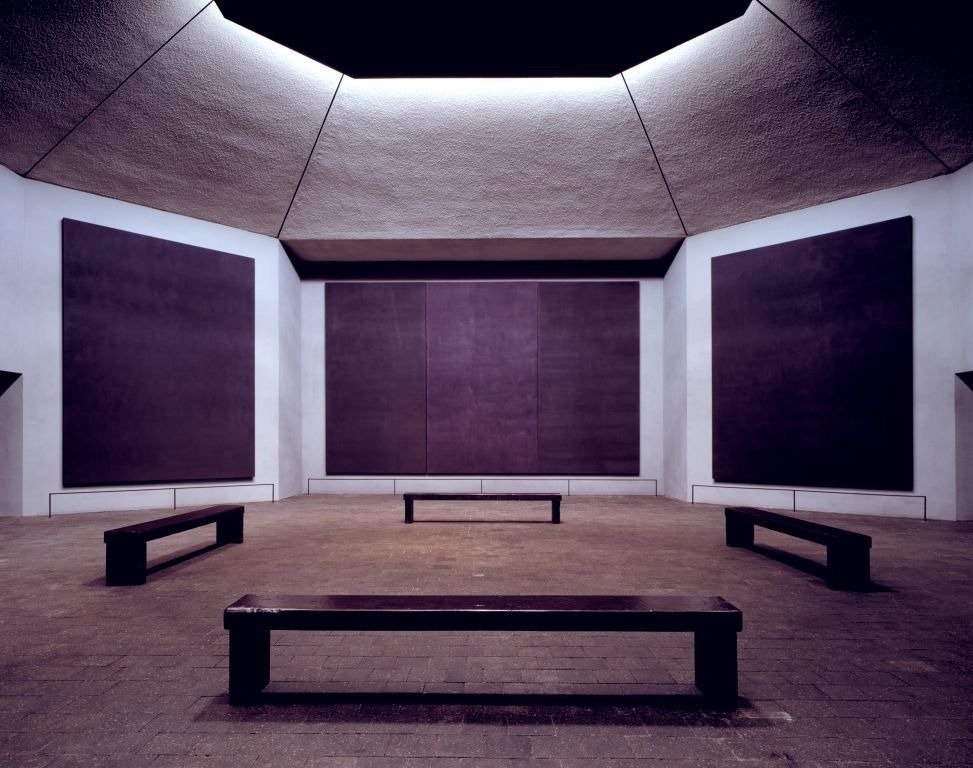
The Rothko Chapel is an interfaith sanctuary, a center for human rights — and a one-man art museum devoted to 14 monumental paintings by abstract expressionist Mark Rothko. The Houston landmark, commissioned by John and Dominique de Menil, opened its doors 40 years ago, in February 1971.

For the past four decades, the chapel has encouraged cooperation between people of all faiths — or of no faith at all. While the chapel itself has become an art landmark and a center for human-rights action, the sanctuary’s creator never lived to see it finished. Rothko committed suicide in 1970.

Approaching the chapel from the south, visitors first see a steel sculpture called Broken Obelisk by Barnett Newman in the middle of a pool — it appears to be floating on the surface of the water. The chapel itself is a windowless, octagonal brick building. Solid black doors open on a tiny glass-walled foyer. (The foyer was walled off from the rest of the interior when the Gulf Coast’s notorious humidity began to affect the paintings.)

The main room is a hushed octagonal space with gray stucco walls, each filled by massive paintings. Some walls feature one canvas, while on others, three canvases hang side by side to form a triptych. A baffled skylight subdues the bright Houston sun, and the surfaces of the paintings change dramatically as unseen clouds pass outside. There are eight austere wooden benches informally arranged, and today, a few meditation mats. A young woman brings the meditation hour to a close by striking a small bowl with a mallet, creating a soft peal of three bells in the intense silence of the room.

Concerts, conferences, lectures, weddings and memorial services all take place in the chapel throughout the year, but on most days you will find visitors — about 55,000 annually come to see, to meditate, to write in the large comment book in the foyer, to read the variety of well-thumbed religious texts available on benches at the entrance.

***

These paintings do not feature the luminous color fields that made Rothko famous. The paintings in the chapel are dark, in purplish or black hues. And there’s a reason for that, says [chapel historian Suna] Umari.

“They’re sort of a window to beyond,” she explains. “He said the bright colors sort of stop your vision at the canvas, where dark colors go beyond. And definitely you’re looking at the beyond. You’re looking at the infinite.”

***

At first glance, the paintings appear to be made up of solid, dark colors. But look closely, and it becomes evident that the paintings are composed of many uneven washes of pigment that create variations in every inch. Stepping back, waves of subtle color difference appear across the broad surfaces — leading to an unmistakable impression of physical depth.

***

Though Mark Rothko didn’t live to see the sanctuary he created, Christopher Rothko says his father knew what it should be.

“It took me a while to realize it, but that’s really my father’s gift, in a sense, to somebody who comes to the chapel. It’s a place that will really not just invite, but also demand a kind of journey.”

—Pat Dowell, “Meditation and Modern Art Meet In Rothko Chapel,” NPR, 3/1/11

*****

reading table

Our lives are Swiss –
So still – so Cool –
Till some odd afternoon
The Alps neglect their Curtains
And we look farther on!

Italy stands the other side!
While like a guard between –
The solemn Alps –
The siren Alps
Forever intervene!

—Emily Dickinson

Thursday, January 30th

Morton Feldman (1926-1987), Why Patterns?; California EAR Unit (Dorothy Stone, flute; Arthur Jarvinen, glockenspiel; Gaylord Mowrey, piano), 1991


His music makes so much use of space it seems to keep going even after the sounds have stopped.

Monday, November 25th

alone

Something quiet to start the week.

Morton Feldman (1926-1987), Palais de Mari (1986); Michael Hicks (piano), live, Brigham Young University (Provo, Utah), 2006

His music, like Mozart’s, grants us access to an alternative world—one that’s clear, and light, and airy.

Thursday, November 7th

Feel like floating?

Morton Feldman (1926-1987), For Philip Guston (1984)
S.E.M. Ensemble, 2000

Saturday, October 12th


This I could listen to forever.

Morton Feldman (1926-1987), Piano and String Quartet (1985)
Aki Takahashi (piano) and Kronos Quartet


**********

lagniappe

musical thoughts

Earlier in my life there seemed to be unlimited possibilities, but my mind was closed. Now, years later and with an open mind, possibilities no longer interest me. I seem content to be continually rearranging the same furniture in the same room. My concern at times is nothing more than establishing a series of practical conditions that will enable me to work. For years I said if I could only find a comfortable chair I would rival Mozart.

***

If a man teaches composition in a university, how can he not be a composer? He has worked hard, learned his craft. Ergo, he is a composer. A professional. Like a doctor. But there is that doctor who opens you up, does exactly the right thing, closes you up—and you die. He failed to take the chance that might have saved you. Art is a crucial, dangerous operation we perform on ourselves. Unless we take a chance, we die in art.

Morton Feldman

Saturday, August 24th

alone

If you’re in the mood for his music, as I often am, nothing else will do.

Morton Feldman (1926-1987), Triadic Memories (1981); Louis Goldstein, piano


**********

lagniappe

reading table

In the summer rain
the path
has disappeared.

—Yosa Buson (1716-1783; translated from Japanese by Robert Hass)

*****

musical thoughts

What would it be like to live in a world without sound?

Wednesday, July 3rd

what’s new

I don’t understand a word of German. No matter. Commitment and passion don’t require translation.

Carolin Widmann (violin), playing and talking; Morton Feldman (1926-1987), Violin and Orchestra (1979); CM, Frankfurt Radio Symphony Orchestra (Emilio Pomarico, cond.), ECM Records, 5/13

Saturday, April 6th

Composers, too, like singers, saxophonists, even drummers, have distinctive voices. Here’s one we haven’t heard in a while.

Morton Feldman (1926-1987), For Stefan Wolpe (1986), The Choir of Saint Ignatius of Antioch (Harold Chaney, cond.), Benjamin Ramirez & Thomas Kolor, vibraphones

**********

lagniappe

random thoughts

My father, gone since 1977, does he miss being alive?