Tuesday, September 11th
voices I miss
The way a bass should sound—fat, dark, bottomless.
Malachi Favors (1927-2004), live, New York, 2001
voices I miss
The way a bass should sound—fat, dark, bottomless.
Malachi Favors (1927-2004), live, New York, 2001
MCOTD Hall of Fame
Lester Bowie (1941-1999, trumpet) with Amina Claudine Myers (piano, vocals), Arthur Blythe (alto saxophone), Malachi Favors (bass), Phillip Wilson (drums), “God Has Smiled on Me,” 1978
**********
lagniappe
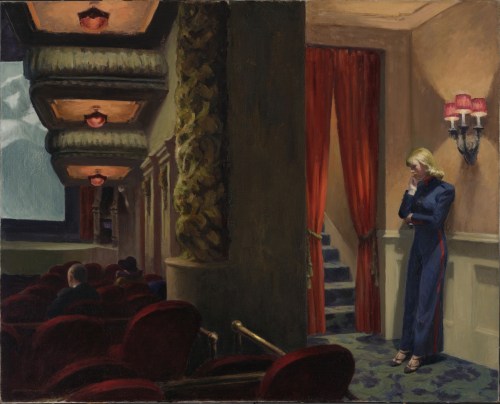
art beat: other day, Art Institute of Chicago
Edward Hopper (1882-1967), New York Movie, 1939 (America after the Fall, Painting in the 1930s, through 9/18/16)
sounds of Chicago (day one)
Art Ensemble of Chicago (Roscoe Mitchell, reeds; MCOTD Hall-of-Famer Lester Bowie [1941-1999], trumpet; Malachi Favors [1927-2004], bass; Don Moye, drums), live, Hungary (Budapest), 1995
voices I miss
Lester Bowie’s From the Root to the Source (MCOTD Hall-of-Famer Lester Bowie [1941-1999], trumpet; Fontella Bass, vocals, piano; Martha Bass, vocals; Malachi Favors, bass, et al.), live, 1983
**********
lagniappe
reading table
I walked through the mountains today. The weather was damp, and the entire region was grey. But the road was soft and in places very clean. At first I had my coat on; soon, however, I pulled it off, folded it together, and laid it upon my arm. The walk on the wonderful road gave me more and even more pleasure; first it went up and then descended again. The mountainous world appeared to me like an enormous theatre. The road snuggled up splendidly to the mountainsides. Then I came down into a deep ravine, a river roared at my feet, a train rushed past me with magnificent white smoke. The road went through the ravine like a smooth white stream, and as I walked on, to me it was as if the narrow valley were bending and winding around itself. Grey clouds lay on the mountains as though that were their resting place. I met a young traveller with a rucksack on his back, who asked if I had seen two other young fellows. No, I said. Had I come here from very far? Yes, I said, and went farther on my way. Not a long time, and I saw and heard the two young wanderers pass by with music. A village was especially beautiful with humble dwellings set thickly under the white cliffs. I encountered a few carts, otherwise nothing, and I had seen some children on the highway. We don’t need to see anything out of the ordinary. We already see so much.
—Robert Walser (1878-1956), “A Little Ramble” (translated from German by Tom Whalen)
No background. No foreground. Three lines, intertwining.
Dewey Redman (1931-2006), tenor saxphone; Malachi Favors (1927-2004), bass; Ed Blackwell (1929-1992), drums; “Paris? Oui!,” 1969
**********
lagniappe
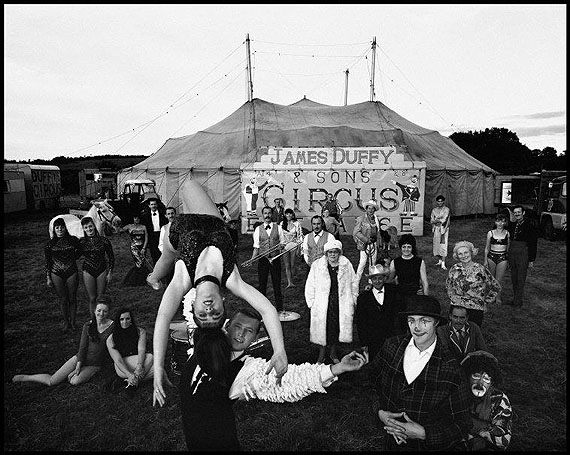
art beat
Bruce Davidson (1933-), Duffy Circus, Ireland, 1967
sounds of Chicago
One-word review: mesmerizing.
Art Ensemble of Chicago, live, France (Chateauvallon), 1970
**********
lagniappe
reading table
Despite all my inner crumblings,
I’m still able to recognize a perfect day:
sea without shadow,
sky without wrinkles,
air hovering over me like a blessing.—Nina Cassian (1924-2014), “Summer X-Rays” (fragment)
sounds of Chicago
Art Ensemble of Chicago (Roscoe Mitchell, saxophones, percussion; Joseph Jarman, saxophones, percussion, electric guitar; Lester Bowie [MCOTD Hall of Famer], trumpet, percussion; Malachi Favors, bass, percussion; Don Moye, drums, percussion [first clip])
Live, Chicago (Jazz Showcase), 1981
***
Recording (“Rock Out”), 1969
passings
Fontella Bass, singer, July 3, 1940-December 26, 2012
“Rescue Me,” TV Show (Shindig), 1965
***
“Theme De Yoyo,” with the Art Ensemble of Chicago, 1970
***
“God Has Smiled On Me,” with mother Martha Bass, brother David Peaston, Amina Claudine Myers (piano), Malachi Favors (bass), Phillip Wilson (drums), 1980
***
“All That You Give,” with The Cinematic Orchestra, 2002
passings
In?
Out?
No matter—he played it all.
Jodie Christian, February 2, 1932-February 13, 2012, Chicago-based pianist; cofounder, AACM (Association for the Advancement of Creative Musicians)
With Eddie Harris, tenor saxophone (Melvin Jackson, bass; Billy Hart drums), “Listen Here” (with a nod at the end to “Freedom Jazz Dance”), live, Montreux, 6/20/1969
***
With Roscoe Mitchell, soprano saxophone (Malachi Favors, bass, et al.), live, Chicago, 1984
**********
lagniappe
reading table
A dead beetle lies on the path through the field.
Three pairs of legs folded neatly on its belly.
Instead of death’s confusion, tidiness and order.
The horror of this sight is moderate,
its scope is strictly local, from the wheat grass to the mint.
The grief is quarantined.
The sky is blue.
To preserve our peace of mind, animals die
more shallowly: they aren’t deceased, they’re dead.
They leave behind, we’d like to think, less feeling and less world,
departing, we suppose, from a stage less tragic.
Their meek souls never haunt us in the dark,
they know their place,
they show respect.
And so the dead beetle on the path
lies unmourned and shining in the sun.
One glance at it will do for meditation—
clearly nothing much has happened to it.
Important matters are reserved for us,
for our life and our death, a death
that always claims the right of way.
—Wislawa Szymborska, “Seen From Above,” (translated from Polish by Stanislaw Baranczak and Clare Cavanagh)
 music clip of the day