Ed Blackwell (drums, 1929-1992) with Mal Waldron (piano), Charlie Rouse (tenor saxophone), Woody Shaw (flugelhorn), Reggie Workman (bass), “The Git Go” (M. Waldron), live, New York (Village Vanguard), 1985
Ed Blackwell (drums, 1929-1992) with Mal Waldron (piano), Charles Rouse (tenor saxophone, flute), Woody Shaw (trumpet, flugelhorn), Reggie Workman (bass), live (“The Git Go,” “All Alone,” “Fire Waltz”), New York (Village Vanguard), 1985
**********
lagniappe
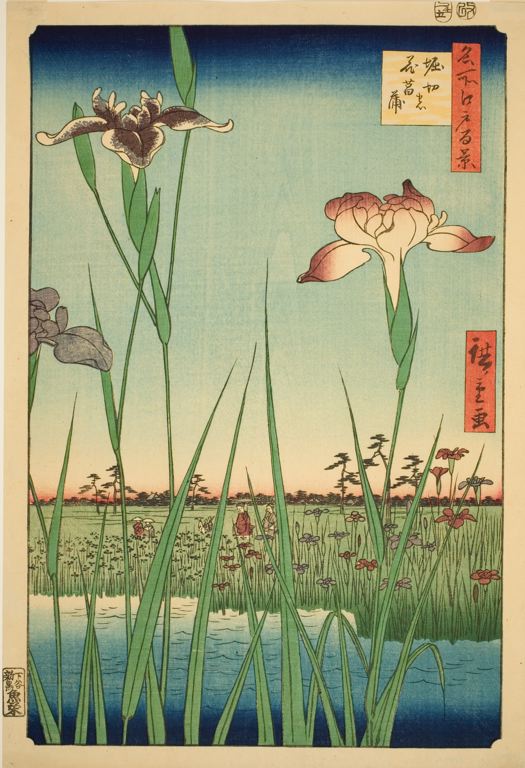
art beat: other day, Art Institute of Chicago
Utagawa Hiroshige (1797-1858), Irises at Horikiri, 1857
Has there ever been a finer hour of jazz—of music—on TV?
The Sound of Jazz(CBS), 1957*
(A couple excerpts have been posted previously—here and here—but until the other day I’d never seen the whole show.)
*With Count Basie (piano), Thelonious Monk (piano), Billie Holiday (vocals), Jimmy Rushing (vocals), Coleman Hawkins (tenor saxophone), Ben Webster (tenor saxophone), Lester Young (tenor saxophone), Gerry Mulligan (baritone saxophone), Jimmy Giuffre (tenor saxophone, clarinet), Pee Wee Ellis (clarinet), Henry “Red” Allen (trumpet), Roy Eldridge (trumpet), Vic Dickenson (trombone), Danny Barker (guitar), Freddie Green (guitar), Jim Hall (guitar), Milt Hinton (bass), Jo Jones (drums), et al.
Who else (besides, of course, Bob Dylan) has played so many different roles so brilliantly?
Miles Davis (with Robben Ford & guest Carlos Santana, guitars), “Burn”
Live, Giants Stadium, East Rutherford, New Jersey, 6/15/86
Listen to stuff long enough and it changes—or you do, anyway. Once I might have faulted this for being repetitive. But that’s a bit like faulting roast beef for being meat. Of course it’s repetitive. That’s part of what makes it soar.
• WKCR-FM (broadcasting from Columbia University)
—Bird Flight (Phil Schaap, jazz [Charlie Parker])
—Morning Classical (Various)
—Amazing Grace (Various)
• WFMU-FM
—Mudd Up! (DJ/Rupture, “new bass and beats”)
—Sinner’s Crossroads(Kevin Nutt, gospel)
—Give The Drummer Some (Doug Schulkind, sui generis)
—Fool’s Paradise (Rex, sui generis)
—Transpacific Sound Paradise (Rob Weisberg, “popular and unpopular music from around the world”)
Few musicians, on any instrument, give me so much joy.
Ed Blackwell, October 10, 1929-October 7, 1992
Mal Waldron Quintet (Mal Waldron, piano, with Ed Blackwell, drums; Reggie Workman, bass; Charlie Rouse, saxophone; Woody Shaw, flugelhorn), “The Git-Go,” live, New York (Village Vanguard), 1986
I’ve been playing with Blackwell over 20 years. We used to play when I first went to Los Angeles. Blackwell plays the drums as if he’s playing a wind instrument. Actually, he sounds more like a talking drum. He’s speaking a certain language that I find is very valid in rhythm instruments.
Very seldom in rhythm instruments do you hear rhythm sounding like a language. I think that’s a very old tradition, because the drums, in the beginning, used to be like the telephone—to carry the message.
In one of my clearest memories of the drummer Ed Blackwell, he sat in an Indian restaurant drawing percussion notation on the tablecloth with a felt-tipped pen. The waiters looked on, aghast, as the splodgy black figures spread across their white linen, but Blackwell, rapt in concentration behind his dark glasses, remained oblivious. Music was all that mattered to him, the drums in particular, and there was a particular point he needed to make.
***
Blackwell was a deeply serious artist who, whatever his circumstances, put the music first and insisted his associates did likewise. In New York percussion circles he was seen as a teacher. He often quoted the Chinese adage, ‘Neglect your art for a day, and it will neglect you for two’, and would actively pursue other drummers whom he respected, should he feel they reneged on commitment.
I never saw him without a pair of drumsticks or homemade mallets in his hand; these he would employ constantly as much to accentuate a point as to strengthen his wrists. Some percussionists have made a cabaret act from beating out rhythms on any available surface; Blackwell would do it to fill in gaps in conversation. He played drums like that, too: the perfect listener, who could equally stimulate and inspire with his enviable grasp of polyrhythmic possibilities.
No jazz musician can claim greater authenticity than a New Orleans birth. It is the most African of US cities, where Yoruba religious practice continues and the Second Line that accompanies street-parades moves with an African strut. From the moment he could walk, Blackwell was part of that Second Line and as a child he danced in the street for pennies. That characteristic dancestep and the ‘double-clutching’ two-beat of the parade bass drum remained features of his playing, securely anchoring his adventurousness in an earlier memory.


 music clip of the day