The sound quality may be pretty raggedy, but that hardly matters—this is history.
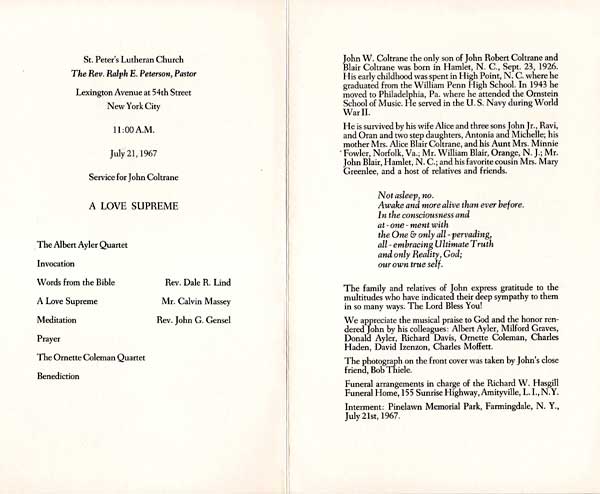
Albert Ayler, tenor saxophone (“Love Cry,” “Truth Is Marching In,” “Our Prayer”), live, John Coltrane’s funeral, St. Peter’s Lutheran Church, New York, July 21, 1967
**********
lagniappe
Click for a clearer image.
*****
Pinelawn Memorial Park, Farmingdale, New York
*****
Trane was the father. Pharoah was the son. I was the holy ghost.—Albert Ayler
With John Coltrane (saxophone), Wynton Kelly (piano), Paul Chambers (bass), Jimmy Cobb (drums), Gil Evans Orchestra; live (TV Broadcast), 1959
*****
Take 2
With Wayne Shorter (saxophone), Herbie Hancock (piano), Ron Carter (bass), Tony Williams (drums); live (TV broadcast), 1964
**********
lagniappe
[Many admirers of Kind of Blue] are forced to reach back before the modern era to find its measure. Drummer Elvin Jones hears the same timeless sublimity and depth of feeling ‘in some of the movements of Beethoven’s Ninth Symphony, or when I hear Pablo Casals play unaccompanied cello.’ ‘It’s like listening to Tosca, says pianist/singer Shirley Horn. ‘ You know, you always cry, or at least I do.’
***
Quincy Jones: ‘That will always be my music, man. I play Kind of Blue every day—it’s my orange juice. It still sounds like it was made yesterday.’
***
Chick Corea: ‘It’s one thing to just play a tune, or play a program of music, but it’s another thing to practically create a new language of music, which is what Kind of Blue did.’
—Ashley Kahn, Kind of Blue: The Making of the Miles Davis Masterpiece (2000)

 music clip of the day