John Coltrane, Dorothy Love Coates, this guy: the genre makes no difference; some folks play like (as Buddhists put it) their hair is on fire.
Bach, Partita No. 4 in D Major, BMV 828
Glenn Gould, live, Canada, 1981
1: Ouverture
***
2: Allemande
***
3: Courante
***
4: Aria
***
5: Sarabande
***
6: Menuet
***
7: Gigue
**********
lagniappe
heaven, n. a condition or place of great happiness, delight, or pleasure. E.g., WKCR-FM’s annual Bach Festival, which begins today, at 3 p.m., and runs until midnight New Year’s Eve.
• WKCR-FM (broadcasting from Columbia University)
—Lester Young/Charlie Parker birthday marathon
—John Coltrane birthday broadcast
—Bird Flight (Phil Schaap, jazz [Charlie Parker])
—Traditions in Swing (Phil Schaap, jazz)
—Eastern Standard Time (Carter Van Pelt, Jamaican music)
• WFMU-FM
—Mudd Up! (DJ/Rupture, “new bass and beats”)
—Sinner’s Crossroads(Kevin Nutt, gospel) —Airborne Event (Dan Bodah, “electronic noise to free jazz, drone rock to a capella African song”)
—Give the Drummer Some (Doug Schulkind, sui generis, web only)
—Transpacific Sound Paradise (Rob Weisberg, “popular and unpopular music from around the world”)
• WHPK-FM (broadcasting from University of Chicago)
—The Blues Excursion (Arkansas Red)
John Coltrane Quartet (JC, tenor saxophone; McCoy Tyner, piano; Jimmy Garrison, bass; Elvin Jones, drums), “I Want To Talk About You,” live, Sweden (Stockholm), 1962
Synesthesia is a rare neurological condition that leads stimulation in one sensory pathway to trigger an experience in another. Basically, a short-circuiting in the brain that enables such strange phenomena like perceiving letters and numbers as inherently colored (color-graphemic synesthesia) or hearing sounds in response to visual motion. More than 60 types of synesthesia have been identified, with one of the most common being the cross-sensory experience of color and sound — “hearing” color or “seeing” music.
Israeli artist and jazz musician Michal Levy . . . is an actual synesthetic: When she listens to music, she sees shapes and colors as different tones, pitches, frequencies, harmonies, and other elements of the melody unfold.
• WKCR-FM (broadcasting from Columbia University)
—Bird Flight (Phil Schaap, jazz [Charlie Parker])
—Traditions in Swing (Phil Schaap, jazz) —Out to Lunch (Various, jazz)
—Jazz Profiles (Various, jazz)
—Jazz Alternatives (Various, jazz)
—Afternoon New Music (Various, classical and hard-to-peg)
—Eastern Standard Time (Carter Van Pelt, Jamaican music)
—Rag Aur Taal (Various, Indian)
—Morning Ragas (Various, Indian)
—Amazing Grace (Various, gospel)
—Live Constructions (Various, hard-to-peg)
• WFMU-FM
—Mudd Up! (DJ/Rupture, “new bass and beats”)
—Sinner’s Crossroads(Kevin Nutt, gospel)
—Give The Drummer Some (Doug Schulkind, sui generis)
—Transpacific Sound Paradise (Rob Weisberg, “popular and unpopular music from around the world”)
—Daniel Blumin (sui generis)
—Airborne Event (Dan Boodah, sui generis)
—The Push Bin with Lou (Lou Z., sui generis)
*****
art beat
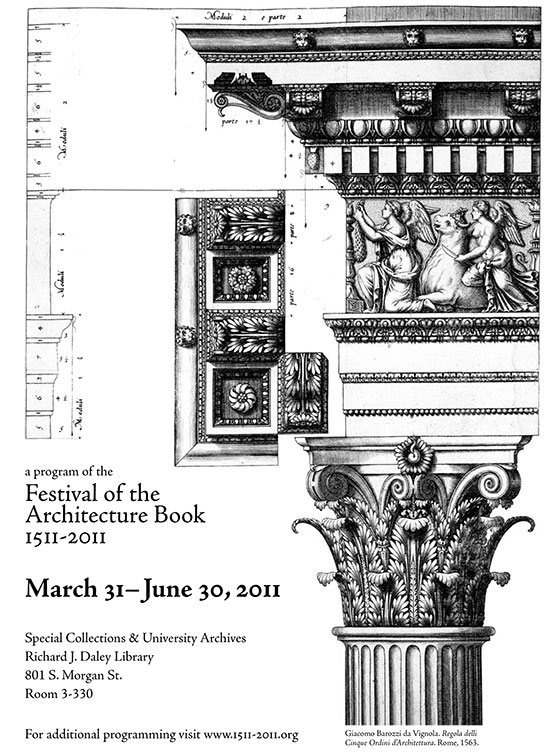
One of the great things about having friends is that they invite you to things you’d never get to, or even know about, otherwise—like, for instance, this wonderful exhibit of illustrated architecture books (dating from 1511), something I wouldn’t have gotten to but for my friend Bob Blythe.
Billy Bang (AKA William Vincent Walker), violinist, 9/20/47-4/11/11
Billy Bang Quintet (BB, violin; Frank Lowe, tenor saxophone; Ahmed Abdullah, trumpet; William Parker, bass; Abbey Rader, drums), live, New York (Knitting Factory), 10/1/00
Vodpod videos no longer available.
*****
Billy Bang Quartet (BB, violin; Ngo Thanh Nahn, dan tranh; Todd Nicholson, bass; Shoji Hano, drums), live, New York (Vision Festival X), 6/18/05
Vodpod videos no longer available.
**********
lagniappe
As I lived in Harlem in the early Fifties as a kid, I heard music all around me from the jazz clubs and from the candy stores. They had speakers outside the candy stores that they would play music, music like Eddie Harris and once in a while, Brubeck’s “Take Five.” So I started hearing jazz very, very early, and when you lived in Harlem in those days, it was in the blood. It was in the people. It was in the clothing. It was prevalent. As a young man, I bought a pair of bongos and two of my friends and I used to play the bongos on the New York City subway system. We would take turns dancing and playing the bongos and earn some money. That was my professional debut in the music.
***
I bought the Delmark records and heard Leroy Jenkins. Then I started hearing all the Joseph Jarman and Roscoe Mitchell. I loved the AACM. I loved Delmark for putting them out, Muhal Richard Abrams. This music really turned me on. It seemed very political, very conscious for me at the time and also very free, but with structure. So when Leroy Jenkins came to New York, I tracked him down and I did a little study with him for about six months. It was enough to reshape my direction. I already had a direction, but it really straightened it. From that point on, I just kept trying to go for it. Nobody would hire me, but that didn’t stop me. I would hire myself and hire a band and we would play at places like lofts in New York. Eventually, loft jazz became very, very big in New York and that catapulted my name and my career. During that period, I did all sorts of things, sitting in with Sam Rivers at The Five Spot. I sat in with Jackie McLean. I just had to be around the music and the cats that I loved and respected. I was disappointed that John Coltrane passed away because I think I would have followed him day after day after day to try and get in his band.
***
[The loft scene] was a very big thing. I think that catapulted my name internationally along with the David Murrays, the Henry Threadgills, the Frank Lowes, the Lester Bowies, the Joe Bowies. A lot of us wrote our own compositions. We weren’t playing standards. The bebop guys had to play standards to be legitimate. We were able to create our own music, direction, and compositions that also helped to lend a more directional input into the music. The loft jazz’s impact of it came when the Newport Jazz Festival came to New York that year and they didn’t hire any of us, so we had our own loft jazz festival. There were meetings and I remember Archie Shepp was talking and Rashied Ali was talking. I was very, very happy to be in New York at that time and to be around such a powerful movement with powerful names in it, Braxton, a lot of cats, all the cats that I love. We started setting up concerts all over, all the places. Sam Rivers had Rivbea and Rashied Ali had Ali Alley, which is where I played most of the time. When I played there with my Survival group, Werner Uehlinger came from hatHUT and he signed me to do a solo record. We were very adamant and strong about what we were doing. We were committed in belief. The World Saxophone Quartet started. The String Trio of New York started. Air was here. There was a lot of power going on simultaneously. There was a movement going on. We actually saw it in the making. I find it extremely important. The only reason why it does not have as much importance as I see it is because a lot of the writers didn’t pick up on it. Francis Davis from Philadelphia, he did and Stanley Crouch to some degree. There were people that picked up on it, but it wasn’t enough of a movement. The next year, George Wein hired some of the loft guys to play at the jazz festival. I was even offered a gig there with the String Trio. I didn’t make it because I like to hold out. I will be very honest, Fred. After I did my tour in Vietnam, I felt above a lot of the everyday activities in this world. I faced death and I think I had died more than once, so after that, I was sort of an untouchable. Me with my music, I didn’t feel the threatening situation that others felt. I didn’t feel obligated to have to compromise or the necessity to have to kiss anybody’s ass. I was determined to be focused in a Billy Bang direction until today, I am the same way. I think that strength is what kept me going, that commitment of strength, that conviction. They didn’t like the things that I did in the beginning. In fact, I didn’t like a lot of it, but I was committed enough to keep trying and not be shot down by critics, writers, peers, whomever.
***
Cats [today] are trying to be technical. You can exercise all your technical prowess and you sound like what’s been out already. I hear more guys sound like Clifford Brown or Freddie Hubbard then I heard them do. That was not the thing. We were always going for individual voices and individual sound. That is the only thing that almost made me stop. I didn’t sound like anybody. I thought I sounded so horrible that one particular day, I was ready to smash up my violin and I remember James Jackson from the Sun Ra band came in and tried to recruit me and he had a long talk with me. He told me that I had my own sound and that I had a Billy Bang sound. I took that to heart and started working from that perspective and saying that I needed to keep working at it and developing my sound.
Whatever I’d say would be an understatement. I can only say my life was made much better by knowing him. He was one of the greatest people I’ve ever known, as a man, a friend, and a musician.
—John Coltrane
Eric Dolphy (alto saxophone, bass clarinet, flute)
June 20, 1928-June 29, 1964
James Brown, “I Got You (I Feel Good),” live (TV broadcast), c. 1965
Vodpod videos no longer available.
Like Lester Young and Charlie Parker and John Coltrane, James Brown floats over the bar lines, defying, as he dances, the gravitational pull of the downbeat.
“Naima,” live (with McCoy Tyner, piano; Jimmy Garrison, bass, Elvin Jones, drums), Europe, 1965
#1 (7/27/1965, Antibes, France)
***
#2 (4/1/1965, Comblain-La-Tour,Belgium)
**********
lagniappe
[Coltrane’s sound is] [b]ig, resonant, and it begins at a very high level. He comes to the microphone and delivers a big block of sound rather than doing the normal sort of bell-shape that the best soloists tend to do, where they start out small, then they get big, then they get small and elegant.
Physical descriptions of his sound, especially from my own mouth, always sound meager, because the whole thing about his sound—and the reason I keep using that word in the book—has to do with the fact that if you follow his career, and if you look at what he was doing at the end of his life, you hear these tracks that seemed more and more similar from one to the next, so in the end the message of his work was not so much about composition or structure any more, it was about sound—both the sound coming out of his individual instrument, and the sound coming out of his band.
 music clip of the day