John Cage, Solo for flute, from Concert for Piano (1958); Eric Lamb, flute (International Contemporary Ensemble); Chicago, 2012
**********
lagniappe
musical thoughts
Music is theater for the ear. Take this performance. The phrasing, the interplay between sound and silence—this unfolds like something by Samuel Beckett.
Conlon’s music has such an outrageous, original character that it is literally shocking. It confronts you. Like Emerson said of Thoreau, ‘We have a new proposition.’
This music is the greatest discovery since Webern and Ives . . . something great and important for all music history! His music is so utterly original, enjoyable, perfectly constructed but at the same time emotional . . . for me it’s the best of any composer living today.
Conlon Nancarrow, an expatriate American composer whose frustrations with the limitations of live performance technique led him to compose almost exclusively for mechanical player pianos, and who was widely regarded as one of the few truly visionary composers of the century, died on Sunday at his home in Mexico City. He was 84.
Mr. Nancarrow, who was a jazz trumpeter before he turned his attention to formal composition, was fascinated throughout his life by the complex relationships that resulted when competing rhythms were set against each other. His best-known works, the more than 40 Studies for Player Piano, dazzle the ear with torrential figuration, thick counterpoint, colliding meters and melodies that draw on everything from blues and Spanish music to the spiky abstractions of free atonality.
***
Mr. Nancarrow was born in Texarkana, Ark., on Oct. 27, 1912, and undertook his musical studies at the Cincinnati College-Conservatory of Music from 1929 to 1932. He later studied privately in Boston with Nicolas Slonimsky, Walter Piston and Roger Sessions. In 1936, he went to Spain to fight against Franco with the Abraham Lincoln Brigade, and upon his return to the United States, in 1939, he became involved in the growing new music scene in New York, both as a composer and as a critic for the magazine Modern Music.
His stay in New York was brief, however. In 1940, when the United States Government refused to renew his passport because of his outspoken Socialist views, he moved to Mexico City. He became a Mexican citizen in 1956. Until 1981, when he attended a performance of his music in San Francisco, he had returned to the United States only once, in 1947, to obtain a machine for cutting his own piano rolls, the long paper strips that drive player pianos.
Mr. Nancarrow’s interest in mechanical pianos can be traced to the mid-1930’s, when he found pianists unable to play works like the Toccata for Violin and Piano and the Prelude and Blues (both composed in 1935) at the speeds or with the clarity that he demanded. Soon after his arrival in Mexico City, he bought two Ampico player pianos, which he modified by covering their hammers with leather and steel straps in order to make their attacks sharper.
He also began composing directly onto piano rolls, and for about four decades he composed exclusively this way. But with the renewed interest in his music that began in the 1970’s and picked up speed in the 1980’s, he became acquainted with virtuosic young players like Ms. [Ursula] Oppens and Mr. [Yvar] Mikhashoff, and pioneering new music ensembles like the Arditti Quartet, in England. Reconsidering his attitude toward live music-making, he began accepting commissions for piano, chamber and orchestral works, and produced a series of vivid scores that includes the rhythmically vital and texturally vivid ”Piece No. 2 for Small Orchestra,” the ”Three Canons for Ursula” and the String Quartet No. 3.
John Cage, composer, September 5, 1912-August 12, 1992
Today, celebrating his centennial, we revisit past clips.
*****
10/9/09
No matter where you are, this landscape is just around the corner.
John Cage (1912-1992), In a Landscape (1948); Stephen Drury, piano
**********
lagniappe
musical thoughts
Music is a means of rapid transportation.
***
What I’m proposing, to myself and other people, is what I often call the tourist attitude—that you act as though you’ve never been there before. So that you’re not supposed to know anything about it. If you really get down to brass tacks, we have never been anywhere before.
***
As far as consistency of thought goes, I prefer inconsistency.
—John Cage
*****
5/22/10
Here’s a piece that sounds different every time you hear it.
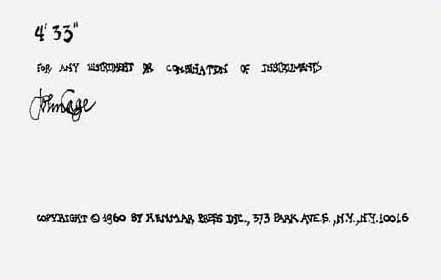
John Cage, 4’ 33” (1952); David Tudor, piano
lagniappe
***
*****
musical thoughts
I didn’t wish it [4′ 33″] to appear, even to me, as something easy to do or as a joke. I wanted to mean it utterly and be able to live with it.
***
Until I die there will be sounds. And they will continue following my death. One need not fear about the future of music.
Monday, n. the day the weekly tide of confusion rolls in.
How about something simple?
John Cage (1912-1992), Six Melodies (for violin and keyboard; dedicated to Josef & Anni Albers), 1950; Annelie Gahl (violin) & Klaus Lang (electric piano), 2010
[Morton Feldman and I] were driving back from some place in New England where a concert had been given. He is a large man and falls asleep easily. Out of a sound sleep, he awoke to say, “Now that things are so simple, there’s so much to do.” And then he went back to sleep.
—John Cage, in Silence: Lectures and Writings by John Cage (1961)
Monday, n. the day the weekly tide of confusion rolls in.
How about something simple?
John Cage (1912-1992), Six Melodies (for violin and keyboard; dedicated to Josef & Anni Albers), 1950; Annelie Gahl (violin) & Klaus Lang (electric piano), 2010
Labels are often worse than useless. This guy, for instance, is often tagged as “cerebral.” But here’s something you can’t—I can’t, anyway—listen to without smiling.
Anthony Braxton, Composition No. 58
Taylor Ho Bynum Chicago Big Band,* live, 2009, Chicago
*****
Here’s another take—Braxton’s original recording (The Complete Arista Recordings of Anthony Braxton [Mosaic], rec. 1976).
To obtain the value
of a sound, a movement,
measure from zero.
***
A sound has no legs to stand on.
***
The world is teeming: anything can
happen.
—John Cage, “2 Pages, 122 Words on Music and Dance” (excerpts)
*Taylor Ho Bynum & Josh Berman (cor), Jaimie Branch (tpt), Jeb Bishop & Nick Broste (tb), Nicole Mitchell (fl), Caroline Davis, Keefe Jackson & Dave Rempis (saxes), Jeff Parker (g), Jason Adasiewicz (vib), Nate McBride (b), Tim Daisy & Tomas Fujiwara (d)


 music clip of the day