John Coltrane Quartet (JC [1926-1967], tenor saxophone; McCoy Tyner [1938-2020], piano; Jimmy Garrison [1934-1976], bass; Elvin Jones [1927-2002], drums), “Impressions” (J. Coltrane), rec. 12/7/1963, San Francisco (Ralph J. Gleason’s Jazz Casual)
John Coltrane Quartet (JC [1926-67], tenor saxophone; McCoy Tyner [1938-2020], piano; Jimmy Garrison [1934-76], bass; Elvin Jones [1927-2004], drums), live (performance begins at 6:45), New York (Half Note), 1965
John Coltrane Quartet (JC, tenor saxophone; McCoy Tyner, piano; Jimmy Garrison, bass; Elvin Jones, drums), “Impressions” (J. Coltrane), live (TV show), 1963
**********
lagniappe
random thoughts
What did we do to deserve such a beautiful world?
*****
art beat
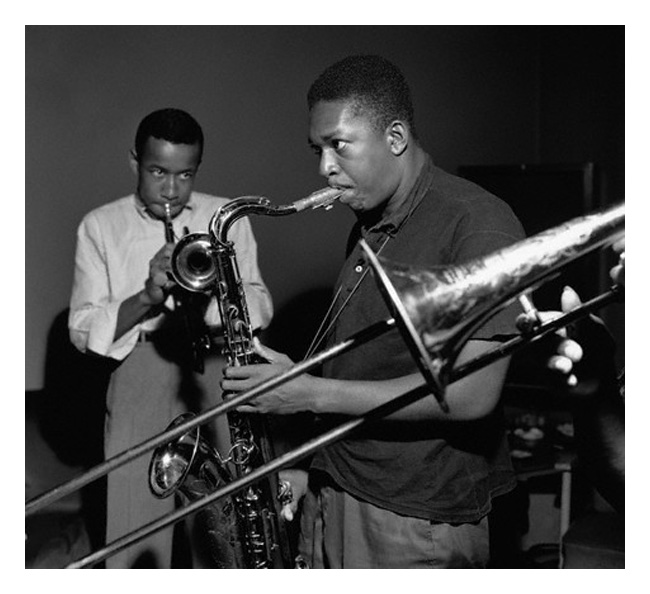
Francis Wolff, Blue Trane recording session (JC, tenor saxophone; Lee Morgan, trumpet; Curtis Fuller, trombone), Hackensack, N.J., 1957
*****
A big birthday shout-out to my oldest listening companion, my brother Don, with whom (as I’ve noted before) I’ve shared more musical experiences than I could ever count: the Beatles (Comiskey Park, 1965), the Velvet Underground (Kinetic Playground, 1968), the MC5 (Lincoln Park, 1968) . . .
Ravi Coltrane (JC’s son), tenor saxophone; Matt Garrison, bass (son of Coltrane bassist Jimmy Garrison); Nikki Glaspie, drums; live (Le Poisson Rouge), New York, 1/7/12
John Coltrane Quartet (JC, tenor saxophone; McCoy Tyner, piano; Jimmy Garrison, bass; Elvin Jones, drums), “I Want To Talk About You,” live, Sweden (Stockholm), 1962
“Naima,” live (with McCoy Tyner, piano; Jimmy Garrison, bass, Elvin Jones, drums), Europe, 1965
#1 (7/27/1965, Antibes, France)
***
#2 (4/1/1965, Comblain-La-Tour,Belgium)
**********
lagniappe
[Coltrane’s sound is] [b]ig, resonant, and it begins at a very high level. He comes to the microphone and delivers a big block of sound rather than doing the normal sort of bell-shape that the best soloists tend to do, where they start out small, then they get big, then they get small and elegant.
Physical descriptions of his sound, especially from my own mouth, always sound meager, because the whole thing about his sound—and the reason I keep using that word in the book—has to do with the fact that if you follow his career, and if you look at what he was doing at the end of his life, you hear these tracks that seemed more and more similar from one to the next, so in the end the message of his work was not so much about composition or structure any more, it was about sound—both the sound coming out of his individual instrument, and the sound coming out of his band.