With just one horn, there’s a lot of space for the other players—the so-called “rhythm section”—to fill, which these guys do as well as anyone I’ve heard in a long time.
David Murray’s Black Saint Quartet (DM, tenor saxophone, bass clarinet; Lafayette Gilchrist, piano; Jaribu Shahid, bass; Hamid Drake, drums), live, Berlin, 2007
Peter Brötzmann Chicago Tentet,* “Aziz” (M. Zerang), recorded live in Chicago (Empty Bottle), 9/17/97 (Okka Disk OD-12022)
**********
lagniappe
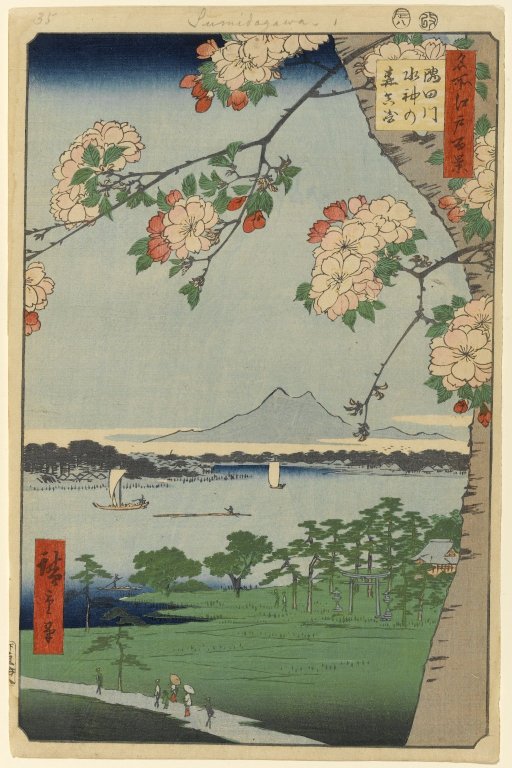
art beat: yesterday at the Art Institute of Chicago (after meeting with a client at the nearby federal jail)
Utagawe Hiroshige, Suijin Shrine and Massaki on the Sumida River (from the series One Hundred Famous Views of Edo), c. 1856
*****
reading table
Were I to choose an auspicious image for the new millennium, I would choose . . . the sudden agile leap of the poet-philosopher who raises himself above the weight of the world, showing that with all his gravity he has the secret of lightness, and that what many consider to be the vitality of the times—noisy, aggressive, revving and roaring—belongs to the realm of death, like a cemetery for rusty old cars.
—Italo Calvino, “Lightness,” in Six Memos for the New Millenium (1988, translated from Italian by Patrick Creagh)
*****
*PB, tenor sax/clarinet/tarogato; Mars Williams, tenor/alto/soprano sax/clarinet; Ken Vandermark, tenor sax/clarinet/bass clarinet; Mats Gustafsson, baritone sax/fluteophone; Joe McPhee, pocket cornet/valve trombone/soprano sax; Jeb Bishop, trombone; Fred Lonberg-Holm, cello; Kent Kessler, bass; Michael Zerang, drums/percussion; Hamid Drake, drums/percussion.
Just a week after hearing vibist Jason Adasiewicz’s Sun Rooms trio there, my older son Alex (home for the holidays) and I went back to the Hideout, a small club on Chicago’s north side, to hear these guys.
DKV Trio (Hamid Drake, drums; Kent Kessler, bass; Ken Vandermark, reeds), live, Chicago (Hideout), 12/28/11
This is the first project, in my 30-year career, that I have devoted to the music of someone else. It grew out of “Sitting by the Window,” a homage to Curtis Mayfield that I wrote for my band In Order To Survive. The current project develops this inspiration while trying to call upon the spirit in which Curtis Mayfield wrote his songs. We are trying to let that spirit find its voice today through musicians who not only know Mayfield’s songs, but more importantly, know themselves. They are familiar with the language of a music that includes Curtis Mayfield as well as Sun Ra.
I grew up listening to Smokey Robinson, The Temptations, Martha and The Vandellas, Gladys Knight and The Pips, and Curtis Mayfield and The Impressions. In my mind, their music was not separate from Marian Anderson, Count Basie, Coleman Hawkins, Ben Webster, Don Byas, Sarah Vaughn, Ornette Coleman, Don Cherry, Cecil Taylor, Bill Dixon, and Louis Armstrong. All this music is part of an African American tradition that comes out of the blues. The roots of the jazz known as avant-garde are also in the blues, the field holler, and the church. Avoiding artificial separations is the key to understanding the true nature of the music. All these artists ultimately speak using this reservoir of sounds and colors that we can use to paint our own music.
The music that passed through the life and work of Curtis Mayfield cannot be duplicated. The question becomes, how can it then continue? I also ask myself this question in connection to Duke Ellington or Thelonious Monk. It always seemed to me that when Ellington died, the music physically died with him. We were left orphaned, with just the recorded part of his work and all these notes on paper, but that is not the reality. Once you realize this truth, you can find a different way to proceed to re-create the songs. Paradoxically, you can only find a way to play the music by initially affirming that it cannot be done. Let us imagine the Creator: part of his voice was expressed through Duke Ellington, a part through Albert Ayler, another part through Curtis Mayfield. The method doesn’t consist in following or imitating anyone’s style; the method consists of plunging into the Tone World, which is the source of all music. You can’t counterfeit a music. One can only collect strands and begin to weave a new tapestry out of them.
Curtis Mayfield was a prophet, a preacher, a revolutionary, a humanist, and a griot. He took the music to its most essential level in the America of his day. If you had ears to hear, you knew that Curtis was a man with a positive message—a message that was going to help you to survive. He was in the foreground, always in the breach, both soft and powerful at the same time. For these reasons, his music still resounds in my heart.
Muscular, unadorned, direct: his playing conjures the old Chicago, when there was no Millennium Park, no flowers blooming in the middle of the street, no dining al fresco (unless you had nowhere else to eat).
Fred Anderson, tenor saxophonist, co-founder of the Association for the Advancement of Creative Musicians (AACM), club owner (Velvet Lounge), March 22, 1929-June 24, 2010
Live, with DKV (Ken Vandermark, tenor saxophone; Kent Kessler, bass; Hamid Drake, drums), Chicago (Hideout), 2008
(Hamid Drake is among my favorite drummers; he’s the perfect foil, in his buoyancy and drive, for Anderson’s dark, searching, sometimes brooding lines.)
*****
“Spirits Came In,” live (with Kidd Jordan, tenor saxophone; William Parker, bass; Hamid Drake, drums), live, New York (Vision Festival), 2002
*****
Live (with Jaribu Shahid, bass; Hamid Drake, drums), France (Le Mans), 2005
 music clip of the day