music clip of the day

jazz/blues/rock/classical/gospel/more

Tag: Emily Dickinson

Wednesday, 9/12/12

earthy (horns) + ethereal (vibes) = enthralling

Peter Brötzmann (saxophones, tarogato) and Jason Adasiewicz (vibraphone), live, New York (Le Poisson Rouge), 9/5/12

Part 1

***

Part 2

***

Part 3

***

Tonight these guys will be at the Hideout, a little club on Chicago’s near northwest side, which is where I’ll be too.

**********

lagniappe

reading table

Four trees – upon a solitary Acre –
Without Design
Or Order, or Apparent Action –
Maintain –

The Sun – upon a Morning meets them –
The Wind –
No nearer Neighbor – have they –
But God –

The Acre gives them – Place –
They – Him – Attention of Passer by –
Of Shadow, or of Squirrel, haply –
Or Boy –

What Deed is Theirs unto the General Nature –
What Plan
They severally – retard – or further –
Unknown –

—Emily Dickinson

Thursday, 9/6/12

love it or hate it

Fire Room (Ken Vandermark, reeds; Lasse Marhaug, electronics; Paal Nilssen-Love, percussion), live, Poland (Poznań), 2011

**********

lagniappe

musical thoughts

What Emily Dickinson says of poetry applies to music too: “If I feel physically as if the top of my head were taken off, I know that is poetry.”

Saturday, 1/14/12

If you wanted to conjure a world full of mystery, what better instrument to lead the way than one that possesses neither the brightness of the violin nor the darkness of the cello?

Morton Feldman, Rothko Chapel (1971), live, Houston (Rothko Chapel), 2011; Kim Kashkashian (viola), Brian Del Signore (percussion), Sarah Rothenberg (celeste), Maureen Broy Papovich (soprano), Houston Chamber Choir (Robert Simpson, cond.)

Part 1

***

Part 2

***

Part 3

Another take? Here.

**********

lagniappe

Rothko Chapel, Houston, Texas

***

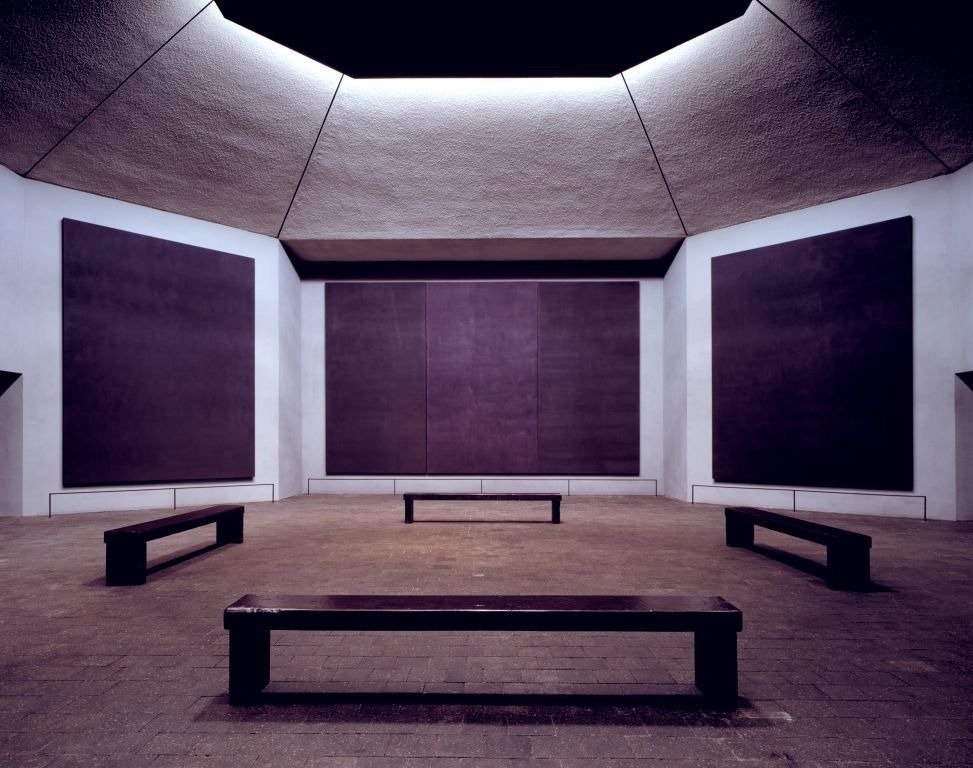
The Rothko Chapel is an interfaith sanctuary, a center for human rights — and a one-man art museum devoted to 14 monumental paintings by abstract expressionist Mark Rothko. The Houston landmark, commissioned by John and Dominique de Menil, opened its doors 40 years ago, in February 1971.

For the past four decades, the chapel has encouraged cooperation between people of all faiths — or of no faith at all. While the chapel itself has become an art landmark and a center for human-rights action, the sanctuary’s creator never lived to see it finished. Rothko committed suicide in 1970.

Approaching the chapel from the south, visitors first see a steel sculpture called Broken Obelisk by Barnett Newman in the middle of a pool — it appears to be floating on the surface of the water. The chapel itself is a windowless, octagonal brick building. Solid black doors open on a tiny glass-walled foyer. (The foyer was walled off from the rest of the interior when the Gulf Coast’s notorious humidity began to affect the paintings.)

The main room is a hushed octagonal space with gray stucco walls, each filled by massive paintings. Some walls feature one canvas, while on others, three canvases hang side by side to form a triptych. A baffled skylight subdues the bright Houston sun, and the surfaces of the paintings change dramatically as unseen clouds pass outside. There are eight austere wooden benches informally arranged, and today, a few meditation mats. A young woman brings the meditation hour to a close by striking a small bowl with a mallet, creating a soft peal of three bells in the intense silence of the room.

Concerts, conferences, lectures, weddings and memorial services all take place in the chapel throughout the year, but on most days you will find visitors — about 55,000 annually come to see, to meditate, to write in the large comment book in the foyer, to read the variety of well-thumbed religious texts available on benches at the entrance.

***

These paintings do not feature the luminous color fields that made Rothko famous. The paintings in the chapel are dark, in purplish or black hues. And there’s a reason for that, says [chapel historian Suna] Umari.

“They’re sort of a window to beyond,” she explains. “He said the bright colors sort of stop your vision at the canvas, where dark colors go beyond. And definitely you’re looking at the beyond. You’re looking at the infinite.”

***

At first glance, the paintings appear to be made up of solid, dark colors. But look closely, and it becomes evident that the paintings are composed of many uneven washes of pigment that create variations in every inch. Stepping back, waves of subtle color difference appear across the broad surfaces — leading to an unmistakable impression of physical depth.

***

Though Mark Rothko didn’t live to see the sanctuary he created, Christopher Rothko says his father knew what it should be.

“It took me a while to realize it, but that’s really my father’s gift, in a sense, to somebody who comes to the chapel. It’s a place that will really not just invite, but also demand a kind of journey.”

—Pat Dowell, “Meditation and Modern Art Meet In Rothko Chapel,” NPR, 3/1/11

*****

reading table

Our lives are Swiss –
So still – so Cool –
Till some odd afternoon
The Alps neglect their Curtains
And we look farther on!

Italy stands the other side!
While like a guard between –
The solemn Alps –
The siren Alps
Forever intervene!

—Emily Dickinson

Thursday, 12/1/11

No matter how often I hear it, this piece—Beethoven’s final piano sonata—never fails to astonish.

Beethoven, Piano Sonata No. 32
Rudolf Serkin (piano), live, Austria (Vienna), 1987

#1: 1st movement

***

#2: 2nd movement, part 1

***

#3: 2nd movement, part 2

***

If I knew I had a week to live, this is one of the things I’d want to listen to—more than once.

***

Another take on this sonata? Here (Claudio Arrau).

More of Serkin playing Beethoven? Here.

**********

lagniappe

100

200

300

400

500

600

700

Today marks our 800th post.

*****

reading table

A Day! Help! Help!
Another Day!
Your prayers – Oh Passer by!

—Emily Dickinson, c. 1858 (58 [Franklin], excerpt)

**********

musical thoughts

If it wasn’t for the music, I don’t know what I’d do.

“Last Night A DJ Saved My Life”

Tuesday, 10/11/11

Great music, unlike great food, doesn’t fill you up.

It leaves you wanting more.

Bach, Partita No. 2 in C minor, BWV 826
Martha Argerich, piano, live, Switzerland (Verbier Festival), 2008

Part 1

Vodpod videos no longer available.

***

Part 2

Vodpod videos no longer available.

More Bach? Here. And here. And here. And here. And here. And here. And here. And here. And here. And here. And here.

**********

reading table

Last night, opening a book at random, I came upon this—another reminder that Emily Dickinson, surely one of my desert-island writers, takes a backseat to no one when it comes to strangeness.

I see thee better — in the Dark —
I do not need a Light —
The Love of Thee — a Prism be —
Excelling Violet —

I see thee better for the Years
That hunch themselves between —
The Miner’s Lamp — sufficient be —
To nullify the Mine —

And in the Grave — I see Thee best —
Its little Panels be
Aglow — All ruddy — with the Light
I held so high, for Thee —

What need of Day —
To those whose Dark — hath so — surpassing Sun —
It deem it be — Continually —
At the Meridian?

—Emily Dickinson

Sunday, 7/3/11

This guy I can’t get enough of.

Vernard Johnson, “Don’t Wait ’Til The Battle Is Over, Shout Now!”; live, TV broadcast (Bobby Jones Gospel)

Vodpod videos no longer available.

Time for just one note? 6:23.

More? Here. And here.

**********

lagniappe

art beat

Lee Friedlander, Cherry Blossom Time in Japan (2006)

*****

reading table

Yesterday, opening my Emily Dickinson collection (The Poems of Emily Dickinson, edited by R. W. Franklin) at random, I came upon this.

We do not play on Graves —
Because there isn’t Room —
Besides — it isn’t even — it slants
And People come —

And put a Flower on it —
And hang their faces so —
We’re fearing that their Hearts will drop —
And crush our pretty play —

And so we move as far
As Enemies — away —
Just looking round to see how far
It is — Occasionally —

—Emily Dickinson (#599)

***
*****

listening room: what’s playing

Echocord Jubilee Comp. (Echocord)

Art Ensemble of Chicago, Full Force (ECM)

Art Ensemble of Chicago, Urban Bushmen (ECM)

Paul Motian (with Lee Konitz, soprano & alto saxophones; Joe Lovano, tenor saxophone; Bill Frisell, guitar; Charlie Haden, bass), On Broadway Vol. 3 (Winter & Winter)

Rebirth Brass Band, Feel Like Funkin’ It Up (Rounder)

Marc Ribot, Silent Movies (Pi Recordings)

• Wadada Leo Smith, Kabell Years: 1971-1979 (Tzadik)

Charles “Baron” Mingus, West Coast, 1945-49 (Uptown Jazz)

• John Alexander’s Sterling Jubilee Singers, Jesus Hits Like The Atom Bomb (New World Records)

Rev. Johnny L. Jones, The Hurricane That Hit Atlanta (Dust-to-Digital)

Elliott Carter, composer; Ursula Oppens, piano; Oppens Plays Carter (Cedille)

Arnold Schoenberg, Anton Webern, composers; Maurizio Pollini, piano, piano works (Schoenberg), Variations Op. 27 (Webern) (Deutsche Grammophon)

Morton Feldman, For Bunita Marcus, Stephane Ginsburgh, piano (Sub Rosa)

WKCR-FM (broadcasting from Columbia University)
Bird Flight (Phil Schaap, jazz [Charlie Parker])
Traditions in Swing (Phil Schaap, jazz)
—Daybreak Express
(Various, jazz)
Out to Lunch (Various, jazz)
Jazz Profiles (Various, jazz)
Jazz Alternatives (Various, jazz)
Morning Classical (Various, classical)
Afternoon New Music (Various, classical and hard-to-peg)
Eastern Standard Time (Carter Van Pelt, Jamaican music)

WFMU-FM
Mudd Up! (DJ/Rupture, “new bass and beats”)
Sinner’s Crossroads
(Kevin Nutt, gospel)
—Give The Drummer Some
(Doug Schulkind, sui generis)
Downtown Soulville with Mr. Fine Wine (soul)
Saturday, 3/12/11

Have you heard of Brandt Brauer Frick?

Rachael Z., the 20-something stylist who cuts my hair

The Brandt Brauer Frick Ensemble, live (rehearsal), Germany (Berlin), 2010

Vodpod videos no longer available.

**********

lagniappe

reading table

Teenager

Me — a teenager?
If she suddenly stood, here, now, before me,
would I need to treat her as near and dear,
although she’s strange to me, and distant?

Shed a tear, kiss her brow
for the simple reason
that we share a birthdate?

So many dissimilarities between us
that only the bones are likely still the same,
the cranial vault, the eye sockets.

Since her eyes seem a little larger,
her eyelashes are longer, she’s taller
and the whole body is closely sheathed
in smooth, unblemished skin.

Relatives and friends still link us, it is true,
but in her world almost all are living,
while in mine almost no one survives
from that shared circle.

We differ so profoundly,
talk and think about completely different things.
She knows next to nothing —
but with a doggedness deserving better causes.
I know much more —
but nothing for sure.

She shows me poems,
written in a clear and careful script
that I haven’t used for years.

I read the poems, read them.
Well, maybe that one
if it were shorter
and fixed in a couple of places.
The rest do not bode well.

The conversation stumbles.
On her pathetic watch
time is still cheap and unsteady.
On mine it’s far more precious and precise.

Nothing in parting, a fixed smile
and no emotion.

Only when she vanishes,
leaving her scarf in her haste.

A scarf of genuine wool,
in colored stripes
crocheted for her
by our mother.

I’ve still got it.

—Wislawa Szymborska (trans. Clare CavanaghStanisław Barańczak; Here [2010])

*****

five desert-island poets

Wislawa Szymborska

William Bronk

John Berryman

Emily Dickinson

Kobayashi Issa

Friday, 12/10/10

two voices

Some voices are so distinctive and indelible that, once heard, they occupy rooms all their own in your mind.

Willie Mae “Big Mama” Thornton, “Hound Dog,” live (TV broadcast; Buddy Guy, guitar; Fred Below, drums), Europe, 1965 (originally recorded 1952)

Vodpod videos no longer available.

*****

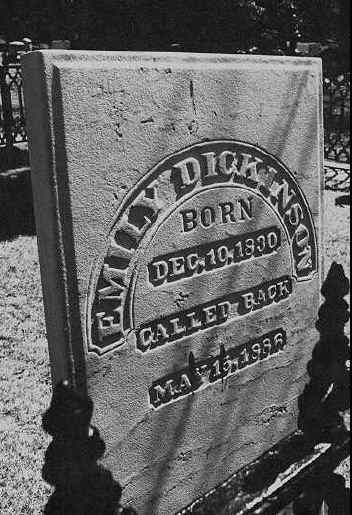
Happy (180th) Birthday, Emily!

I’d subscribe to her Twitter feed in a heartbeat.

I’m Nobody! Who are you?

***

Escape is such a thankful Word

***

Our lives are Swiss –

***

I felt a Funeral, in my Brain,

***

My Life had stood – a Loaded Gun –

—Emily Dickinson (first lines)